These fragments I have shored against my ruin

I first shared this blog post in 2016. To date, it’s still my best-performing blog post. Not sure if that is because it’s one of my shortest – I am quite a waffler these days.

But I love that line. It’s line 431 from T S Eliot’s The Waste Land. The first time I read the poem, when I got to this line I burst into tears, because it seemed such a beautiful summation, of the poem, of my life, everything. Words do that to me–I’m a very emotional person, I’m glad to say.

I believe that our lives are made up of fragments. We are, in essence, a walking, talking collection of every experience we’ve ever had. This includes what we’ve read. Words.

So often I am out and about–yes, I escape now and again–and I hear something, see something, smell something which provokes a memory of something I’ve read. Most often it is snatches of conversation I overhear, being nosey and a crime writer, which as we all know gives me special dispensation to eavesdrop on others. (‘I ain’t been dropping no eaves, sir, honest.’) Words seem to lead to more words.

I hear someone say, ‘The wonderful thing…’ and mentally I’ve added ‘…about Tiggers is Tiggers are wonderful things.’ (I didn’t promise it was anything erudite!) Or someone may say ‘Wherever I go…’ and I think to myself ‘there’s always Pooh, there’s always Pooh and me.’ (By the way, Winnie the Pooh is not just for kids. Just read the chapter called The Piper At the Gates of Dawn…)

It’s not just A A Milne, though. So often snatches of Shakespeare, Agatha Christie, songs, poems, plays, hymns, prayers, all sorts of words come into my head. I can’t look at spring flowers without thinking ‘A host of golden daffodils’ or ‘April is the cruellest month’. (The Waste Land again!) A tall person becomes ‘thou painted Maypole’. A mouse is a ‘wee sleekit cowrin tim’rous beastie’. (Burns of course, who else?)

If something annoying happens, I hear Miss Marple whisper, ‘Oh dear, how extremely vexing,’ or I hear someone say something stupid, and Mr Bennett’s frustrated, outraged, ‘Until you come back…I shall not hear two words of sense spoken together’ comes to mind. I share his pain. In extremis, ‘I shall be in my library; I’m not to be disturbed.’ (Not unless there’s cake or Midsomer Murders.) Or I might hear Miss Silver’s indulgent, ‘In their own way, men can be quite useful.’

Or if sorrows come in, it’s Matthew Arnold’s painful comment filled with longing, ‘Ah love, let us be true to one another,’ because he believed that one another was all we have. (Dover Beach).

Or…

There’s always another wonderful sketch of words from someone who lived many years before my time. Or a contemporary. Or the next generation. We all use and need words.

And because of this, none of us can ever come to a text, for the first time, or the tenth, ‘cold’ or ‘new’. There is really no neutral approach in the human soul. We bring with us the sum of all our experiences and emotions, our world-view and our beliefs, and those inform what we read, and mercifully sometimes, what we read can inform all those things too.

When I was studying literature ‘back in the day’, I remember The Waste Land was one of our set texts. Critics deplored it, dismissing it as a pastiche, a patchwork quilt of other peoples’ work, revealing only a good memory for quotations. Students shuddered and declared it was one of the worst experiences of their life. But for some of us, there was a sense of ‘wow, I never knew poetry could be like this!’

When I read his words, ‘These fragments I have shored against my ruins’ (line 431), I said to my tutor, I think he is saying that literature, that words, will save us in times of crisis, bolster us when we are at a low ebb. I was told I was wrong, but in spite of that, I still choose to believe this could be one meaning of these, for me, immortal words. These fragments of remembered stories, poems, previous experiences, feelings, of words, I have stored up, internalised, to use as a defence, shored against my ruin, my unhappiness, times of want, misery, sorrow and confusion. Ruin.

For me it is a reminder that many things in life are transient, passing, temporary, but I will always carry within me the sum of what I have read. Just read Shakespeare’s sonnet 18 and tell me I’m wrong. It’s short, it’s sweet, it’s got a cheeky grin at the end. It’s perfect, and all human life is there.

***

Some small happy things – people watching again!

These days it’s quite hard to find something positive in the world. Life is tough. Even 2020 and the onset of covid is enough to fill me with a gentle nostalgia, those seem like fun times compared to right now. But kindness and goodness is not dead and gone, no matter what we read in the media or see on TV. If your mental health is at an all-time low, as many of us are finding, just look around you and you will find small things to make you smile.

Today I saw:

An elderly man ask a young mum struggling with a screaming toddler if she was okay. He wasn’t complaining about the noise. He wasn’t telling her how she should raise her kid. He just asked if she was okay. She said she was, thank you, and told him that her child had just been vaccinated and was crying because of that. But the man’s simple kindness made me happy. Because sometimes we just need someone to ask, right?

And as I was waiting for my other half, a woman–a total stranger–asked me about something I was holding – bird food (as usual!). ‘Is that stuff any good?’ she asked me. ‘Because my sister-in-law bought some for my dad’s garden, and it’s like sawdust. The birds won’t touch it.’

I told her the birds that come to my garden wolf it down like crazy. ‘I’ll get some,’ she said, so I told her where I got mine.

‘It’s a bit pricey, ‘ I warned her.

‘That doesn’t matter,’ she said. ‘My dad’s 96, and watching the birds gives him so much pleasure, it’s worth it just to make him happy.’

Aww. Obviously that small encounter warmed my heart too.

As my mum used to say, good things come in threes–when we got back to our car, the rain had started, and everyone was in a rush to leave. A young dad and very small girl cute in her school uniform, arrived to get into the car next to ours, and the dad said to the little one, ‘We’ve got to get home quick, I’ve left the washing out!’

I smiled. He wasn’t too worried, the child wasn’t being hurried or pushed along, they were just taking life in their stride, calm, relaxed, happy. As I said, small things, nothing earth-shattering, but the mundane minutiae of everyday life. That’s what makes me smile.

Actually there were more than three–the cafe owner where we went stayed back a few more minutes after closing to make a cup of tea for a late customer, an elderly woman. The staff in the shops I visited were cheerful and friendly.

So that was a good day. I had a lovely chatty  lunch with my family, the sun shone (briefly) and I saw at first hand some simple things that showed me that there are good people in the world, and not everything is horrible. And I thought I would tell you.

Next week, I promise, it will be more about writing genre fiction.

***


Happy New Year! Let’s party like it’s… (insert decade of choice here)

There’s one thing we can say for sure about the changing taste of different decades. We might do it differently but we still do it. Party, I’m talking about, you smutty people. We humans have always loved a celebration. And no matter what we’re celebrating, that will definitely include music, and if at all possible we can all ‘get down and get with it’.

Here are a few playlist recommendations, depending on your era of choice.

If you fancy partying like it’s the 1740s, check out these bad boys, guaranteed to get you in the party mood as New Year comes around:

CPE Bach’s Harpsichord Concerto in A Major (There are not enough harpsichord concertos if you ask me.)

Thomas Arne’s Rule Britannia. I’ll admit this is not for everyone, especially if you’ve suffered under our oppressive yoke. Sorry about that. Blokes with a superiority complex, boats, flags and guns, what can you do? But it is a banging tune.

GF Handel’s Hercules Oratorio (no, I don’t know it either…)

CPE Bach’s Harpsichord Concertos in E and D minor, and in E major. I feel like CPE has got himself stuck in a rut here, but again, if you’re good at something, maybe it’s a good idea to stick with it.

And finally, Vitali’s Chaconne in G minor – a great end to a fabulous evening.

Or say you’re in the mood for something a little more modern, you could boogie down with my amateur sleuth Dottie Manderson and the best of them to these fabulous tunes from the 1930s:

My absolute favourite from the 1930s:

Midnight, The Stars and You. Such a romantic title, and romantic concept. What more does anyone need than those three things? This was brought to us by the Ray Nobel orchestra, featuring Al Bowlly (of course) on vocals. It was famously used in The Shining, and is the title of my next-but-one Dottie Manderson mystery, book 8 which should hopefully appear either at the end of 2022 or the middle of 2023.

Let’s not forget also, other 1930s crowd-pleasers such as Stormy Weather (another wonderful and evergreen song) by Leo Reissman and his orchestra and with Ethel Waters singing .

Then you could move on to Night and Day, a Cole Porter song from 1933, I love the Ella Fitzgerald version.

Or you might like another one by Al Bowlly – how about The Very Thought of You. another romantic one for close-up smooching in dim lighting. Ah!!

And you could round the evening off with a rousing chorus of one of the follwoing:

Judy Garland – Somewhere Over The Rainbow

Cab Calloway – Minnie the Moocher (not as good as his late-life version as per The Blues Brothers, in my opinion.)

Artie Shaw – Begin the Beguine – another perennial favourite, I absolutely love this one. Or if you want a different approach to this classic, you could try the really wonderful Louis Armstrong version…

And finally…

These Foolish Things – the Benny Goodman/Teddy Wilson version with Billie Holiday.

Not quite right for your bash? How about something from the 1960s? Get your beehive hair-dos and drainpipes ready…

Now you can really have some variety – try putting together a list featuring some of these great 60s tunes:

Daydream Believer – The Monkees

Concrete and Clay – Unit 4 + 2

Always Something There To Remind Me – Sandie Shore

Natural Born Bugie – Humble Pie

Nights in White Satin – Moody Blues

I Only Want To Be With You – Dusty Springfield

Will You Still Love Me Tomorrow – The Shirelles

Yeh Yeh – Georgie Fame and the Blue Flames

Do You Love Me – the Tremeloes

Maybe that’s a bit too up-to-the-minute for you and you want something a bit classier? How about some great dance music from the Regency era? This is the era that invented line-dancing, albeit somewhat more stately than we have now:

Let’s open with the amazing Beethoven piece for piano, Für Elise. That’ll really get ’em all out on the dancefloor.

Then next, maybe we’ll shake things up a bit with a singalong, the opera Adelina by Generali and Rossi

Or maybe an excerpt from an opera by Beethoven – he was The Man in the early 1810s, with Schubert close behind. This might be the perfect moment to play a bit from Symphony number 8 in F major. Let’s all hum along with the chorus…

For a bit of slow dancing with your beloved, you can’t beat Schubert’s String Quartet in C major.

Due to the rather lengthy nature of this kind of music, we’ll leave it there, closing the evening’s entertainment with Ferdinand Ries’s bestselling top-twenty hit, Concerto for Two Horns. (Admit it, you were missing the concertos, weren’t you?)

One thing is for sure, since time immemorial, humans have loved to come together to celebrate something–anything–and that has included music, dancing, big frocks, bigger hair and quite possibly alcohol.

Happy New Year! May 2022 be everything you long for. Just go easy on the resolutions.

***

Autumn brings renewal

I know I say this every year, but for me, it is not Spring, but Autumn and Winter that form my season of creativity. I have no idea why this is. I don’t know why, but for me, autumn is not the season for rest and consolidation, but of flights of imagination taking wings. I get quite excited about the approach of autumn and winter. Maybe it’s the cuddly jumpers, I don’t know.

It seems as though the rest of the world is full of new life in the Spring. Is it because I’m an October baby, my lifecycle naturally goes from Autumn onwards? Or because when we lived in Brisbane, October was in the Spring? But how can five years there undo the habits of the other fifty-six years I’ve lived in the Northern Hemisphere? Or maybe it’s because for parents everywhere in the UK, Autumn is when the children go back to school and you at last get two minutes to sit in silence and just enjoy hearing – nothing. Ah, bliss!

New ideas are taking shape, even before the old ideas have been put to bed. I’m thinking about what I want to say in a new story. I’m having a wonderful time creating book covers, and though I’m struggling to come up with new titles, I have some ideas to mull over.

I’m always drawn to old stuff, I’m drawn backwards into the past. I’m thinking of long print frocks, ladies in beads, feathers in their hair, tea-dances, afternoon picnics on wide sweeping lawns, croquet. I’m thinking of couples dancing on a veranda under the stars, the doors open to let out the soft lamplight and the music from the gramophone. The music is softened by distance and the soft evening breeze ruffles hair.

I’m thinking rural, villagey, fields, water, trees. I’m thinking of sorrow and haunting, of deeds never talked of, of the guilty secrets of the past. I’m thinking of shame and sacrifice, I’m humming old pastoral songs and rhymes, Scarborough Fair, children’s songs and folk songs, ‘Bobby Shafto(e) Went To Sea, He’ll Come Back And Marry me… Bonny Bobby Shafto(e).’ Or the old folk song and pop hit from the 70s, Whiskey in the Jar – ‘When I was going over/the Cork and Kerry mountains…I saw Captain Farrell and his money he was counting…’’

I’m remembering the duplicitous nature of the minstrel, wandering, legitimately able to plant one foot in each camp, never on any side but his own. A useful means for conveying information, often ill-gotten. And he can sing out in public everyone’s secrets, and how can you stop a man doing that?

I’m thinking of myths and legends, hillsides cloaked in mist, an unseen bird calling in the gloom, of the soft insinuating sound of the wind, like a sigh, like a breath, or like a dragon’s terrible approach. I’m thinking about the returning home of the prodigal, how we carry the past with us, inside, even when we are looking forward and moving on, something draws us ever back.

I am thinking, staring at the falling leaves, driven across the grass by a pushing wind, I’m lost in my thoughts. I am thinking of long ago, of people who may not have existed, but who could come into being in my imagination. I see images in my mind, people, objects, places, and weave stories about these imaginary characters.

I am thinking of a man at a window staring out, his mind working on things he cannot put into words. What should he do? Has the time for action finally arrived?

I’m thinking of a woman, always waiting, wringing her hands in front of the window, her own shadow cast out across the lamplit stones of the yard. When will he return? Will he ever return? The waiting woman. The unspeaking man.

I’m thinking of a boy coming over the hill. Of grass, green, long, dewy. Of the sun, soft, golden, gentle as a mother’s hand, just touching his hair, his shoulder of his white cotton shirt. How long has he been away? How much has changed? Will anything ever change?

If I never have another new idea, I’ve already got enough to keep me writing for the next twenty years. I only hope that’s possible.

‘Now fades the glimmering landscape on the sight,/And all the air a solemn stillness holds.’ Thomas Gray’s Elegy.

Autumn – not for sleeping but for creating anew.

***

More vintage magazines for women

Last year I posted a couple of articles about women’s magazines from the 1930s. (If you missed them, you can find them here.)

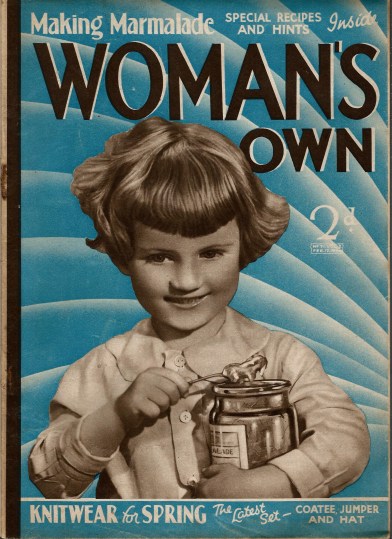
Over the last two weeks I’ve been fortunate enough to acquire two more vintage magazines aimed directly at women. what impressed me about these was first of all, that this magazine – Woman’s Own – is still in circulation and massively popular today. The second thing I noticed is that there really isn’t a lot of difference between the WO of 1934 and those of 2021.

Have women’s concerns changed very much in 90+ years? I’m not sure they have. for many women, the home and family is still one of the most important things in life, and I’m not saying that in a patronising way, nor ignoring the fact that women today have many more opportunities to have a career, and that the concept of ‘the family’ is miles different – and rightly so – to that of the 1930s.

But at rock bottom, many women are interested in and still worry about how to care for, manage or improve their relationships, their attractiveness, their budget, and their partners and children.

My Woman’s Own mags are from Feb 1934 and this week’s copy – by chance I nabbed a ‘diet special’. Here are a few snippets that struck me as interesting:

Hubby Management: It’s the wife’s job to make her home as welcoming as possible to induce the man (and man ONLY!) to stay at home instead of going out gallivanting. tips are given on how to do this, though the mags expert – whoever that was, possibly (we don’t know!) a bloke – comments that some men will always stay out and shouldn’t get married in the first place. Too late if you’ve got one of those, girls!

We have the readers’ letters, essentially a problem page. My faves are ‘should cousins marry?’ (Surely they know the answer to that?) and the ‘worried wife’ letters. I feel for the worried wife. She knows exactly what the answer will be but doesn’t want to admit it. Poor woman. Did she sling him out? Or – as I feel is more likely – did she just suffer in silence?

There’s a load of fashion tips and ideas, mostly, I was interested to note, clothes you could make at home. This magazine is aimed at the upper working class and lower middle class, women who have a little money but not enough to buy off-the-peg items and certainly not bespoke. ‘Home economy’ was one of the watchwords of the day, and it included apparel.

I personally think this looks absolutely horrid, and a cross between a Christmas panto costume and something out of Red Riding Hood. This one below is slightly nicer, but again, still all your own work.

Although the models in the designs look about 35 to 40, in fact some of these are aimed for teenagers from 14 years of age. not much difference in those days between what mums and their daughters were wearing.

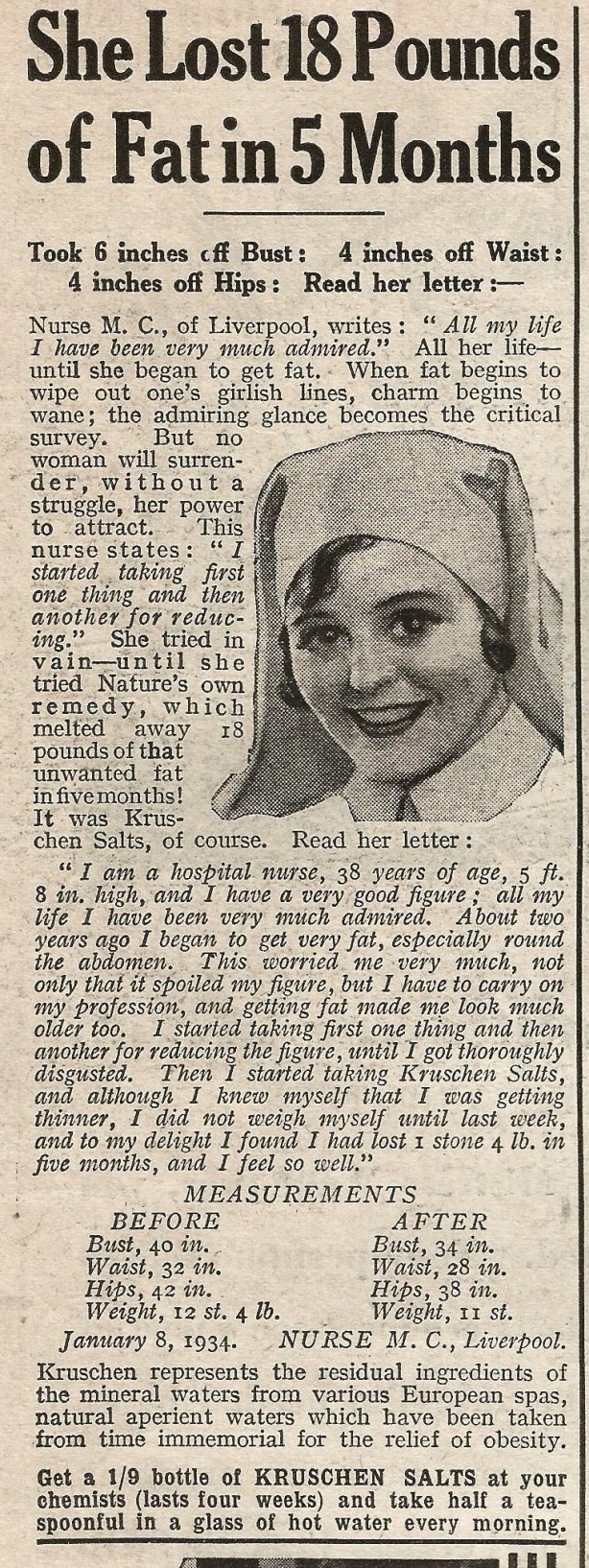
And of course, the eternal battle with the scales. I was interested to see things haven’t changed much here either, although some of our modern ingredients – chorizo and the whole gluten-free plan would have been completely alien to women of the 1930s.

Looks like this lady – a nurse, not a nun as I first thought – was following the crap-yourself-thin diet. 18lbs was a good result! Was she just a bit constipated after Christmas? All those mince pies…

Looking good appears to be a perennial issue for many women. We want to keep our looks as long as possible, after all, and keep ourselves in good condition. So I suppose it’s not surprising magazines for women contain so many hints, tips and advice. With the growth of city populations, the expansion of the suburbs, many women would have been cut off from their usual channels of information: mothers, grandmothers, aunties. Equally, magazines adopt a sisterly or motherly tone to offer the advice so desperately needed in those times. Today, magazines are more likely to have a friendly, conversational tone, inviting you to confide and share like a friend coming alongside to offer a sympathetic ear.

I’m in awe of the fact that this magazine has been around so long. It’s fascinating to read that the same ideas preoccupied women before my mother was born, as they do now. We may have Smartphones, the Internet, Netflix and Just Eat, but at the end of the day, we still want to look good, feel good, and keep our man where we can see him.

***


Interview with Debaleena Mukherjee, poet and writer of observational life pieces

This week I’d like to welcome Debaleena Mukherjee to my blog.

Debaleena and I go way back. We’ve never met (who knows, maybe one day?) but have been friends for years. We first met online through a shared love of murder mysteries. Talking about books led to talking about family, work and cake. The important things in life! Debaleena has also been a staunch supporter of my writing, and I am proud now to be able to do the same. Debaleena writes poetry, the first volume of which was published a few months ago by Blue Rose Publishers.

Debaleena, welcome. It’s amazing to have this conversation with you! Congratulations on publishing your first book of poems, I’m sure there will be many more. I wasn’t entirely surprised when you announced the book was coming out – you’ve always shared such lively and passionate posts on Facebook and Instagram. Your powers of description are so vivid that I often feel as if I’m there with you. I particularly love your posts about the various festivals you celebrate.

But let’s move on. My first question is, What do you write?

I write poems; and I am now experimenting with short stories. It started with Facebook posts, Book Club reviews: that’s how we met, remember! I would write little notes about my day; like little letters to myself . Then I translated a Bengali poem for someone very close. And I could do it, although I’d been very hesitant and nervous about poetry. Poetry has always been “the impossible dream”. After that little translation, I got a bit braver. One night I started out very very tentatively. And I saw I could do it: very rough and cobbled together; but I could feel my thoughts in my words. My writing is just as  the title suggests – Ink smudged dreams: by the reading light. All written in the later hours of the night when I would drowse, browse and write. They are not about any coherent thoughts or convictions. They are more of inarticulate thoughts, emotions: ramblings you could say. So the poems were written.

There is a strong observational thread in your writing, so lovingly shared, that marks you out as a great writer. Question two, What were your earliest influences? What did you read as a child?

I’ve always been a bit of a dreamer; the cobwebs in my mind have never been swept away.  As a child I remember, I would  sit quietly for hours together, playing in my head. Now this head game was very interesting. I would imagine different scenarios- people, families, foreign countries I’d seen in photographs. I would spin stories in my head about people and places. Then I would imagine myself in castles and mansions. But it all had to be happy. This head game continued and I loved it. Later I would look at houses ; especially old houses; distant windows, silhouettes of people through the windows and concoct stories about their daily lives.

I really can’t remember a time when I didn’t read. Before I learnt to read, I would  love looking at illustrated books, magazines. I remember I had a book on dolls and I would look at it all day long. Then, once I learnt my ABC: I found the Ladybird series of fairy tales. Let me tell you the enchantment still remains as fresh as ever. Those covers! My favourite was The Beauty and The Beast. That started my life long enchantment with fairy tales. By the time I was ten, the Enid Blyton world became my world. I simply lived in those books. They were like a perpetual picnic life for me. Of course Nancy Drew, the Hardy Boys, school stories, they kept appearing in my life, and my head was a lovely place to visit. Then of course Mr. Rochester entered my life when I was twelve or thirteen – all ready to fall in love. By fifteen I got to know Mr. Darcy, whom – I know you’ll be shocked – I did not love. Mr. Knightley was my hero! Then  came Charlotte Bronte’s books- Shirley, Villette. And Louisa May Alcott. I used to imagine myself as Jo. We all do. I decided that Professor Bhaer would be my love for life. Until I read about some other character the next day, that is! Isn’t it delightful: to fall in love with so many heroes all at once! And I have a macabre taste for horror. So I wallowed in  gruesome murder mysteries. Then I was given an Agatha Christie book: The Man in the Brown Suit. After that there was no looking back. Christie led me to Victoria Holt, Bram Stoker, Sherlock Holmes and Father Brown. As well as a wide range of Bengali literature of all genres. I am also a fan of romantic fiction, esp the mean and moody hunks that are Mills and Boon heroes! 

We read very similar things as children and young people, it seems, I was into all those books too. I’ve already touched on this next question a bit, but, next question, do you believe your culture influences your writing, and if so, how?

Oh yes! My culture has a profound influence on my writing, as you can see in my poems. They are imbued with a sense of belonging to my land and my people in every which way. This is more pronounced in the sections in my book, The Prayer and Hymn to the Earth. I am writing about my way of life. I realised that I’ve chosen colours, comparisons, ambience that are totally inherent to my culture. I’ve grown up reading our mythological stories, the epics Ramayana and Mahabharata, as well as my parent tongue-Bengali literature- folk tales, fairy stories, poems. For me Gitanjali by Tagore is the ultimate prayer book.

I think culture can often be an almost hidden extra character in our writing. But looking ahead, what can we look forward to in the future from you?

Now that my mind block is gone, and I’ve tested the waters, I have become quite adventurous. Poems definitely. I’ve discovered this about myself that as I grow older, poetry grows more appealing. I find that I now can interpret life and emotions better through poetry. It is an instinctive response.

Like I told you – short stories. I am trying my hand at those. It’s very challenging but extremely interesting. And intriguing. Writing in someone else’s skin, creating another individual, different points of view: I find it extremely fascinating. I have to construct a short story, not just pour it out. So it is a constant process of study too. I have to keep going back to little research, references to literary devices, unity of time, place and action; and above all keep a firm track of all the threads.

Oh short stories are the slippery slope to novels! That’s exciting news for us! We’ve talked a bit about the books that influenced you, but who are your favourite authors? Do you have certain favourite books you return to again and again?

I am glad you asked “authors” and not “author”? You know we cannot have just one favourite. Ever. I of course love  re reading the classics like Jane Eyre, Emma, the Little Women series, Rose in Bloom. My comfort and enchantment lies in Mary Stewart’s books. I read them whenever I need a holiday of the heart. Elizabeth Peters is another favourite. I started reading Georgette Heyer pretty late in life, but I find her delightful. What shall I say about Patricia Wentworth! I adore Miss Silver and I still pine for Frank Abbot. One author who is a verbal illumination is Eva Ibbotson. I find her books poetic prose. I simply love medieval mysteries, and I keep discovering authors in this genre. Even more, I like the thrillers based on archaeological mysteries, religious relics, and mythological mysteries. And now: there’s Dottie Manderson. I am loving this return to the cozy mystery genre, very exciting and warmly familiar. Like I said, and I know you too agree: that one cannot have just one favourite.

Absolutely – and I know that like mine, your to-be-read pile is very substantial! What do you do when you are not writing or reading?

I am a homemaker. And not a very efficient one at that please! But I try. I do try! I cook. I cook traditional meals every day. Very often there are kitchen secrets that I dare not share. Of splattered oil, exploding blender. But yes, I prepare our Indian, especially Bengali cuisine ( that sounds so much more impressive than “food”). I enjoy baking, more so because I eat most of the cake myself. Music! That is my soul balm. I love to listen to oldies goldies: English, Hindi and Bengali. Instrumentals are my ‘go to’ solace when I am tired of words. And as I’ve been told “I have the spirit of enquiry”. Do you think it’s a polite way of saying I am nosy? I love people watching. My best pastime is to sit in a cafe and watch the world go by. As I watch people, I make stories about the passerby in my head. Another thing is that I haunt bookstores; especially old books, pre-loved books. All the obscure, dusty corners: I am very good at finding treasures there. Long drives with music in the car. I sit absolutely silent in the car and I soak up the peace and the purr of the car.

I’ve often heard you talking about the meals you prepare – your descriptions make the mouth water. But I remember that you used to be a teacher. How has that inspired you or helped you with your writing?

It gave me insight. That’s the crux of my teaching experience. I’ve learnt to probe into people’s minds and see stories there. Teaching young teenagers and college students made me more receptive and absolutely non- judgmental. That helps  when I write. I learnt from students and colleagues, that as a teacher I am not dealing with folders that you open at 9.am and shut at 5 pm. Everyday I found something new in my work. And that influenced my writing . Most of all it heightened my sense of humour as well as the perception of the Absurd in life. Not to forget teaching made me quite tech savvy about which I love preening and boasting.

Debaleena, it’s been an absolute delight and I’d love to talk more about these things. In the meanwhile, where can readers find your book?

My book: ‘Ink-Smudged Dreams: by the Reading Light is available as an eBook from Google Play, or from BlueRose Publishers online store, or for those readers living in India, from Amazon India and Flipkart . 

Thank you so much Caron for this wonderful and warm interaction. And for giving me this opportunity to talk to you. You’ve always been an inspiration. You encouraged me all the way. But I still envy you Dottie. Thanks so much for helping me reach out to readers with my Ink- Smudged Dreams: by the Reading Light. They’re just that- dreams, that as I penned down, the ink was not candid and clear; but smudged in places with tears, and vivid in places with smiles.

Thank You.

Debaleena, my pleasure xx

ABOUT  DEBALEENA  MUKHERJEE

Debaleena is a homemaker, who has also been a teacher and college lecturer over the course of years. She grew up in Jamshedpur and did her schooling at Sacred Heart Convent School,Jamshedpur, and Rajendra Vidyalaya, Jamshedpur. She has done her Masters and M.Phil in English Literature from Jadavpur University, Kolkata.She lives with her husband in Bangalore, and she  has a twenty four year old daughter. Reading is Debaleena’s way of life. That’s what she is always doing. She enjoys the moonlight and roses kind of music. She loves travelling to places from the pages of history text books. Haunting bookstores is her pastime. She loves going on shopping expeditions for shoes, bags, and bling.  Observing people as they go about their lives, fascinates her. At the end of the day she needs her recliner, her books, and coffee. With some cake.

ABOUT THE BOOK

Ink-Smudged Dreams: by the Reading Light is a collection of poems. Poems that reflect the many facets of my life: maybe any woman’s life. Certain moments, fleeting experiences, lasting impressions, unknown anxieties, silly apprehensions, humble realisations, intense joys and every hurt felt; these are the poems’ moods . And above all a growing perception that life is not about tomorrow: it is about today. But all these are not my consciously addressed ideas. Each day, they have gently enfolded me. Then in the quiet of the night, I would sit down and pour my heart out on paper. Drowsy, blurred, and very close to my heart. These are those ink-smudged dreams by the reading light. 

You can find Debaleena on Facebook as Debaleena Mukherjee from Bangalore, and on Instagram as m.debaleena

***


The reading writer or the writing reader

We are surrounded by words. They are there on the side of your breakfast cereal packet, full of persuasive ideas or nutritional information. They are on the wall of the lift as you make your way from car park to shopping mall. ‘In case of emergency DO this or DON’T do that…’ They are on our clothes – a logo, a designer’s name; they are on the label – how to wash the garment, the size, the fabric constituents.

As I say, we are surrounded by words. We as humans have come a long way from the days when we communicated through pictures. The concept of communication fascinates me. Why do we communicate? Is it to know our allies from our enemies, or to form friendships, assist pair-bonding, or create a safe environment for our children? We developed words because if a buffalo or something similarly huge is rushing towards you, no one’s got time to whip out a slate and chalks to create a nice little scene to indicate the usefulness of running away. So words are more efficient, maybe.

But words change us. From our earliest days on the planet, gazing fondly at our mothers, we learn words. We learn how to physically say them by watching and listening, and we learn what they mean by observing consequences and effects.

We connect not just words together to form a sentence, but ideas together to create a narrative or story. We might hear the words, ‘Let’s go to the mall’, but what we really hear are ideas based on prior knowledge of that as a situation. ‘Let’s go to the mall’ becomes a narrative: ‘Let’s go to the mall – where we will walk about the shops, talking as we go, laughing and enjoying being together, and discussing life issues or relationships, or personal goals and dreams, where will we notice and comment on the latest trends, where we will exchange currency (or more likely swipe a small piece of plastic) for new goods, that we can then take home and discuss at length, creating a new shared experience. Whilst at the mall we will likely go and get some food somewhere, so it will become a social event, we will sit and eat, and talk some more, possibly on a deeper emotional level, and this day will become part of our shared memories and we will often revisit the occasion in our thoughts, and enjoy the time over and over again, and the whole experience from beginning to end will enhance our relationship and sense of closeness.’

It doesn’t always work like this. Sometimes we have a row as soon as we get there, sulk all the way round the shops and come home later frustrated and disappointed, still in a frosty silence. The great tapestry of human experience!

Where am I going with this? It’s just this: simply, words are key to the storytelling of human life, whether an ordinary trip out to buy new jeans, or whether we are sitting curled up in our favourite armchair reading words on a pages, pages bound together in one book, a book enclosed by a hard or soft cover, possibly enhanced with a relevant image on the front.

This is not the first time I’ve pondered on the weird and truly wonderful impact of words on my life. At the moment I’m wrestling with the final edit of my novel The Spy Within, (coming soon to an internet store near you), but I’m making time to read. In the last few weeks I’ve read my dear friend Emma Baird’s romance, Highland Chances, and another good friend’s Paul Nelson’s Cats of The Pyramids, yet another writer friend’s book Undercover Geisha, by Judith Cranswick. I’m now reading Mary Stewart’s The Wind Off The Small Isles, as well as P G Wodehouse’s A Damsel In Distress, and dipping in and out of non-fiction books: The Great British Bobby by Clive Emsley, and The 1960s fashion sourcebook by John Peacock. 

Each of these books will leave a lasting imprint on my life. I’ve blogged before about how what we read–especially when it’s something we love–leaves its mark on our soul, a fragment of its written beauty that will see us through the hard times. And this year has been one of hard times, hasn’t it? I think in the coming months we will all need as many beautiful phrases, sweet or witty situations, dastardly intrigues and happy-ever-afters as we can get our hands on.

Happy reading!

***


Anyone for Mock Turtle soup?

So in these weird times, when we are told to keep three feet away from everyone or to stay at home, and your dodgy neighbours down the road have now acquired two years’ supply of toilet paper, I thought it would be appropriate to see how an earlier generation dealt with this kind of upheaval.

I immediately started thinking about the rationing our parents/grandparents endured during the war years. This week, even the Queen has announced that she will ‘do her bit’ and has urged everyone to adopt a ‘blitz spirit’ of the usual muddling through that we do so well in this country.

My German pen-friend’s dad, when I was 17 (going back into the mists of time, more than forty years ago) told me proudly that they survived war-time rationing by eating daisies from the lawn. I told him that my grandparents had eaten dandelions in salad. It felt a bit like a competition as to who had it the hardest. If I’d known a bit more about it, or had the guts to stand up to this guy, I’d have said that people dug up their lawns to plant vegetables. But it didn’t seem a good idea to have a Germans versus Brits conversation about the war. (He brought it up!) I’m guessing it was a terrible time for everyone, whichever side of the channel you happened to have been born on.

But leaving aside the actual trauma of death, injury, destruction, and uncertainty, there was, it can’t be denied, a sense of ‘all pulling together’ which only conflict with an outside enemy can bring, no matter where you are geographically.

So it’s not surprising that many older people look back with almost fond memories of the war, hopelessly idealised, of course, with dance band music, dreary clothes and an urgent sense of seizing the moment that we just don’t experience today. We hear about our grandparents or great grandparents meeting and marrying within weeks instead of months and years, of 48-hour pass honeymoons in Brixham or Bognor rather than the Algarve, and the uncertainty of ever seeing one another again after that. Is it any wonder that wartime romance, of all things, stands out as a bright moment, like a jewel on a dirty piece of string?

I have a number of reference books about ‘life during the second world war’. Here are a couple of the most interesting, bought from the shop at Cosford Air Museum: If you enjoy browsing through reproductions of the actual information supplied to people’s homes, then these are for you as they contain dozens if not hundreds of ads, advice booklets and articles.

Above right is the back of a railway ticket – with the usual warning to not gasbag in public. And I think most of us have heard the ‘coughs and sneezes’ slogan (probably courtesy of Tony Hancock) featured on my favourite item: this post card (top). I blame footballers for the fact that these days everyone thinks it’s okay to spit on the ground – a revolting habit once punishable by a hefty fine for the way it (possibly) contributed to the spread of viruses and bacteria.

When we think of roughing it during the war, the main thing that comes to mind has to be rationing. Now kind of back in force at the moment in an attempt to stop greedy or panicking people from buying far more than they need, let’s hope the current rationing doesn’t continue for too long.

Here is a reproduction of a ration book: with the name and address of the recipient of the ration on the cover, and inside, the name of the specific merchants who were to provide the family with their food or other items.

If you were going to stay with someone out of your area, your auntie for example, or future mother-in-law, you had to take your ration book with you – or they wouldn’t be able to feed you. Not legally anyway! This is the kind of detail I love that crops up all the time in Agatha Christie’s books, and others of that era.

The government produced thousands of leaflets at that time to explain to people how to make their food ration last, and how to make sure family members got enough nutritional value from the diet to be healthy.

This tiny booklet contains a number of ‘healthy’ or ‘economical’ recipes for the housewife to use. But don’t expect anything exciting! A quick glance through will show you a heavy dependency on potatoes and for desserts or baking, dried fruit especially dates. I can only imagine the excitement people would experience of some ‘exotic’ food such as tinned fruit, or dairy products, or biscuits and chocolate. In many ways, it is a healthy diet – I’m pretty sure if I worked on the land five or six days a week and ate Ministry food, I’d be half my weight – definitely a good thing. But remember, rationing in Britain didn’t end until July 1954! Can you imagine eating this way, living this way for fourteen years? It must have been incredibly difficult, until after a while, it just became normal. I think many people would have been quite slow to go back to buying whatever they wanted, whenever they wanted once the rationing of food ended.

Some of the recipes make me feel so grateful I didn’t live through that time. Many of us today eat a very different diet to those of that of most Brits in the 1940s. Tripe and Liver Hot Pot? Eww! And as for the Mock Turtle Soup I’ve read about in various novels of the era… surely mock turtle soup has to be morally and gastronomically superior to actual turtle soup??? It must have been a very desperate person who decided to try eating a turtle. (Turtle soup: to prepare, first catch your turtle…)

In Eat For Victory there are also recipes for Potato and Cheese Flan (potato, cheese, celery and onion), Potato Stew (potato, onion and a tiny smidge of bacon), Potato in Curry Sauce (potato, apple, ‘one small tomato’, and the inevitable onion), Potato Sandwich Spread (??????????), Potato and Bacon cakes (patties I think they mean, there’s no icing on this guy), Irish Potato Cakes (same as above but without the bacon), Potato Soup (essentially just a potato, boiled but not drained…), Potato and Watercress soup (pretty that’s grass) (or dandelions).

So I’m guessing things got a bit mundane. No wonder everyone smoke and drank so much. I think I would have too. Try drawing a straight stocking seam up the back of your leg after a dinner consisting of potato soup and two glasses of 1930s cooking sherry.

But now I’ve whetted your appetite, here are two versions the famous Mock Turtle Soup, not at all a recipe for wartime deprivation as I imagined, but very heavy on meat and grossness and originating in the 18th century. Feel free to share.  And here is a brief history of that soup. 🙁 I would definitely rather eat daisies or dandelions. Or Sainsburys’ Petit Pois and Ham, with a very buttery slice of toast – om nom nom.

Take care people and share your loo rolls, please.

***

A Quick Trip To The Loo (bathroom, for you non-Brits)

A flushing toilet, almost the same as the ones that had a removable bowl.

These days it is more or less standard to have 2 or maybe 1.75 bathrooms per average home in the Western world. If you ever watch a house moving TV show, such as Escape To The Country or similar, top of most home-buyers’ wish-list is an en-suite bathroom to the main bedroom. I’d say probably the majority of families have a main bathroom with a toilet, shower/bath and a wash basin, and many have a spare ‘loo’ (toilet) in addition to the one in the main bathroom. Not everyone, but many people do. It’s quite easy these days too to stick a new loo in any unused walk-in cupboard, or utility room, or to section off a piece of a large bedroom. A lot of people think of a luxury home as one that includes more bathrooms. The bathroom has become our special little private world for relaxation as well as taking care of our bodies. Though we don’t really give the same attention to our toilets as we do the rest of the bathroom.

Can you imagine sharing your toilet with a dozen other families? What about if those families all have four or six kids? That’s a lot of trips to the loo!

Yet that used to be normal. In fact, it was once common for even larger numbers of people to all use the same toilet all the time. It’s easy to see how contagious diseases and infections could sweep through a whole community very quickly. Add to that open sewers running (literally) down the middle of the street and the potential for an epidemic is huge. There were several major outbreaks of cholera in London in the nineteenth century, and there can be little doubt that contaminated drinking water from the sewer-filled Thames was the cause.

In Judith Flanders’s book The Victorian House, the author quotes a report from 1858 (the same year as ‘The Great Stink’ when London was sunk beneath a terrible sewer stench resulting from a long hot summer) that the army wanted to combat the high number of deaths amongst servicemen that could be attributed to disease and poor hygiene. Flanders says, ‘When the Army improved the ventilation ‘and nuisances arising from latrines and defective sewerage’ in its barracks, the death rate dropped dramatically’. (Nuisances here means spillage, overflowing, and the smell, not to mention infestation of pests.)

So it seemed the time was finally ripe for an advancement in the provision of hygienic solutions. It was time for a loo.

Just let me clarify for overseas readers. In Britain, you are more likely to be invited to make use of a loo or a w.c. or a lav. Any of these means toilet. If you are in a public place, most people will announce (but why?) that they are going to the ladies’ or to the gents’, or (cringe) to the little boys’ room/little girls’ room. Brits usually ‘pop’ to the loo. No idea why. Brits rarely say they are going to the bathroom. American visitors, in Britain if you ask for a bathroom, people will look at you oddly, wondering why you need to take a bath right now.

Please note the plunger handle beside the loo, (the little white circle, not the red and black thing at the back) This loo was flushable!

When I studied Spanish years and years ago, we laughed like mad when our teacher told us a very old-fashioned word for the loo in Spanish was el retrete. I loved it though, and thought it was a very useful descriptive name. Maybe they should bring that back? I think a lot of people like the idea of ‘retreating’ to use the loo in peace. Or beating a hasty retreat.

In Britain too we talk about ‘spending a penny’, a coy euphemism dating back to the days when you had to put a penny in the slot of the lock mechanism to open the door of a public loo. Though when we were kids we used to hold the door open for one another as we came out, and save our mums a fortune. These days it will probably set you back 20p or 50p in places where they still charge money to use the toilet. Who knows, it could be more by now.

Flushing toilets, in the modern sense of pulling a chain, pressing a lever, or a button or just waving your hand in front of a detector on the wall, to flush the toilet, is a relatively new concept. But the idea of using a flow of water to sluice out a latrine has been around for hundreds, even thousands, of years, since the Roman times, and probably earlier. Technology seems to rise and fall, doesn’t it, as humans learn a new idea then immediately unlearn it again, only for that same idea to be rediscovered later.

However the notion of a flushing toilet didn’t really fully catch on in the domestic sphere until the recent past. Maybe it was just easier to use a chamber pot then let someone else have the problem of disposal? Or maybe, with plenty of people around to do the more revolting tasks, those with the money to advance technology had no need to do so?

In the first half or even two-thirds of the nineteenth century, toilets for the use of the wealthy or moderately wealthy were still mainly chamber pots under a bed or in a commode, with waste needing to be carried out of the house and ‘disposed of’, sometimes into earth pits or closets, sometimes into a furnace. There were even people, ‘Night-men’, who came to the house to empty all your waste and take it away and sell it–yes, sell it! Urine was valuable for its nitrogen content, so useful in making gunpowder, in dyes, bleaches, and tanning leather, and as an ingredient in cleaning products, whilst poo was a great fertiliser and compost material (still is actually…)

Many households still relied on the outhouse, or outdoor earth-closet. These were not just the arrangements for the working classes, or servants, but were sometimes used by the middle and upper classes too.

In Kate Summerscale’s wonderful true-crime book The Suspicions of Mr Whicher, the dead body of a child is found in the earth-closet outside the family residence. This was a fairly well to do family in a large country house, and in 1860, when the murder took place, it was still unremarkable to have an earth-closet in the garden for the use of the servants. (With newspaper as toilet tissue!) The child’s body was found two feet below the seat of the closet, caught or placed on the splashboard (eww!) suspended above the pit for the waste.

The chamber pots waiting in the dumb waiter to be sent upstairs to bedrooms, and sent back downstairs in the morning to be cleaned. Also, as this is near to the dining room, gentlemen, sitting over their cigars and brandy or port, were able to pop into the corridor to ‘use the facilities’.

In rural areas, even up to the middle of the twentieth century there would be households whose main w.c. was an earth-closet outside and a short walk away from the house. But the flushing toilet first went on ‘display’ to the British public at the Great Exhibition of 1851, and a record number of almost 850,000 people queued over the course of the event to make use of the convenience of one of these new flushing toilets in one of the waiting rooms. It caused such a stir that it was reported in Parliamentary Papers, noting that although urinals had been provided for gentlemen to use in addition to cubicles, there was a much longer waiting time for ladies–nothing changes, does it?

But once flushing toilets were exposed to the British public, everyone wanted one. In middle and upper class households almost everyone had a flushing toilet by the end of the century. Obviously in working class homes, it took a lot longer to catch up with modern hygiene trends. Hence the shared toilets on blocks of slum dwellings, and the composting toilets in the countryside. As I said a couple of weeks ago, that’s almost come back around now, with eco-friendly, low water use toilets being installed in rural and out of the way or arid areas.

More reading:

The Victorian House by Judith Flanders

Lost Voices of the Edwardians by Max Arthur

If Walls Could Talk by Lucy Worsley

The Suspicions of Mr Whicher by Kate Summerscale

A stateroom at Kedleston Hall, Derbyshire. This beautiful silk wall fabric disguises a glorious and ingenious design – a new bathroom was fitted for a royal visit that sadly never took place.

A curator holds up a photo of the bathroom hidden behind the walls of this stateroom. I would love to go inside, but unfortunately we weren’t allowed!

***

The bath that came in from the cold: the rise of the modern domestic bathroom: part 2

A baby bath now used for logs for the fire

I’ve been re-reading a great book about domestic life: ‘If Walls Could Talk: An Intimate History of the Home’ by Lucy Worsley. I highly recommend this book for a fascinating, very accessible history of the home. Of bathrooms she says, ‘Bathrooms are now…the only rooms…with a lock on their doors, yet the activities that take place within did not always require privacy’.

The full immersion of the body into water was more of a ritual for spiritual purposes or for political allegiance than it was to do with getting clean. Soldiers would cleanse themselves before going off to the crusades – it was a setting aside of the physical and the spiritual self for the express purpose of going into battle for God. Knights bathed before receiving the    conveyed upon them.

The concept of a room set aside (more or less) for the sole purpose of cleansing the body is a relatively new one. Previously, bathing was a communal, social activity. In the medieval times, both sexes enjoyed bathing in public bathhouses. It was not done to cleanse the body but for fun and relaxation. You could even get a meal sent in to you, and a few pints of ale from a nearby inn. Unfortunately the bathhouses where you could bathe, drink and be merry rapidly acquired a reputation for naughty sexual shenanigans, and it wasn’t long before bathhouses became brothels, pure and simple. There were other concerns too: sharing water with a large number of other people meant that bacteria lurked, and bathing became more likely to infect your body, not less. Bathing began to be regarded with suspicion and distrust, and consequently, people stopped doing it.

This gave rise to the private wash in the bedroom. We have probably all seen the large jug sitting in a matching china bowl on a washstand, a vital piece of furniture. Hot water was carried up from the fires of the kitchen or scullery by panting maids who must have had biceps and shoulders like a modern action movie hero. These days we still see these jug sets in homes, guest houses and boutique hotels, no longer for daily use but for decoration, used to convey a sense of homely comfort and traditional values.

But with bathing out, the emphasis was on the wearing of clean clothes. Underwear was invented, and it became the norm to change the clothes more often. Washing was done in the dim recesses of the servants areas of the large country house, with households employing one, two or sometimes a whole team of laundresses for this particular work. Labour was cheap, clothes were not.

And it wasn’t all about the nasty germs that you might pick up from bathing, nor about having enough staff to fill a bath or run up and down with hot water. From the middle of the nineteenth century more than half of Britain’s population were living in cities. The sheer logistical demands of bringing fresh, clean water into the cities was a nightmare. Remember these places still had open sewers until the beginning of the 19th century. Water, when piping began, was often rusty, or tainted, or just not available due to the inefficiency of the system or the lack of proper distribution. Piped water was often only available at set times, so households had to either manage without, or get used to collecting and storing it until needed. This all required management and planning.

But from the Regency period onwards bathing, at home and beyond, again began to be seen as an important part of everyday life across all social strata. If you watched the new adaptation/reimagining of Jane Austen’s unfinished work, Sanditon on TV recently, you would have enjoyed the sight of gorgeous young men emerging from the sea after a swim – naked, of course, but perilously close to where the ladies are bathing from bathing machines in a ridiculous array of clothing to swim in. In Jane Austen’s wonderful work Pride and Prejudice, the precocious Lydia says, ‘I’m sure I should love to go sea-bathing,’ whilst her mother responds with ‘A little sea-bathing would set me up forever.’

There were still concerns about the dangerous effects of the action of the sea having a stimulating effect on women in particular, as ‘everyone’ knew that women were hysterical creatures at the best of times, and any kind of physical enjoyment was to be strictly controlled. I wonder if the birth rate went up nine months after a trip to the seaside? I guess that depends on whether or not ladies spotted someone like Sidney Parker (aka Theo James!) ambling out of the sea with not a stitch on.

Jane Austen’s works are so popular these days.

In Northanger Abbey, Catherine Morland travels to Bath with Mrs Allen to take the waters for their health, and in doing so, they are participating in the huge trend that was sweeping the nation: it was once more a good and healthy thing to do, not to mention a vital aspect of the social calendar for the well-to-do. To go to Bath, to see and be seen in the various rooms of the spa was on everyone’s to-do list. Science – or natural philosophy as it was then called – touted the benefits to mind, body and spirit of warm water containing salts and minerals. They didn’t just bathe in it, either. It was drunk by the pint.

But what if you were too poor to be able to be seen at a trendy spa?

The poor, or even middling wealthy, could of course, always swim in the sea, or lakes and rivers, and were arguably less at risk of the rapid rise and fall of fashionable opinion. New coastal resorts sprang up from the Regency era onwards, and from the middle part of Victoria’s reign the railways took even the less well-off to the coast for a day’s relaxation, walking swimming and sandcastle building. But even at home, the tin bath would come out and be filled with hot water for getting off the week’s grime and starting a new week fresh and clean. Ish.

Faith played a part here. Religion determined your bath night. Did you believe that Sunday or Saturday was the sabbath? Was the start of the new week Sunday or Monday for you? Because that dictated which day of the week your family had their weekly bath. For many, the end of the week was Sunday, and that was bath night, but there were large numbers for whom Saturday was the last day of the week and Sunday the first, so they had their bath on a Saturday night. Scandanavian languages still carry this concept in the everyday word for Saturday – in Swedish it’s lördag, in Danish and Norwegian it’s lørdag, and in Icelandic it’s laugardag (which is the closest to the language of origin). But they all mean the same – pool or bath day. There was also a sense that bathing was a social duty – one had to consider the people aroudn one, and the idea of smelling bad to others was abhorrent.

That long ditch in the middle of the street is the communal open sewer

For most people who were brought up C of E (Church of England/Anglican) Sunday remained the day when you had your weekly bath. And there was a strict order to who got to have the bath: starting with either the eldest or the ‘man of the house’ or main bread-winner (usually all three would have been the father of the family), and proceeding down the chain to the youngest. All using the same water. Can you imagine the state of the water by the end? There is a reason we have an old saying ‘Don’t throw out the baby with the bath-water.’ I’m guessing the water was so murky it would be hard to tell if anyone was left in there, though I sincerely hope no mother would accidentally leave her baby int he water and forget about it. (Said the woman who once took a picture of her baby in her new coat, then left the house, and was halfway into town before remembering the baby was still lying on the sofa… sorry, Darling!)

In 1918, a law was passed in Britain to the effect that all new houses had to have hot and cold running water to a bathroom. But of course, this had no impact on the millions of older homes. Only as finances allowed would bathrooms be added to the terraces and villas across the nation. These days if you buy a Victorian home, you will find either a bedroom or two have been sacrificed to provide bathrooms, or a bathroom has been added on as a built extension to the back of the house, often downstairs.

Fast forward to the Second World War, and hot water was rationed – or rather the coal that was usually the means of heating it, and individuals were only supposed to use a depth of four inches of water per day in their baths. I’m not sure how anyone hoped to regulate this, or how much it contributed to the war effort, but like a lot of things at that time, it gave the community as a whole a sense of ‘doing our bit’ and made people think they were helping their nation to win the fight.

So that’s it, from there we went to actual baths in actual designated bathrooms, and the concept of a daily shower quickly became a normal part of our cleansing ritual.

I want to close with this lovely item. I took this picture at Calke Abbey, Derbyshire. It’s a portable or travelling shower bath. The bamboo supporting canes can be removed, and the water tank at the top taken off, so that the traveller is left with conveniently-sized separate sections that can be readily reassembled on arrival at the destination. Always supposing you haven’t left vital screws, nuts or bolts etc on the dining room table at home. I like to think of it as a kind of IKEA device, with a Scandanavian-sounding name. Maybe The Lördag?

next week – the loo!

***