The bath that came in from the cold: the rise of the modern domestic bathroom: part 2

A baby bath now used for logs for the fire

I’ve been re-reading a great book about domestic life: ‘If Walls Could Talk: An Intimate History of the Home’ by Lucy Worsley. I highly recommend this book for a fascinating, very accessible history of the home. Of bathrooms she says, ‘Bathrooms are now…the only rooms…with a lock on their doors, yet the activities that take place within did not always require privacy’.

The full immersion of the body into water was more of a ritual for spiritual purposes or for political allegiance than it was to do with getting clean. Soldiers would cleanse themselves before going off to the crusades – it was a setting aside of the physical and the spiritual self for the express purpose of going into battle for God. Knights bathed before receiving the    conveyed upon them.

The concept of a room set aside (more or less) for the sole purpose of cleansing the body is a relatively new one. Previously, bathing was a communal, social activity. In the medieval times, both sexes enjoyed bathing in public bathhouses. It was not done to cleanse the body but for fun and relaxation. You could even get a meal sent in to you, and a few pints of ale from a nearby inn. Unfortunately the bathhouses where you could bathe, drink and be merry rapidly acquired a reputation for naughty sexual shenanigans, and it wasn’t long before bathhouses became brothels, pure and simple. There were other concerns too: sharing water with a large number of other people meant that bacteria lurked, and bathing became more likely to infect your body, not less. Bathing began to be regarded with suspicion and distrust, and consequently, people stopped doing it.

This gave rise to the private wash in the bedroom. We have probably all seen the large jug sitting in a matching china bowl on a washstand, a vital piece of furniture. Hot water was carried up from the fires of the kitchen or scullery by panting maids who must have had biceps and shoulders like a modern action movie hero. These days we still see these jug sets in homes, guest houses and boutique hotels, no longer for daily use but for decoration, used to convey a sense of homely comfort and traditional values.

But with bathing out, the emphasis was on the wearing of clean clothes. Underwear was invented, and it became the norm to change the clothes more often. Washing was done in the dim recesses of the servants areas of the large country house, with households employing one, two or sometimes a whole team of laundresses for this particular work. Labour was cheap, clothes were not.

And it wasn’t all about the nasty germs that you might pick up from bathing, nor about having enough staff to fill a bath or run up and down with hot water. From the middle of the nineteenth century more than half of Britain’s population were living in cities. The sheer logistical demands of bringing fresh, clean water into the cities was a nightmare. Remember these places still had open sewers until the beginning of the 19th century. Water, when piping began, was often rusty, or tainted, or just not available due to the inefficiency of the system or the lack of proper distribution. Piped water was often only available at set times, so households had to either manage without, or get used to collecting and storing it until needed. This all required management and planning.

But from the Regency period onwards bathing, at home and beyond, again began to be seen as an important part of everyday life across all social strata. If you watched the new adaptation/reimagining of Jane Austen’s unfinished work, Sanditon on TV recently, you would have enjoyed the sight of gorgeous young men emerging from the sea after a swim – naked, of course, but perilously close to where the ladies are bathing from bathing machines in a ridiculous array of clothing to swim in. In Jane Austen’s wonderful work Pride and Prejudice, the precocious Lydia says, ‘I’m sure I should love to go sea-bathing,’ whilst her mother responds with ‘A little sea-bathing would set me up forever.’

There were still concerns about the dangerous effects of the action of the sea having a stimulating effect on women in particular, as ‘everyone’ knew that women were hysterical creatures at the best of times, and any kind of physical enjoyment was to be strictly controlled. I wonder if the birth rate went up nine months after a trip to the seaside? I guess that depends on whether or not ladies spotted someone like Sidney Parker (aka Theo James!) ambling out of the sea with not a stitch on.

Jane Austen’s works are so popular these days.

In Northanger Abbey, Catherine Morland travels to Bath with Mrs Allen to take the waters for their health, and in doing so, they are participating in the huge trend that was sweeping the nation: it was once more a good and healthy thing to do, not to mention a vital aspect of the social calendar for the well-to-do. To go to Bath, to see and be seen in the various rooms of the spa was on everyone’s to-do list. Science – or natural philosophy as it was then called – touted the benefits to mind, body and spirit of warm water containing salts and minerals. They didn’t just bathe in it, either. It was drunk by the pint.

But what if you were too poor to be able to be seen at a trendy spa?

The poor, or even middling wealthy, could of course, always swim in the sea, or lakes and rivers, and were arguably less at risk of the rapid rise and fall of fashionable opinion. New coastal resorts sprang up from the Regency era onwards, and from the middle part of Victoria’s reign the railways took even the less well-off to the coast for a day’s relaxation, walking swimming and sandcastle building. But even at home, the tin bath would come out and be filled with hot water for getting off the week’s grime and starting a new week fresh and clean. Ish.

Faith played a part here. Religion determined your bath night. Did you believe that Sunday or Saturday was the sabbath? Was the start of the new week Sunday or Monday for you? Because that dictated which day of the week your family had their weekly bath. For many, the end of the week was Sunday, and that was bath night, but there were large numbers for whom Saturday was the last day of the week and Sunday the first, so they had their bath on a Saturday night. Scandanavian languages still carry this concept in the everyday word for Saturday – in Swedish it’s lördag, in Danish and Norwegian it’s lørdag, and in Icelandic it’s laugardag (which is the closest to the language of origin). But they all mean the same – pool or bath day. There was also a sense that bathing was a social duty – one had to consider the people aroudn one, and the idea of smelling bad to others was abhorrent.

That long ditch in the middle of the street is the communal open sewer

For most people who were brought up C of E (Church of England/Anglican) Sunday remained the day when you had your weekly bath. And there was a strict order to who got to have the bath: starting with either the eldest or the ‘man of the house’ or main bread-winner (usually all three would have been the father of the family), and proceeding down the chain to the youngest. All using the same water. Can you imagine the state of the water by the end? There is a reason we have an old saying ‘Don’t throw out the baby with the bath-water.’ I’m guessing the water was so murky it would be hard to tell if anyone was left in there, though I sincerely hope no mother would accidentally leave her baby int he water and forget about it. (Said the woman who once took a picture of her baby in her new coat, then left the house, and was halfway into town before remembering the baby was still lying on the sofa… sorry, Darling!)

In 1918, a law was passed in Britain to the effect that all new houses had to have hot and cold running water to a bathroom. But of course, this had no impact on the millions of older homes. Only as finances allowed would bathrooms be added to the terraces and villas across the nation. These days if you buy a Victorian home, you will find either a bedroom or two have been sacrificed to provide bathrooms, or a bathroom has been added on as a built extension to the back of the house, often downstairs.

Fast forward to the Second World War, and hot water was rationed – or rather the coal that was usually the means of heating it, and individuals were only supposed to use a depth of four inches of water per day in their baths. I’m not sure how anyone hoped to regulate this, or how much it contributed to the war effort, but like a lot of things at that time, it gave the community as a whole a sense of ‘doing our bit’ and made people think they were helping their nation to win the fight.

So that’s it, from there we went to actual baths in actual designated bathrooms, and the concept of a daily shower quickly became a normal part of our cleansing ritual.

I want to close with this lovely item. I took this picture at Calke Abbey, Derbyshire. It’s a portable or travelling shower bath. The bamboo supporting canes can be removed, and the water tank at the top taken off, so that the traveller is left with conveniently-sized separate sections that can be readily reassembled on arrival at the destination. Always supposing you haven’t left vital screws, nuts or bolts etc on the dining room table at home. I like to think of it as a kind of IKEA device, with a Scandanavian-sounding name. Maybe The Lördag?

next week – the loo!

***


The rise of the domestic bathroom: My childhood in the 60s

As you will know if you’ve been to this blog before, I’m a bit of a history nut, and in particular I love the history of the private home. I mainly write mysteries set in the 1930s, although I set my books in other eras too from time to time.

But the few short years between the World War I and World War II bewitch and intrigue me. These were the years that really created the world as we know it now, and the legacy of those years is still widely felt and experienced today. (To read a bit more about how I see this era, please click on this link to read a blog post from last year)

Because of my daft preoccupation with the first part of the twentieth century, I visit a lot of English country houses and I take LOADS of pictures. I’m particularly interested in the more ‘basic’ aspects of life. I want to know about how meals were created, how houses and clothes were cleaned, and how people cleaned themselves. So I thought I’d tell you a bit about my childhood, and also next week, a bit about the rise of the modern domestic bathroom.

I was born in 1960 in the South of England. Contrary to many peoples’ view, this was not a time of universal comfort and modernisation. Not that I was particularly aware of it as a child, but looking back now, I can see we were very badly off by modern standards. Yet we were not alone, and I doubt if our experience was a rare one.

From when I was about three, or a little younger, we lived in what can only be described as a bedsit, though in those days we gave it the grander name of a one-room flat. Mum and I slept, cooked, and relaxed in that one room in an old house, with many other such rooms. If you read books written in the 40s, 50s and 60s, you will often come across mention of these grand old houses gone down in the world and divided up into flats or bedsits. Larger private homes became unmanageable without a staff to run them, and after the first world war, wages rose, and labour was scarce, lured away by the higher wages and often shorter working weeks in the factories. We lived in one of those grand old houses, a handsome very square, white-washed Georgian villa over four floors.

We were on the first floor ( second floor to you guys from the States), and our room faced out the back where there were the remains of a beautiful garden. Our neighbours on the same floor were two men sharing a room. They were British but called themselves Pierre and Rene, and they worked as hairdressers. They were young, noisy and seemed to have a lot of fun. They gave me gifts and sent postcards whenever they went away. I realise now they were a gay couple. But not then. Then, we thought they were just good friends. Really good friends…

Next door to them was ‘Uncle’ Harry, an elderly refugee from the former Yugoslavia. He’d been living there for fifteen or so years, since the war ended. He gave me tinned fruit and cream as a treat, and told me stories. I think he was lonely. He had lost his family in the war. He proposed to Auntie Zonya regularly but sadly she always turned him down. It was normal for children to call adult friends Auntie or Uncle, even if they were no such relation.

Across the hall was Auntie Zonya. I adored her. She was a strong influence on my early years. I have written a number of short pieces about her, including Jazz Baby, Patrick’s Irish Eyes, Big Knickers, and others. More importantly, she bought me my first cat.

There were others too, who were out for most of the day or kept to themselves, so we didn’t know them so well as these four. Upstairs in what used to be the servants’ quarters in the attic, was Miss Lilian, who was the owner of the house, and I was always told to behave and be polite when she came down to our floor, as she had the power to throw us out onto the street. I remember her as seeming incredibly old, with very white wavy hair, and not much taller than me. I’d love to know more about her life and whether she remembered the house in its prime, when it was all for one family. There’s never a time machine around when you need one.

There were people who lived downstairs in the basement too, but I only slightly knew the couple with the little girl who I played with occasionally. They had windows that were below the level of the garden, with little dug-outs around them to bring in the light. These were presumably the old kitchen, scullery etc of the house when it was in its heyday.

There was a shared bathroom on each floor. I remember we shared our bathroom with at least three and sometimes more other families, though usually these families consisted of single people or couples.

It wasn’t unusual to be on the loo or in the bath and someone else needed to use the facilities. It wasn’t unusual for there to be no hot water because someone else had used too much for their own bath. (No shower!) Most of the time when I was having a bath, someone would come in to shave, or wash, to rinse some clothes, or to use the loo–not a pleasant experience for either of us!

One friend in the house–my Auntie Zonya–used a chamber pot until well into the late 60s. I found it (empty I hasten to add) under her bed once and thought she was putting out cups of tea for an invisible giant. (I was an imaginative child) I only found out what it was when I asked her where the saucer was, as the ‘cup’ was shaped and patterned just like a huge teacup. I’d say that the fact that I didn’t know what it was shows that usage of chamber pots was in decline by the 60s, although clearly not completely done away with.

Even when we moved from there to a house–one bedroom upstairs and a kitchen/sitting-room downstairs, with a toilet in the backyard under a lean-to roof and with no light and loads of spiders–we still had no bath of our own. That was around 1966 or so. But it was private, and cosy, and I remember I loved that house. I was about 6 when we moved in, and only about 7 when we left, so we weren’t there as long as it seems in my memories. It’s gone now: that and the house next door–that belonged to a blind gentleman who was a piano-tuner–were bulldozed to create something a bit nicer. Auntie Zonya lived in the house after us, when we moved on. She said the piano-tuner’s house was haunted. Then again, she said that about everywhere.

Hot water had to be boiled. Baths were not available at all–we didn’t have one of those old-fashioned baths you see in period dramas. We had a plastic washing-up bowl and used to put hot water in it, stand in it and wash ourselves down. I had long hair. Washing that was a nightmare. We used to take a torch out to the loo when we needed it. As a lean-to shack, the loo had no light, no windows, and was freezing cold – even in summer. And the spiders…

When we moved into a council flat (again, for those from outside the UK, I mean an apartment complex in social housing/government housing for the needy/low-income families) we had a big dining/sitting room, a separate kitchen, two bedrooms. AND–drum roll please–a bathroom!!!!!!!! Not to mention under-floor heating. (That was blissful) We had to go to the flat to clean it the week before we moved in as the previous occupants had left it dirty, and this gave us the perfect excuse to have a hot bath, which seemed to us the height of luxury and I can remember it even now, more than fifty years later.

The most exciting part of this house, apart from the bathroom, and the two bedrooms, was the coal door next to the front door. Basically if a thief timed it right they could get into the flat through this coal door and take whatever they wanted (not that we had anything!) and leave by either the front door or the coal door. Not a great feature from a security point of view. As an avid Famous Five reader, I loved the idea of the coal door giving absolutely anyone access to our home.

From there, we entered the modern world of running hot water, central heating and baths, then showers, of washing machines, then tumble driers, fridges, freezers, microwaves, toasters and colour television, computers, the Internet, eBooks and self-publishing…

But long before I came into the world, the common approach to washing, going to the loo, and in personal grooming had undergone massive changes. Read more next week!

***


A shameless plug to a captive audience.

The use of advertising media to sell products to customers is not something new, it’s been around for a lot longer than I ever realised. I think I vaguely knew that advertising ‘must have’ been used before I became fully aware of it in the late 1960s or early 1970s, and I suppose that most of us have seen those hilarious TVs shows featuring ‘how we used to be’ commercials from the 50s and 60s, showing a happy smiling housewife holding up a box of laundry detergent, or a pipe-smoking father in a suit sitting behind a newspaper.

A few years ago, it was so popular to collect old advertising boards, usually made of tin, or printed onto postcards, calendars, place-mats, mugs, mouse mats, you name it. Pears Soap ads appeared on tea-towels and even t-shirts. You know the ones? With the Millais-inspired pics of Victorian children, rosy-cheeked and curly-haired, with frilly collars or petticoats?

But until recently I hadn’t imagined that advertising was rife in the earlier part of the twentieth century, and I’m now convinced, even before that.

Last month I finally caved in and bought a few items I had been looking at a while – and I’m warning you now that this means you will have to look at these over the next couple of weeks. I’ve now received some gorgeous vintage items from Messrs eBay and Etsy.

These included two copies of Betty’s Paper: a magazine aimed at (young) (working class in the main) women from 1935, and one copy of The Picture-Goer. I love this vintage stuff, and as you know, I’m a bit obsessed with the 1920s, and even more so with the 1930s. I was so excited to get my hands on these items. And if you also like this stuff, they are usually not expensive, and there are quite a few of them around! But please don’t buy them all, there are still a few I’ve got my eye on.

Soon I’m going to have a more general look through Betty’s Paper, and maybe even, if you can stand it, through The Picture-goer. But right now, I’d like to take a quick look at some 1935 advertising, and what I discovered amongst the hallowed pages of these once avidly-read magazines.

Th first two pics I’ve shared are for ‘guidance from beyond our world’ – yep, clairvoyance was all the rage from the Victorian era up to…well, I think a lot of people still check their horoscopes and send for readings etc. Now we probably see more in the way of crystals and meditation, whereas back then it was quite literally written in your palm. Note that on the one hand a male figure offers information about the future in a pseudo-scientific manner, the maleness, the use of the title of professor adding authority to make the ad seem genuine and plausible. His odd kimono thingie is his robe of office, as is his hat. It all ties in with the late 19th century and early 20th century passion for culture and art from the ‘mysterious East’.

The second one, Madame Astral, looks far more like the contemporary modern young women’s look – if anything she looks like your sister who had a tent at the church fete last summer. So the reader is being invited to share a sisterly gossip about matters of the heart, just like a cosy and none-too-serious reading of the tea-leaves at home. Good old Betty’s offers coupons to give readers a discount!

I love this. We’d never do this today, would we? or would we? This is the Bettys’ Paper Loveliest Reader competition – complete with photos of the ladies, and… Wait for it – their names and addresses!!!!!!!!!!!!!!!!!!!

What on earth??????

It was definitely a different era. What, I ask myself, is to prevent any ruthless person rocking up to Miss Metcalf’s at 144 Wanstead Park Road, Ilford??? It seems naive in the extreme, but I can’t decide if that was perfectly okay for those days or was it the height of idiocy even then? Or was it Miss Metcalf’s design, in the hope that a gorgeous single man with a good income, good sense of humour, own home, would arrive on her doorstep with a bouquet of flowers and a pleasing smile? Mind you, the £10 prize money for the winner had to be a big bonus.

Speaking of a pleasing smile, in the corner of the Loveliest Reader comp page there was another ad – for toothpaste. Surely what we get from that is, if you want to be Betty’s Papers loveliest reader, and have strange men turning up at your door, you’d better follow the trend for wavy dark hair, perfect skin and you’d better have fabulous teeth too.

You can tell that Betty’s paper is all about appearance, inspiring women and showing them how to look Silver-Screen-great on a limited budget. In the first half of the twentieth century many young women were earning their own money and had disposable income for the modern commodities that science and technology had created.

So it’s no surprise that these ads are all about looking right. They address clothes, skin, hair and teeth, as well as the hope instilled by the stories and the ads for clairvoyant assistance. It’s all about looking as good as you possibly can – not for yourself, obviously, but so you can catch a man. These were not the days of sisters doing it for themselves.

When I first saw this next ad, with the woman drinking something and the slogan ‘slenderising and modish’ I assumed it was for some kind of diet or weight-loss supplement. But no. It’s for wool. To make your own slim-look sweaters and cardis. Not sure this ad would work so well today (leaving aside the fact that most women simply buy their woollens now) as it immediately sent me in the wrong direction. Or is that just me, coming to the ad with my 21st century eye? Again, here it’s all about looking right – and that means thin. Maybe nothing changes, after all.

Interesting that the slogan is a ‘quote’ from one Lady Georgiana Curzon – her title gives authority to her pronouncement, and yes, she is the wool manufacturer’s ‘fashion adviser’. Note also the family-empire sounding name – well, it probably was a family run business at least originally, but these days everything is General something, or Associated whatnot… no family businesses any more. Again, I feel, but this might be my contemporary perspective, but this sense of family-run, long-standing, aristocratically-endorsed seems to add to the authority and trustworthiness of the ad and the product.

Two more. One is an ad for the cheaper new stockings made from a man-made fibre rather than real silk. They ask,’Which is which?’And add that only your purse will know the difference. The use of the pictures of men to imply that males are looking at your legs, girls, and they’d better be worth looking at would doubtless have worked better if, a) they’d used different pictures of men and b) the men were actually facing the legs in question-or would that have been too risqué?

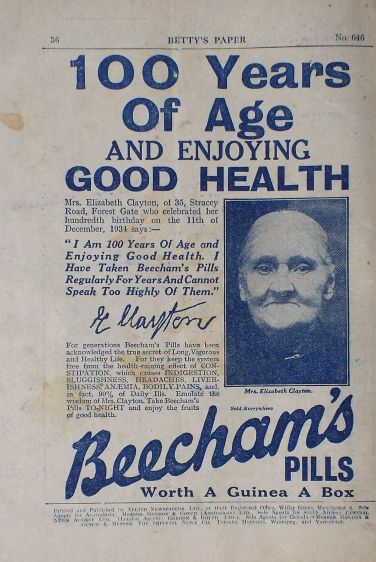
Lastly, my favourite ad of all. It made me spit coffee all over my t-shirt. Scroll down and take a look at the pinnacle of Betty’s Paper’s fine advertising material. It’s from the back page. It’s the one with the lady purporting to be over one hundred years old and still ‘enjoying’ good health.

Bless her. Mrs Elizabeth Clayton, she doesn’t look as though she enjoys anything. I know we all want to live forever, but this is funny. Again, I love the use of the lady’s address. Did people go there to marvel at the lady and her great age? Surely it’s fictitious, put in to lend credence to the advertisement? But part of me really wishes I could go there and witness the spectacle of Mrs Clayton enjoying life to the full and a hundred years old. I really hope it’s not just cynical advertising but that the old girl had a brilliant life and earned a fortune from companies using her face to astonish the world.


People Watching for Writers

Inspiration comes from all different places. And I’m often asked where I get my ideas. It’s more that ideas come looking for me than I go looking for them. I’m incredibly nosy about other people, and I am an incurable people-watcher.

I don’t advocate, as a writing tutor in Brisbane once told a group of creative writing students, that you should actually follow people to get ideas for your story or to experience what it’s like to ‘shadow’ someone a la detective fiction. BUT I must admit I do covertly eavesdrop and watch people, especially in a coffee-shop situation. I don’t actually record conversations or film people, though it is SOOOO tempting.

I remember overhearing one yoof talking to another about his baseball cap. Yoof #2 was admiring the cap and trying it on. Yoof #1 said, rather anxiously, ‘Don’t you lose my cap, man. That cap is my identity.’

It’s these kind of scenarios that fuel my imagination.

Here’s what happened one day. I must just add, as a disclaimer, that all I saw were two people in a coffee-shop—my imagination, tawdry and cynical, and my love of detective fiction did the rest!

So I was sitting there with my cappuccino and my triangle of ‘tiffin’, in a Coffeebucksta Emporium in the town where I live. And I saw this:

A smart young man, late twenties, in a very modern suit, latest hair-do etc., all smiles and full of conversation. With him a frail and bent old lady in a wheelchair. She was also smartly dressed and her white hair was short and chic a la Dame Judi Dench. But she was way too old to be his mother. Grandmother? Great aunt? Great-Great-grandmother? I mean, she was OLD.

I’m already plotting a story around them. He parked her at a table and went to join the queue. She was reading the paper. I’m thinking, maybe she’s not a relative but his Sugar Mommy?

The idea appeals to me. I can remember several detective novels where scandal ensues due to an inappropriate attachment between a favoured young man and an older, vulnerable (or perhaps not so vulnerable) woman. I like the idea that even in this day and age, a young man can still cash in on his good looks, and an old lady can still enjoy having someone to dance attendance on her.

I decide she probably has someone at home to help with her personal care. And to take care of the cooking and cleaning. I’m picturing a large sprawling mansion, empty of people but stuffed with suits of armour and gloomy, grimy portraits of people who have been dead for hundreds of years. Glass cases of long-dead animals. Lots of wood panelling. Surrounded by vast expanses of grass and tall dark trees. Maybe some peacocks? An old uneconomical car, with her cosseted in the back under blankets, and him in front at the steering wheel.

if you try people-watching, just make sure you don’t get caught, people don’t always enjoy being spied on.

And I don’t want to think there could be anything sexual involved (eww!) but that he acts as chauffeur, secretary, assistant, companion and entertainer. He flatters her, makes her laugh and she pays him for his smiles.

I think of the people that know her, local villagers? I imagine them talking to me. Or to a policeman sent down from Scotland Yard to investigate some awful crime. Perhaps she’s been murdered? Or him? Perhaps he’s the victim, not the perpetrator? Over our coffee, my informant tells me, (this is in my head, you understand,) “Well of course she gave out that he was her great-nephew, though I’ve never believed it. But she said it—you know—for appearance’s sake. He certainly is a charmer. And so patient. Well all I can say is, he’s worked damned hard for the money she’s left him. If there is any money. No one seems to be too sure about that.”

Was he a little too friendly with the nurse who looked after the old lady? Is that what they’ll say when her body is discovered? Did the old lady resent him giving those smiles to someone else?

Back in the real world, I’m picking up on tiny details. He returns with a coffee for her. Nothing for himself. Which seems odd. He sits. She leans forward and says something to him, and he takes her cup and has a sip of the coffee, and shakes his head. He returns it to its saucer. Too much sugar? Not enough? Does this taste a little odd to you? I’m not sure what is going on, but she doesn’t drink it.

They don’t stay long. I think he was actually in the queue longer than they sat over the drink that went almost untouched. Why didn’t she have her drink? Why even bother coming into the cafe? Why didn’t he have anything? Does she hold on a little too tightly to the purse-strings?

Even though he is smartly turned out, perhaps his shoes are showing signs of wear? Not quite as new or of such good quality as they first appeared? Perhaps she doesn’t pay him so well after all? Are there arguments over money? She thinks he spends too much, or asks for too much. He thinks it’s unfair that he has to beg and plead and justify what he needs, thinks she is too keen on having power over others. Perhaps it’s just not worth it after all? Perhaps it’s time for this ‘arrangement’ to come to an end?

For one mad moment I think about taking her cup for analysis before the table is cleared. Then I remember. Only in my imagination am I a detective. Here in the real world, I’m just another person sitting in a cafe. But in my mind, and in my notebook, I have the bones of a story.

***

A bit of colour in your cheeks: 1930s make-up

This ad for Maybelline shows the archetype for 1930s make-up.

Make-up in the 1930s was gradually moving away from the secretive, rather apologetic attitudes of the 1920s and earlier which kept make-up containers such as compacts small and discreet, in much the same way as women’s smoking accoutrements. Partly this new acceptance was to do with the trend for more a feminine look after the androgynous 20s, but it was also due to the burgeoning movie industry and the new passion for celebrity role models, and the aspiration to adopt Hollywood styles and trends as part of everyday life, even for those on low incomes. You might see a certain dress or hat in a film, and a week later your friend, sister, mother or yourself could have copied it at home to create your own variation to wear on your half-day out or the next time you went to the cinema.

Yes, that is 1930s mascara, to be applied with a kind of toothbrush thing. It looks like boot polish. And who knows, maybe it was. But it got a girl noticed.

The cosmetics companies lost no time in showing the everyday woman how to use their products to achieve the same looks, or an approximation of them, as the big screen icons such as Myrna Loy, Barabara Stanwyck, and Carole Lombard, whose glamour was so appealing to women – and of course to men, which was a big part of the thrill.

In 1937, Myrna Loy was featured by Photoplay magazine in a kind of cross-over promotion with Max Factor, sporting her face with a clever ad for her latest film Parnell, in which she appeared with Hollywood megastar Clark Gable, whilst her photograph lent authority and appeared to endorse the products being promoted, no doubt sending her fans out in droves to buy the make-up ‘used by Myrna’.

The typical look was for pale foundation, with pink ‘roses’ on the cheeks. Eyebrows were very arched, and plucked extremely thinly, or even completely removed then pencilled-in in a much higher bow than nature intended. The eyes were emphasised with deep colour–blues, greens and mauves were popular–on the lids and highlighter or shimmer on the under-brow area. Lips were painted in a range of tones, mainly deep pinks, reds and oranges.

A range of lovely, very appealing products from the Coty range, and featuring the Lalique powder puff design.

It’s a surprisingly colourful palette, and the products were manufactured by many of the big brand names we still know today such as  Revlon, Max Factor, Coty, Almay, and Maybelline, not forgetting our own dear Boots No. 7 which first appeared in 1935! Helena Rubenstein created the first waterproof mascara in 1939. Cream eye-shadows, lip ‘glosses’, and ‘pancake’ make-up also appeared in the 1930s. It was an exciting time to be a girl! Make-up like face creams and powders were mostly sold in glass or china pots, or for cheaper brands, or the lighter products such as eye-shadows and lip-sticks, in sturdy, decorated cardboard boxes or in tin or plastic.

Here’s an extract from the sales pitch for Max Factor: ‘Choose your colour harmony shade in Max Factor’s Face Powder and see how naturally the colour enlivens the beauty of your skin.’ It sounds so similar to the kind of advertising copy we read or hear today, doesn’t it?

Sales were booming. The new advances in chemicals and manufacturing processes helped to pave the way for a wider use of make-up, especially among younger women who worked in factories and had their own money. Prices came down and demand went up. Glamourdaze.com quotes the Daily Mail as asserting that ‘In 1931, 1,500 lipsticks were being sold to women for every 1 being sold in 1921.’ How true that is I don’t know, but I wouldn’t be surprised if it were fairly accurate. Affordability, economics, a decade of peace, industrial progress, and women having jobs, their own money and more autonomy all must have combined to create the perfect climate for a boom in make-up alongside other new consumer goods such as clothing, accessories, household appliances and even cars.

The Coty compact with design by Lalique.

In the image above, you can see a lovely vintage Coty powder compact. The design was by Lalique, the famous glass guy. I sold one of these on eBay for a nice little sum a few years ago! Coty started in 1904 and Lalique set up his first glass ware and design business in 1921. This gorgeous powder puff motif is still highly collectable, though affordable, and is still in the very small size compact that was normal for the 1920s – a little over two inches in diameter. A tiny thing of great beauty. You can find them quite easily on the Internet, sometimes still with a little powder inside, and usually with an applicator or sponge. But beware, there are replicas about. They are easy to spot, being much larger–the kind of size we usually see now of about three and a half inches or more–plus shallower, and the design is more precise and detailed.

So make-up, then as now, really did depend on who you wanted to be, and just as in the fashion world, the designers followed trends very closely, with lower priced brands following after the big leagues, and with everyone keeping an eye on their favourite celebs.

PARNELL, US poster art with Clark Gable and Myrna Loy, 1937

***


Searching for Agatha

The newspapers had a field day and speculated about disguises.

As I said last week, literally thousands of people joined the search for Agatha Christie in December 1926 when she disappeared for eleven days. Her car was found, run off the road, at a place called Newlands Corner, in Surrey, in the South of England. Her fur coat was still in the car, and there were some clothes in a suitcase, and some documents, notably an expired driving license. It was assumed–or feared might be a better word–that she had either been kidnapped or murdered–or as her depressed state came to light, had committed suicide.

Indeed, in interviews a few years later, Agatha Christie did admit she had had suicidal thoughts, but it was her Christian belief that suicide was a terrible sin that prevented her from carrying it out. We can see this attitude so often in the news and fiction of that era. When someone kills themselves, they are seen not only as sinful, but as weak, selfish, lacking in moral backbone, and cowardly. So it wasn’t particularly a viable alternative for someone in desperate straits. But to go away, to be completely unknown and anonymous, that was a whole different thing. The prospect of disappearing–even if only for a few days–must have been a tempting one.

Agatha and her daughter Rosalind

But how did she get from Newlands Corner to Harrogate, a distance of 230 miles, having abandoned her car? True, she didn’t check into the hotel for twenty-four hours after leaving home, but I really don’t think could have walked it, no matter how ‘outdoorsy’ she was known to be. She left the house at about 9.45pm on Friday night the 3rd December 1926. The met office reported it as slightly above the average for the time of year, and dry, and about 40f or 4c: which is still pretty chilly. (You can read old met reports here–if like me you revel in that stuff: it’s a fascinating site)

In an interview later, quoted in Surrey Life magazine (Originally published in Surrey Life magazine October 2008/Words by Alec Kingham) says ‘For 24 hours, I wandered in a dream, then found myself in Harrogate as a well-contented and perfectly happy woman who believed she had just come from South Africa.’ It’s not mentioned here but stated elsewhere, that this newly-invented character was a widow, and I find that interesting: is that why this character was happy? Notably, Agatha was said not to have been wearing her wedding ring, though in view of the wreck of that marriage, perhaps that’s not entirely surprising, though the wronged party often does continue to wear their wedding ring, especially until the divorce is finalised. The breakdown of a long-term relationship is known to trigger a deep sense of bereavement.

Alec Kingham claims that Agatha walked to an inn in Shere (interestingly, this is the same small neighbourhood where Archie had gone to a weekend house-party of a friend, and to be with his mistress) and she stayed there  overnight, then went on by train the following day, a tortuous route via local lines to reach Guildford, and from there to London, across London and then on to Harrogate, arriving at the Hydropathic Hotel in the evening.

In my view, she had to have planned it. I’m not talking weeks or months, just a couple of hours is all she would have needed. But I don’t believe this could have all been accomplished off-the-cuff. Is it possible her secretary helped? She was supposed to have been unaware of what had happened, other than the fact that Colonel Christie had left the house for good with his belongings following a final scene, and that Agatha herself went out a little later.

It’s been suggested that the site where she crashed the car had been deliberately set up to resemble a crime scene. And certainly if anyone could have planned and created such an event, she could. Who else would carry an expired driving license on her if not a mystery writer out to set up her own disappearance?

Archie Christie told the police that she had once said that if she wanted to disappear, she knew exactly how she would do it, and she maintained she’d never be found. Perhaps that’s why the newspapers featured her photograph with various disguises such as different hair colour and styles, and with glasses.

Certainly she’d have needed money. She had to travel all the way to Yorkshire, presumably by at least three trains and either underground or bus across London. Even in the 1920s, you’d need hard cash for that. And luggage–no respectable hotel will take a guest with no luggage at all, even if they said at the reception desk, ‘Oh I’m only staying for a day or two, the rest of my stuff is in the car.’ So let’s take it as read she had at least a small holdall or suitcase, with a change of clothes. And some cash.

She knew where she was going, she had everything she needed with her. She had to have planned it. Whether or not she had any help from another person remains a mystery, but this could not have been a spur of the moment occurrence.

***