More vintage magazines for women

Last year I posted a couple of articles about women’s magazines from the 1930s. (If you missed them, you can find them here.)

Over the last two weeks I’ve been fortunate enough to acquire two more vintage magazines aimed directly at women. what impressed me about these was first of all, that this magazine – Woman’s Own – is still in circulation and massively popular today. The second thing I noticed is that there really isn’t a lot of difference between the WO of 1934 and those of 2021.

Have women’s concerns changed very much in 90+ years? I’m not sure they have. for many women, the home and family is still one of the most important things in life, and I’m not saying that in a patronising way, nor ignoring the fact that women today have many more opportunities to have a career, and that the concept of ‘the family’ is miles different – and rightly so – to that of the 1930s.

But at rock bottom, many women are interested in and still worry about how to care for, manage or improve their relationships, their attractiveness, their budget, and their partners and children.

My Woman’s Own mags are from Feb 1934 and this week’s copy – by chance I nabbed a ‘diet special’. Here are a few snippets that struck me as interesting:

Hubby Management: It’s the wife’s job to make her home as welcoming as possible to induce the man (and man ONLY!) to stay at home instead of going out gallivanting. tips are given on how to do this, though the mags expert – whoever that was, possibly (we don’t know!) a bloke – comments that some men will always stay out and shouldn’t get married in the first place. Too late if you’ve got one of those, girls!

We have the readers’ letters, essentially a problem page. My faves are ‘should cousins marry?’ (Surely they know the answer to that?) and the ‘worried wife’ letters. I feel for the worried wife. She knows exactly what the answer will be but doesn’t want to admit it. Poor woman. Did she sling him out? Or – as I feel is more likely – did she just suffer in silence?

There’s a load of fashion tips and ideas, mostly, I was interested to note, clothes you could make at home. This magazine is aimed at the upper working class and lower middle class, women who have a little money but not enough to buy off-the-peg items and certainly not bespoke. ‘Home economy’ was one of the watchwords of the day, and it included apparel.

I personally think this looks absolutely horrid, and a cross between a Christmas panto costume and something out of Red Riding Hood. This one below is slightly nicer, but again, still all your own work.

Although the models in the designs look about 35 to 40, in fact some of these are aimed for teenagers from 14 years of age. not much difference in those days between what mums and their daughters were wearing.

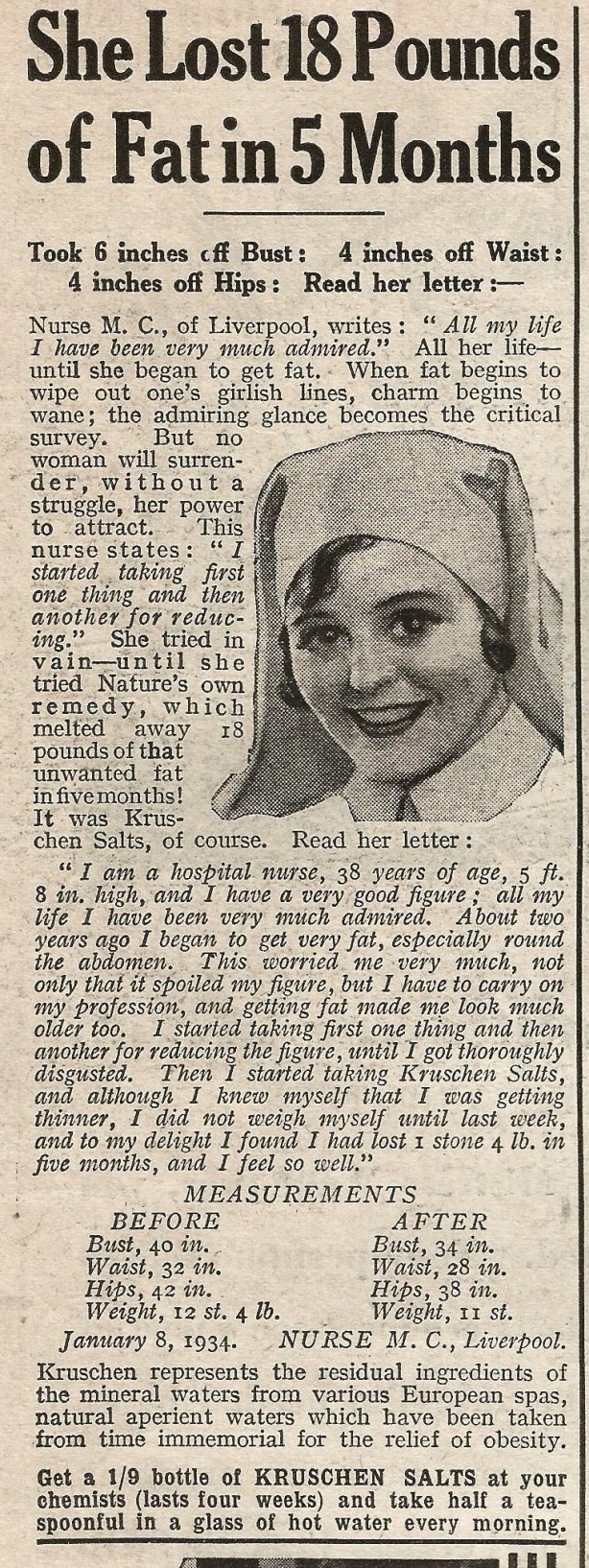
And of course, the eternal battle with the scales. I was interested to see things haven’t changed much here either, although some of our modern ingredients – chorizo and the whole gluten-free plan would have been completely alien to women of the 1930s.

Looks like this lady – a nurse, not a nun as I first thought – was following the crap-yourself-thin diet. 18lbs was a good result! Was she just a bit constipated after Christmas? All those mince pies…

Looking good appears to be a perennial issue for many women. We want to keep our looks as long as possible, after all, and keep ourselves in good condition. So I suppose it’s not surprising magazines for women contain so many hints, tips and advice. With the growth of city populations, the expansion of the suburbs, many women would have been cut off from their usual channels of information: mothers, grandmothers, aunties. Equally, magazines adopt a sisterly or motherly tone to offer the advice so desperately needed in those times. Today, magazines are more likely to have a friendly, conversational tone, inviting you to confide and share like a friend coming alongside to offer a sympathetic ear.

I’m in awe of the fact that this magazine has been around so long. It’s fascinating to read that the same ideas preoccupied women before my mother was born, as they do now. We may have Smartphones, the Internet, Netflix and Just Eat, but at the end of the day, we still want to look good, feel good, and keep our man where we can see him.

***


Interview with Debaleena Mukherjee, poet and writer of observational life pieces

This week I’d like to welcome Debaleena Mukherjee to my blog.

Debaleena and I go way back. We’ve never met (who knows, maybe one day?) but have been friends for years. We first met online through a shared love of murder mysteries. Talking about books led to talking about family, work and cake. The important things in life! Debaleena has also been a staunch supporter of my writing, and I am proud now to be able to do the same. Debaleena writes poetry, the first volume of which was published a few months ago by Blue Rose Publishers.

Debaleena, welcome. It’s amazing to have this conversation with you! Congratulations on publishing your first book of poems, I’m sure there will be many more. I wasn’t entirely surprised when you announced the book was coming out – you’ve always shared such lively and passionate posts on Facebook and Instagram. Your powers of description are so vivid that I often feel as if I’m there with you. I particularly love your posts about the various festivals you celebrate.

But let’s move on. My first question is, What do you write?

I write poems; and I am now experimenting with short stories. It started with Facebook posts, Book Club reviews: that’s how we met, remember! I would write little notes about my day; like little letters to myself . Then I translated a Bengali poem for someone very close. And I could do it, although I’d been very hesitant and nervous about poetry. Poetry has always been “the impossible dream”. After that little translation, I got a bit braver. One night I started out very very tentatively. And I saw I could do it: very rough and cobbled together; but I could feel my thoughts in my words. My writing is just as  the title suggests – Ink smudged dreams: by the reading light. All written in the later hours of the night when I would drowse, browse and write. They are not about any coherent thoughts or convictions. They are more of inarticulate thoughts, emotions: ramblings you could say. So the poems were written.

There is a strong observational thread in your writing, so lovingly shared, that marks you out as a great writer. Question two, What were your earliest influences? What did you read as a child?

I’ve always been a bit of a dreamer; the cobwebs in my mind have never been swept away.  As a child I remember, I would  sit quietly for hours together, playing in my head. Now this head game was very interesting. I would imagine different scenarios- people, families, foreign countries I’d seen in photographs. I would spin stories in my head about people and places. Then I would imagine myself in castles and mansions. But it all had to be happy. This head game continued and I loved it. Later I would look at houses ; especially old houses; distant windows, silhouettes of people through the windows and concoct stories about their daily lives.

I really can’t remember a time when I didn’t read. Before I learnt to read, I would  love looking at illustrated books, magazines. I remember I had a book on dolls and I would look at it all day long. Then, once I learnt my ABC: I found the Ladybird series of fairy tales. Let me tell you the enchantment still remains as fresh as ever. Those covers! My favourite was The Beauty and The Beast. That started my life long enchantment with fairy tales. By the time I was ten, the Enid Blyton world became my world. I simply lived in those books. They were like a perpetual picnic life for me. Of course Nancy Drew, the Hardy Boys, school stories, they kept appearing in my life, and my head was a lovely place to visit. Then of course Mr. Rochester entered my life when I was twelve or thirteen – all ready to fall in love. By fifteen I got to know Mr. Darcy, whom – I know you’ll be shocked – I did not love. Mr. Knightley was my hero! Then  came Charlotte Bronte’s books- Shirley, Villette. And Louisa May Alcott. I used to imagine myself as Jo. We all do. I decided that Professor Bhaer would be my love for life. Until I read about some other character the next day, that is! Isn’t it delightful: to fall in love with so many heroes all at once! And I have a macabre taste for horror. So I wallowed in  gruesome murder mysteries. Then I was given an Agatha Christie book: The Man in the Brown Suit. After that there was no looking back. Christie led me to Victoria Holt, Bram Stoker, Sherlock Holmes and Father Brown. As well as a wide range of Bengali literature of all genres. I am also a fan of romantic fiction, esp the mean and moody hunks that are Mills and Boon heroes! 

We read very similar things as children and young people, it seems, I was into all those books too. I’ve already touched on this next question a bit, but, next question, do you believe your culture influences your writing, and if so, how?

Oh yes! My culture has a profound influence on my writing, as you can see in my poems. They are imbued with a sense of belonging to my land and my people in every which way. This is more pronounced in the sections in my book, The Prayer and Hymn to the Earth. I am writing about my way of life. I realised that I’ve chosen colours, comparisons, ambience that are totally inherent to my culture. I’ve grown up reading our mythological stories, the epics Ramayana and Mahabharata, as well as my parent tongue-Bengali literature- folk tales, fairy stories, poems. For me Gitanjali by Tagore is the ultimate prayer book.

I think culture can often be an almost hidden extra character in our writing. But looking ahead, what can we look forward to in the future from you?

Now that my mind block is gone, and I’ve tested the waters, I have become quite adventurous. Poems definitely. I’ve discovered this about myself that as I grow older, poetry grows more appealing. I find that I now can interpret life and emotions better through poetry. It is an instinctive response.

Like I told you – short stories. I am trying my hand at those. It’s very challenging but extremely interesting. And intriguing. Writing in someone else’s skin, creating another individual, different points of view: I find it extremely fascinating. I have to construct a short story, not just pour it out. So it is a constant process of study too. I have to keep going back to little research, references to literary devices, unity of time, place and action; and above all keep a firm track of all the threads.

Oh short stories are the slippery slope to novels! That’s exciting news for us! We’ve talked a bit about the books that influenced you, but who are your favourite authors? Do you have certain favourite books you return to again and again?

I am glad you asked “authors” and not “author”? You know we cannot have just one favourite. Ever. I of course love  re reading the classics like Jane Eyre, Emma, the Little Women series, Rose in Bloom. My comfort and enchantment lies in Mary Stewart’s books. I read them whenever I need a holiday of the heart. Elizabeth Peters is another favourite. I started reading Georgette Heyer pretty late in life, but I find her delightful. What shall I say about Patricia Wentworth! I adore Miss Silver and I still pine for Frank Abbot. One author who is a verbal illumination is Eva Ibbotson. I find her books poetic prose. I simply love medieval mysteries, and I keep discovering authors in this genre. Even more, I like the thrillers based on archaeological mysteries, religious relics, and mythological mysteries. And now: there’s Dottie Manderson. I am loving this return to the cozy mystery genre, very exciting and warmly familiar. Like I said, and I know you too agree: that one cannot have just one favourite.

Absolutely – and I know that like mine, your to-be-read pile is very substantial! What do you do when you are not writing or reading?

I am a homemaker. And not a very efficient one at that please! But I try. I do try! I cook. I cook traditional meals every day. Very often there are kitchen secrets that I dare not share. Of splattered oil, exploding blender. But yes, I prepare our Indian, especially Bengali cuisine ( that sounds so much more impressive than “food”). I enjoy baking, more so because I eat most of the cake myself. Music! That is my soul balm. I love to listen to oldies goldies: English, Hindi and Bengali. Instrumentals are my ‘go to’ solace when I am tired of words. And as I’ve been told “I have the spirit of enquiry”. Do you think it’s a polite way of saying I am nosy? I love people watching. My best pastime is to sit in a cafe and watch the world go by. As I watch people, I make stories about the passerby in my head. Another thing is that I haunt bookstores; especially old books, pre-loved books. All the obscure, dusty corners: I am very good at finding treasures there. Long drives with music in the car. I sit absolutely silent in the car and I soak up the peace and the purr of the car.

I’ve often heard you talking about the meals you prepare – your descriptions make the mouth water. But I remember that you used to be a teacher. How has that inspired you or helped you with your writing?

It gave me insight. That’s the crux of my teaching experience. I’ve learnt to probe into people’s minds and see stories there. Teaching young teenagers and college students made me more receptive and absolutely non- judgmental. That helps  when I write. I learnt from students and colleagues, that as a teacher I am not dealing with folders that you open at 9.am and shut at 5 pm. Everyday I found something new in my work. And that influenced my writing . Most of all it heightened my sense of humour as well as the perception of the Absurd in life. Not to forget teaching made me quite tech savvy about which I love preening and boasting.

Debaleena, it’s been an absolute delight and I’d love to talk more about these things. In the meanwhile, where can readers find your book?

My book: ‘Ink-Smudged Dreams: by the Reading Light is available as an eBook from Google Play, or from BlueRose Publishers online store, or for those readers living in India, from Amazon India and Flipkart . 

Thank you so much Caron for this wonderful and warm interaction. And for giving me this opportunity to talk to you. You’ve always been an inspiration. You encouraged me all the way. But I still envy you Dottie. Thanks so much for helping me reach out to readers with my Ink- Smudged Dreams: by the Reading Light. They’re just that- dreams, that as I penned down, the ink was not candid and clear; but smudged in places with tears, and vivid in places with smiles.

Thank You.

Debaleena, my pleasure xx

ABOUT  DEBALEENA  MUKHERJEE

Debaleena is a homemaker, who has also been a teacher and college lecturer over the course of years. She grew up in Jamshedpur and did her schooling at Sacred Heart Convent School,Jamshedpur, and Rajendra Vidyalaya, Jamshedpur. She has done her Masters and M.Phil in English Literature from Jadavpur University, Kolkata.She lives with her husband in Bangalore, and she  has a twenty four year old daughter. Reading is Debaleena’s way of life. That’s what she is always doing. She enjoys the moonlight and roses kind of music. She loves travelling to places from the pages of history text books. Haunting bookstores is her pastime. She loves going on shopping expeditions for shoes, bags, and bling.  Observing people as they go about their lives, fascinates her. At the end of the day she needs her recliner, her books, and coffee. With some cake.

ABOUT THE BOOK

Ink-Smudged Dreams: by the Reading Light is a collection of poems. Poems that reflect the many facets of my life: maybe any woman’s life. Certain moments, fleeting experiences, lasting impressions, unknown anxieties, silly apprehensions, humble realisations, intense joys and every hurt felt; these are the poems’ moods . And above all a growing perception that life is not about tomorrow: it is about today. But all these are not my consciously addressed ideas. Each day, they have gently enfolded me. Then in the quiet of the night, I would sit down and pour my heart out on paper. Drowsy, blurred, and very close to my heart. These are those ink-smudged dreams by the reading light. 

You can find Debaleena on Facebook as Debaleena Mukherjee from Bangalore, and on Instagram as m.debaleena

***
 

Persistence is futile – I mean – essential


I think I may have written about this topic before, but I feel it’s one of the most under-estimated skills any writer can have. (Persistence, I mean, not repeating yourself, I do that all the time. Actually that is useful too, for helping me to remember things through repetition…)What is persistence?

To me persistence means a dogged determination to the point of stubbornness to keep going, overcome resistance in yourself and the world around you, to press on towards a goal you have no tangible proof you will ever reach. It means turning your back on discouragement, detractors, self-doubt (which most writers have in abundance?, laziness, weariness, even pain and illness to MAKE yourself achieve something specific or reach a certain goal.

The scariest moment is always just before you start. After that, things can only get better.”
― Stephen King, On Writing: A Memoir of the Craft

Why is persistence a useful tool to have in your arsenal? What does it contribute to your life or work?

Persistence:

  • is character-building – you come to realise you are capable of more than you may have believed initially.
  • is prioritising – you realise that the most important things in life don’t come without you working hard for them.
  • you learn to persevere, and build resilience and inner strength.
  • you learn to trust yourself and believe in yourself.
  • you come to value the results of your hard work.
  • when times are tough, you have previous experience to draw on to get you through.

How to be persistent:
  • Eat well, sleep well, take care of yourself, allow yourself down-time.
  • Develop a routine. Routines can enhance creativity, rather than block it or stifle it. A routine means you are mentally prepared at a certain time to undertake a specific task. that means half the work is done already!!
  • Keep a journal to record your feelings, even the negative ones. Allow yourself to rant or wail if need be. Don’t forget to record your successes, though, as these will keep you going during tough times when you feel like nothing is working.
  • Talk to people who understand and support you. You don’t need to be alone in the middle of your struggle.
  • Set manageable goals, even if it means doing a larger number of smaller tasks rather than a few big tasks. Breaking a large task or goal into small pieces is the key approach. By chipping away at a large task bit by bit you will make progress – it may not be easy to see the results right away but it is easier to work this way in the long haul, and achieving many small goals is excellent for your confidence. This is also a great way to talk yourself into tackling what feels like an impossible or overwhelming job.
  • Don’t listen to your negative thoughts. Learn to recognise then ignore your inner critic who tells you things like: ‘this is a waste of time’, ‘you’ll never be good enough’, or ‘it’s too hard for you’, and that old favourite, ‘not everyone is destined to succeed’. This is probably the hardest thing to overcome, and really requires you to laugh at the inner voice or negative thought and say ‘so what, I’m going to do it anyway.’
  • Roll up your sleeves, grit your teeth, and get on with it. Don’t wait until you are ‘in the mood’ or feel inspiration strike. Nine times out of ten, inspiration waits for you to make the first move. Show the universe – and yourself – that you are going to do this.
  • Reward yourself and feel proud of your achievements. And don’t whatever you do, punish yourself if you feel you have fallen short of your goal. Remember too that pride in a job well done is not a sensation that you necessarily get right away. If you have been engaged for a long time on a demanding project, it can take quite a while to recover, then feel a sense of satisfaction. Be patient, be kind to yourself.

Basically persistence is being super stubborn, and refusing to give in or back down. Find what you want to do and do everything in your power to do it.

Just remember, you can do anything you set your mind to, but it takes action, perseverance, and facing your fears.

Gillian Anderson

***


Reblogged: I am interviewed at Maureen’s Lifestyle

Many thanks to Maureen Wahu at Maureen’s Lifestyle for this interview following her review of The Spy Within: Dottie Manderson mysteries book 6 last week.(you can check out the review here)

Caron Allan Interview

What inspired the Dottie Manderson series?

I’ve always loved the glamour of Golden Age mysteries, and so I wanted to try my hand at something like that. But I wanted to have a young protagonist as most of the books I’d read had older, spinster ladies as detectives. But I didn’t want to write anything too sweet, or too separate from the real world. So in my books, yes, there is glamour and romance, and the bad guy or gal always gets caught (though sometimes not immediately) but there is also heartbreak and the harsh reality of life not being easy, especially as my chosen era of the 1930s is so close to the war.

What is the hardest part of your writing career?

I suppose it’s juggling all the different aspects of being a writer in today’s world – the social media, obviously, I know everyone says they struggle with that, but also all the technical things – covers and document formatting, creating promotional materials, then remembering to share them, setting up a blog and remembering to create something new most weeks. And then remembering to do actual writing too, and stick to my deadlines. So much to do!

Would you ever use a pseudonym?

I always use a pseudonym. In fact have have several, but the only one that I’m using at the moment is Caron Allan. I wanted to use a pen name because to begin with, it gave me the space and privacy to completely mess up without feeling ‘exposed’. And also, I felt my real name was dreary and unromantic!

When writing a series how do you determine where a book should end and it’s sequel should start?

It’s not always easy, and I’m not very good at it, but fortunately because I write mysteries, that kind of gives a natural end, when the perpetrator of whatever dastardly deed is unmasked and taken away in handcuffs, or however they exit the story, it seems right to just have a short wrap-up and end the book. Though I do have ongoing story-lines – mainly the romantic side of things – that continue through the books and aren’t resolved immediately. In book 1 Dottie, my protagonist, is only 19. I think 19 in the 1930s was a lot younger than 19 today in many ways, and so we see her growing and maturing through the books, coming to understand the world, and relationships, but she is very idealistic and so she can be led by her emotions, and is sometimes bruised by life. She’s not perfect, she’s on a journey, and I like that about her. I don’t want to read about or write about a heroine who doesn’t change, and especially one who doesn’t have depth and dimensions to her character.

Who were your biggest critics and cheerleaders in writing this series?

My family are a huge support, my daughter especially is a massive practical help as well as my cheerleader, as writer herself she knows where I’m coming from. I have a couple of very special friends who are also writers and who are so helpful and encouraging.

If you could go back in time which historical figure would you like to meet?

Oh dear, that’s quite hard. I know we’re always supposed to say Marie Curie or someone incredible like that, but maybe just meet my great great grandmother? How did she cope in the late nineteenth and early twentieth century with all the domestic responsibilities and none of the labour-saving devices we have today? Plus she had six kids, and i only had two, so I am in awe of the women of that era. I’d like to meet Agatha Christie, and Patricia Wentworth when they were in their story-writing heyday, and get as many tips as I could, and also express my admiration for their work.

What should we expect from your upcoming series?

Well I will continue my Dottie Manderson mysteries: Book 7, Rose Petals and White Lace will be out around November 2021. In this book, we will see Dottie trying to find out who wants to get a local tea-shop closed down, and why. It’ll be a gentler mystery for Dottie after the previous couple, but nevertheless there will be at least one fatality, and if you’re not a fan of creepy-crawlies, this might not be for you!
I also will be launching a new series, set in the 1960s this time, and featuring the daughter of Dottie’s sister as the detective-protagonist – these will be the Miss Gascoigne mysteries, and begins with A Meeting With Murder. Diana Gascoigne has been ill and goes to the coast for some good sea air to recover, but obviously there are dire doings afoot and she will want to find out who killed an elderly disabled woman. the Diana books will be a little different to the Dottie books, as we know, the 60s were a time of growing freedoms especially for women, and Diana is not an ingenue like Dottie, but a little older, a little wiser and more aware of the difficulties that a woman can face, and she wants independence and more autonomy in her life. But she has the same determination to seek justice and truth.

Would you ever consider writing a biography of your life?

LOL, that would be so boring! I’m not adventurous or glamorous and I’ve done very little with my life other than sit with cats reading or writing. I really don’t think it would sell!

Do you ever experience writer’s block? Sometimes. I don’t agree that it’s not a real thing. I usually find it stems from discouragement, fear or being overtired. I tend to push myself, and I’m always thinking of plots and story ideas, so I get quite mentally tired, and don’t always remember it’s okay to just do nothing and relax. Maybe I need to watch my cats even more than I do! I find rest, music and mundane chores help.

How can your fans reach you and connect with you?

I can be found on twitter: @caron_allan or instagram: @caronsbooks or through my blog, caronallanfiction.com and I’m also on Facebook, but I have to confess I don’t go on there very much, I’m more of a Twitter person.

Find all of Caron Allan’s books on Amazon.

Thanks for stopping by!

Thank you, Maureen, it was fun!

***


My Top 5 Agatha Christie choices

Since my latest book was published last week, I have had a lot more time to concentrate on reading and relaxing. I mainly read mysteries and crime novels or true crime, but I do like the occasional foray into other genres. I love history, not the kings-and-wars type of history, but the stuff about how ordinary people lived their lives. I also love books about art and culture, I enjoy the occasional romance (I’m still talking about books here!) and I love poetry, I read classical books, and also fantasy-ish books by people such as Jodi Taylor, Tom Holt and Jasper fforde. But the mystery/crime genre remains my one true love. I’ve already blogged about which books I would grab if the house was on fire…

Thinking about that, I decided to quickly put together a list of my top five Agatha Christie books. So here they are. Have you read all these? Let me know what you thought. Are there other books in your top five? 

Death On The Nile


There are a number of things I love about Death On The Nile. I suppose the ‘surprise’ ending has to be number one, doesn’t it/ I remember the first time I read it, I was as they say, blown away. I had to think about it for a while, and full of admiration for Christie’s ingenuity, had to say, ‘Wow.’ I don’t want to spoil it by saying more or going into detail if you haven’t read this one, so please buy this and read it immediately if you haven’t read it before. There is romance, passion, mystery and history, and above all else, Hercule Poirot with his magnificent moustaches, his sage predictions,  and his mal de mer.

The second thing I love about this is the glamour of the setting – the exotic destination, the old-fashioned elegance of the characters and the scenes they live and  move in. Dressing for dinner – I’d love to do that. Dancing to a little group of musicians, yes! Leaning on the rail and gazing at the river, maybe whilst sipping a cocktail, definitely my idea of a nice way to spend the evening. Then in the daytime, the exciting trips ashore, the ancient monuments we would visit, the history, the majesty of it all. My more prosaic everyday self would tell you that reality is probably a million miles from the romance of a book published in 1937, but my inner writer-romantic would just retort that it doesn’t matter, or snap back, as Dottie’s mother would say, ‘Nonsense.’

Death Comes As The End


I’m always a bit surprised that not many people have heard of this one. As you can see, it’s one of my favourites. I read it first when I was a teenager, and what struck me first of all was how Christie made the past come alive. I had never seen history in that ‘relatable’ way before, and it kindled a love for history in me that has stayed with me ever since. I didn’t know, then, that Christie was mad about history or that she was married to an archaeologist. 

This book is set in a fictionalised version of the ancient past, no familiar moustache twirling detective or knitting old lady here! It’s set in the time of the Pharoahs (ish), and the era is beautifully brought to life by the author, described fully without being a mere information dump, and it really is absorbing.

It’s a romance, and a traditional murder mystery. There is a sense of menacing unease, and along with Renisenb,  the young female protagonist, you have to ask, ‘Is it you? Or you? Or you?’ Give it a try and like me, you’ll be biting your nails, with everything crossed that things will turn out all right for Renisenb and that she will get her happy ever after.

Lord Edgware Dies


As you can see from the pic above, when I last read this I made tons of notes – I felt I really learned a lot from rereading the book and seeing just how Christie achieved the creation of her mystery.  I even devoted a whole post to this one book!

This book was first published in 1933. Eighty-seven years ago!!!!! Somehow I always think of Christie as a relatively modern crime writer, but of course, she wasn’t, she was very much of her time, two generations before mine. In fact, my character Dottie could definitely be a Christie fan!

Coming back to Lord Edgware…

This book has a host of characters. Too many, I’d say, and I should know, I crowbar in dozens to every book. Although I love this book, I do get muddled with the characters, especially in the beginning. It’s also a long book, and quite complex as a so-called ‘cosy/cozy’ mystery goes.

The plot hinges as always on some clever sleight of hand–my favourite kind of plot! I loved the way the murder was achieved, though obviously I can’t say anything as I don’t want to spoil it for you, if you haven’t read this one yet. So therefore, you must read it!

After The Funeral


The main thing I like about this is the opening scene or two, where the ‘unthinkable’ happens as loosely-attached relatives and associates gather for a funeral, and one of the guests commits a social gaffe by saying, (after a funeral as per the title) ‘Still, it’s all been hushed up very nicely, hasn’t it?’  When everyone blusters and demands to know what she means, Cora says, ‘But he was murdered, wasn’t he?’

Mic drop.

Isn’t that a brilliant way to get things going in a story? I  love the apparent simplicity of this. I say apparent because we all know so much planning and effort goes into a story – it’s never as simple as it appears. I suspect that the simpler it looks, the harder it is for the author.

The story is a good one, not great, but it is a solid good story, and if you haven’t read it, I recommend it. But for me, everything else was secondary to that one astonishing scene. It’s worth it just for that.

The Murder Of Roger Ackroyd


Oh dear, the infamous Murder of  Roger Ackroyd. This book caused something of a furore for Agatha Christie when it was first published in 1926, and may have been one of the factors related to her famous disappearance in that year. Almost a hundred years ago. !!!!!!!!!!!!!!!!!!!!!!!!!!!!!!!!!!!!!!!!!!!!!!!!!!!!!!

What was the problem with Roger Ackroyd? Well the critics said she didn’t play by the (unofficial) rules of murder mystery writing. But again, I can’t tell you precisely why because it will ruin everything if you haven’t read the book. Read it, then come back and then we can have a natter about it. Tell me what you thought. 

Suffice to say, it’s the original twist at the end. And I honestly didn’t see surprise coming when I read it the first time, though admittedly I was a teenager and had no understanding of ‘the rules’ of writing. But it seemed perfectly acceptable and logical to me, and I was captivated, as I always am, when I read this book.

It conjures up the traditional ‘English village’ setting so beloved of writers and readers of murder mysteries, with a range of recognisable stock characters, the spinster, the mysterious, possibly/probably immoral, attractive single woman, the local doctor, the people who live in the ‘big house’, and all the hangers-on.

Go on, get a copy and get reading! It’s not like we can go out at the moment…

***

Alliteration and her sisters 

Round the rugged rock the ragged rascal ran. (rock not included)

Round the rugged rock the ragged rascal ran.

We all know that one, don’t we? Though I usually get rugged and ragged back to front. I have to remind myself that whilst a rascal can be rugged or ragged, a rock can pretty much only be rugged.

As we learned in junior school, alliteration is putting together words with the same initial letter. In the case of the above phrase, R, the pirate’s favourite letter.  This repetition is the foundation of our childhood tongue-twisters. English is not the only language to have these:

French ones:

Les chaussettes de l’archiduchesse, sont-elles sèches? Archi-sèches. (translation: The archduchesses socks: are they dry? Very dry.)

Ces cerises sont si sûres qu’on ne sait pas si c’en sont. (translation: These cherries are so sour, we’re not sure if they are (cherries).)

German ones: 

Schnecken erschrecken, wenn sie an Schnecken schlecken, weil zum Schrecken vieler Schnecken Schnecken nicht schmecken. (translation: Snails are shocked when they lick snails because to the surprise of many snails, snails don’t taste good).

Der Grabengräber gräbt die Gräben. Der Grubengräber gräbt die Gruben. Graben Grabengräber Gruben? Graben Grubengräber Gräben? Nein! Grabengräber graben Gräben. Grubengräber graben Gruben.  (translation:  The gravedigger digs graves. The ditchdigger digs ditches. Do ditchdiggers dig graves? Do gravediggers dig ditches? No!
Gravediggers dig graves. Ditchdiggers dig ditches.)

So now you know! Feel free to use these at virtual-parties, to amaze and impress your friends.

Amuse your cat with a large repertoire of tongue-twisters in various languages…

Alliteration can be a useful literary device when writing, and like most literary devices, it is used to make the reader feel, view or interpret your writing in a particular way by creating a mood or appearance. But use it sparingly. The problem with any literary device, is that all too easily it can draw attention away from what you’re writing and turn the focus to how you’re writing. This will distract your reader from your story in the same way you can sometimes fail to see the puppet-show because you’re focusing on the strings.  Having spent all that time gently leading the reader to suspend disbelief, you don’t want to ruin things by breaking the spell now.

Here are a few more literary devices:

Sibilance is the repeated use of an S sound, or a hissing sound. You put together words with lots of S, SH and soft C sounds: Sid’s silly scented snake slithered smoothly across the shiny façade. Unlike with Alliteration, the repeated sounds don’t have to be confined to the beginning of the word.

Assonance is the repeated use of vowel sounds: cut jug, heed beat,   or the same or similar consonants with different vowels: jiggle juggle, dilly-dally.

Consonance is the repetition of matching consonant sounds: ruthless cutthroats, repeated reports. It can quickly descend into Alliteration if only the initial letter(s) are repeated!

”A soldier’s life is terrible hard,’ said Alice.’

These are used to create a certain mood, or an attitude, or making the reader see a character or setting in a particular way. These can also imbue your writing with a poetic or lyrical quality. You might want your readers mesmerised by a particular scene if you are going to follow it with something spectacular: the calm before the storm effect.  Think of movies where there is a soft love scene before the hero goes into battle.

In fact most poetry contains one or more of these devices. Think of Wordworth’s poem I Wandered Lonely As A Cloud, with all the repeated Ls, the Hs, the Ds, the long vowels of wandered, lonely and cloud.  Or  Buckingham Palace by A A Milne, with its repeated lines and rhyming words. 

Or in this, one of my favourite short poems, there is a clever mixture of all these devices – see if you can spot them!

Song by Christina Rosetti 

When I am dead, my dearest

Sing no sad songs for me;

Plant thou no roses at my head,

Nor shady cypress tree:

Be the green grass above me

With showers and dewdrops wet;

And if thou wilt, remember,

And if thou wilt, forget.

I shall not see the shadows,

I shall not feel the rain;

I shall not hear the nightingale

Sing on, as if in pain:

And dreaming through the twilight

That doth not rise nor set,

Haply I may remember,

And haply may forget.

These literary devices can have a unifying effect, making all parts fit together with a repetition of shared letters and sounds, or by ensuring the reader remembers certain sounds or words. But like all good things, in prose it needs to be used in moderation.  Don’t make your writing just a collection of tongue-twisters!

***

The reading writer or the writing reader

We are surrounded by words. They are there on the side of your breakfast cereal packet, full of persuasive ideas or nutritional information. They are on the wall of the lift as you make your way from car park to shopping mall. ‘In case of emergency DO this or DON’T do that…’ They are on our clothes – a logo, a designer’s name; they are on the label – how to wash the garment, the size, the fabric constituents.

As I say, we are surrounded by words. We as humans have come a long way from the days when we communicated through pictures. The concept of communication fascinates me. Why do we communicate? Is it to know our allies from our enemies, or to form friendships, assist pair-bonding, or create a safe environment for our children? We developed words because if a buffalo or something similarly huge is rushing towards you, no one’s got time to whip out a slate and chalks to create a nice little scene to indicate the usefulness of running away. So words are more efficient, maybe.

But words change us. From our earliest days on the planet, gazing fondly at our mothers, we learn words. We learn how to physically say them by watching and listening, and we learn what they mean by observing consequences and effects.

We connect not just words together to form a sentence, but ideas together to create a narrative or story. We might hear the words, ‘Let’s go to the mall’, but what we really hear are ideas based on prior knowledge of that as a situation. ‘Let’s go to the mall’ becomes a narrative: ‘Let’s go to the mall – where we will walk about the shops, talking as we go, laughing and enjoying being together, and discussing life issues or relationships, or personal goals and dreams, where will we notice and comment on the latest trends, where we will exchange currency (or more likely swipe a small piece of plastic) for new goods, that we can then take home and discuss at length, creating a new shared experience. Whilst at the mall we will likely go and get some food somewhere, so it will become a social event, we will sit and eat, and talk some more, possibly on a deeper emotional level, and this day will become part of our shared memories and we will often revisit the occasion in our thoughts, and enjoy the time over and over again, and the whole experience from beginning to end will enhance our relationship and sense of closeness.’

It doesn’t always work like this. Sometimes we have a row as soon as we get there, sulk all the way round the shops and come home later frustrated and disappointed, still in a frosty silence. The great tapestry of human experience!

Where am I going with this? It’s just this: simply, words are key to the storytelling of human life, whether an ordinary trip out to buy new jeans, or whether we are sitting curled up in our favourite armchair reading words on a pages, pages bound together in one book, a book enclosed by a hard or soft cover, possibly enhanced with a relevant image on the front.

This is not the first time I’ve pondered on the weird and truly wonderful impact of words on my life. At the moment I’m wrestling with the final edit of my novel The Spy Within, (coming soon to an internet store near you), but I’m making time to read. In the last few weeks I’ve read my dear friend Emma Baird’s romance, Highland Chances, and another good friend’s Paul Nelson’s Cats of The Pyramids, yet another writer friend’s book Undercover Geisha, by Judith Cranswick. I’m now reading Mary Stewart’s The Wind Off The Small Isles, as well as P G Wodehouse’s A Damsel In Distress, and dipping in and out of non-fiction books: The Great British Bobby by Clive Emsley, and The 1960s fashion sourcebook by John Peacock. 

Each of these books will leave a lasting imprint on my life. I’ve blogged before about how what we read–especially when it’s something we love–leaves its mark on our soul, a fragment of its written beauty that will see us through the hard times. And this year has been one of hard times, hasn’t it? I think in the coming months we will all need as many beautiful phrases, sweet or witty situations, dastardly intrigues and happy-ever-afters as we can get our hands on.

Happy reading!

***


2020 Autumn Thoughts

If you’ve read any of my blog before, you’ll know that I love the autumn. My birthday is in October, so that’s why I think that for me autumn is the time for rebirth and growth. In the summertime, it’s too hot to work my brain, (apart from this year where in my area, we only had two hot days – but wow, they were soooo hot) so the cooler temperatures of autumn bring a welcome respite from the summer, and a new influx of energy.

Or maybe it’s just that thing that all parents have, where, come September the kids go back to school and finally you have the time to sit and think quietly for more than thirty seconds. My kids are adults with their own lives, but the old routine of the school year still lingers on.

I found this short passage on autumn in an old journal:

The leaves of the plum tree are turning yellow. Although most of them are still green, within a week or two the tree will be bare—how quickly the season marches on, and there is nothing any of us can do about that. In the garden at the bottom of ours, their silver birches are also covered in yellowing leaves.

In the last half hour, almost without me noticing, the world has lost its sunny autumnal afternoon look and is now overcome by the gloomy dullness that heralds the imminent arrival of evening.

The leaves are changing, turning yellow and orange, but mainly yellow. A sickly speckled unhealthy yellow. Soon the branches will be bare and we will be in the grip of winter.

One or two birds dash to the bird table and snatch some seeds. Their movements seem urgent, as if time is running out and they must hide before it’s too late.

The day is fading, night is almost here.

But I’m not the only one who mulls over what autumn means. Here are some thoughts from authors to inspire us all to take up our writing projects and search for the poet inside.

F. Scott Fitzgerald: “Life starts all over again when it gets crisp in the fall.”

Albert Camus: “Autumn is a second spring when every leaf is a flower.”

John Donne: “No spring nor summer beauty hath such grace as I have seen in one autumnal face.”

Basho: “Early autumn–/rice field, ocean,/one green.”

But not all authors have the came rosy outlook when it comes to the winding-down of the year. Many portray it as a doom-laden promise of misery and gloom.

Dodie Smith: “Why is summer mist romantic and autumn mist just sad?”

Stephen King: “The wind makes you ache is some place that is deeper than your bones. It may be that it touches something old in the human soul, a chord of race memory that says Migrate or die – migrate or die.”

Francis Brett Young: “An autumn garden has a sadness when the sun is not shining…”

David Mitchell: “Autumn is leaving its mellowness behind for its spiky, rotted stage. Don’t remember summer even saying goodbye.”

So which of the autumn types are you? Are you a happy golden-hue embracing energy-filled person, or are you more of a Mr/Mrs autumn-is-the-end-of-everything? Let me know!

***

Coming soon-ish: The Spy Within: Dottie Manderson mysteries book 6

Hold everything! EBook NOW available to pre-order (paperback will be released at the same time)

This is an update on the progress of Dottie Manderson book 6 – The Spy Within. Like most of my posts about new books – it begins with an apology. I know, I know in a rash moment of optimism and craziness I said ‘coming Summer 2020’. Even as I said it, my fingers were crossed and I was telling myself, ‘But Summer can be any time between June or August, right?’

But you know, guys, look at what the rest of 2020 has been like. I’ve got a good excuse, haven’t I? Probably the best I’ve had so far. Therefore I’m pleased – though slightly worried – to announce that I plan to release The Spy Within ‘some time’ in October this year. That’s not long! (Note to me: Oh heck, that’s really not long! Argh!) I’m sorry it’s late, but it’s been a tough one. I know I say that about all of them.

To begin with, for some reason it was really, really long. I waffled far more than usual. So I’ve had a lot of tightening up to do. And I had too many strands of plot to juggle. (Sorry about the mixed metaphor). I’ve therefore had to cut loads out, constantly asking myself, ‘Yes that’s fine, but does it really tell us anything new?’ ‘How does it get us further forward?’ It’s quite hard to cut out a scene you love but which deep in your heart, you know serves no purpose at all. I have a document which is all outtakes. Not as funny as the ones you see on TV, that’s for sure, and getting longer every day.

The Spy Within is another crossroads story. Dottie is faced with some new and demanding situations, and of course uses her genuine love of people to find out the truth behind certain rumours and to ferret out answers to help William. We are going to find out a bit more about William’s background, meet a couple more of his family, enjoy quite a few afternoon teas (always high on my list of priorities), and finally the Mantle will come together, a year after the case in which it first featured. (The Mantle of God: Dottie Manderson mysteries: book 2.)

If you are Team Gervase, get ready for some hard truths to be revealed. And – hint, hint – to see your fave wiped off the slate. Sorry about that. Sorry not sorry. Haha.

If you are Team William, get ready for things to finally start going your way.  (Less of a hint, more of a massive nudge.) You might need chocolate, wine or your preferred indulgence/support for emotional scenes.

Chapter One is the only part of the book fully revised and currently not surrounded by warning signs, men in hard hats, and scaffolding, and if you’re bored enough tempted, you can read it here. Hope you like it.

***


One of us?

In the old Golden Age of detective fiction, there is always some Countess clutching her pearls, casting disapproving looks at the corpse leaking blood onto her Aubusson carpet, and declaring that surely the perpetrator is some stranger, some tramp or wandering vagabond. ‘It can’t possibly be one of us.’

For me, the thrill of these books is the certain knowledge that, yes, it is most definitely one of ‘us’. One of these characters, so genteel, so polite, offering around the drinks decanter, or standing when a lady comes into the room, or smiling pleasantly and asking after the vicar’s marrows, it’s one of them. Most of them have known each other for years and see each other almost every day out walking the dog or playing tennis, or at drinks parties or dinner parties, at bridge evenings and coffee mornings.

We always want to assume that those around us are just like us, and thereby comes the assumption that no one ‘like us’ could possibly do something so sordid as kill another person. This implies loss of control, unacceptable levels of emotion, and of course, a denial of the never-say-die attitude that instils us with hope for a better tomorrow. Or if not better, at least no worse.

So when Major Blaine is found underneath the billiard table with his head bashed in or a hat pin piercing his eye to skewer his brain (sorry about that graphic image, the situation got really bad, really fast, didn’t it?) no one I know could possibly have been the one to commit such an act. Therefore – it could only have been done by someone ‘not from here’.

But when we look at those around us, how well do we really know them? The Countess, so used to having her own way in everything, and with a reputation to maintain. Or the major’s wife. She’s known for her knitting circles and good works, but is she ever at home? How often did the major actually get his wife’s attention? What about the vicar’s wife, busily visiting the elderly and infirm, taking care of the vulnerable, dispensing wisdom, and charity. Does she really deep down love her neighbours? The Vicar, does he really need to spend so much time shut away in his office? What’s he really doing in there? What about Miss Simpson, the village busybody, who knows everyone and everyone’s history. They say she has a heart of gold, but is she really over that old romance? After all, she’s never married, does she still carry a torch for that certain someone? What about the village doctor—I bet he knows a secret or two. Then there is the visiting artist along with his famous ‘temperament’. The aunt from another village, always poking her nose in and gossiping with the neighbours. The daughter just returned from university full of frustration with our old stagnant way of life and plans for the future, and of course, the elderly father who once threatened the organist with his walking stick for driving too fast through the village.

Surely no one I know would commit such a vicious crime?

But now I think of it, how well do I really know them? As I watch them gathered around the corpse, the various emotions—triumph, relief, satisfaction, fear, horror, dismay, anger, sorrow—fleetingly appearing on each face in turn, I feel as though I am in a room filled with strangers.

Any one of them could be the killer… that’s the beauty of it.

***