The Language of Flowers #flowersinbooks #literaryquotes

Flowers. They are always mentioned in books, right?  Whether they are a metaphor for the transient nature of life, or for resilience, or else portrayed in a more traditional way as indicating someone’s feelings or emotions, they are the writer’s favourite motif.

In one of my books, they represent something sinister–a kind of veiled threat, when Cressida received dead flowers from an unknown source. But flowers have been written about for centuries by some of the world’s greatest authors.

Do you recognise all of these quotations? There’s no prize, but you can feel very proud of yourself if you do! Hopefully after reading a few of these, you’ll feel as though you’ve had tea in the garden on a sunny afternoon.

“If a kiss could be seen I think it would look like a violet.”

L. M. Montgomery: Anne Of Avonlea

″‘Really, there’s nothing to see.’ Nothing… only this: a great lawn where flowerbeds bloomed…”

Philippa Pearce: Tom’s Midnight Garden

“How extraordinary flowers are… People from a planet without flowers would think we must be mad with joy the whole time to have such things about us.”

Iris Murdoch: A Fairly Honourable Defeat

“A morning-glory at my window satisfies me more than the metaphysics of books.”

Walt Whitman: Leaves of Grass

“In joy or sadness, flowers are our constant friends.”

Okakura Kakuzo: The Book of Tea

“Through primrose tufts, in that green bower,

The periwinkle trailed its wreaths;

And ’tis my faith that every flower

Enjoys the air it breathes.”

William Wordsworth: Lines Written in Early Spring

“Nobody sees a flower – really – it is so small it takes time – we haven’t time – and to see takes time, like to have a friend takes time.”

Georgia O’Keeffe

“All day in grey rain

hollyhocks follow the sun’s

invisible road.”

Basho (translated by Harry Behn)

“Have you blossoms and books, those solaces of sorrow?”

Emily Dickinson: Letters


“All the men send you orchids because they’re expensive and they know that you know they are. But I always kind of think they’re cheap, don’t you, just because they’re expensive. Like telling someone how much you paid for something to show off.”

Winifred Watson: Miss Pettigrew Lives for a Day

“You can see the goldenrod, that most tenacious and pernicious and beauteous of all New England flora, bowing away from the wind like a great and silent congregation.”

Stephen King: Salem’s Lot


“And over walls and earth and trees and swinging sprays and tendrils the fair green veil of tender little leaves had crept, and in the grass under the trees and the gray urns in the alcoves and here and there everywhere were touches or splashes of gold and purple and white and the trees were showing pink and snow above his head and there were fluttering of wings and faint sweet pipes and humming and scents and scents.”

Frances Hodgson Burnett: The Secret Garden

“There has fallen a splendid tear

From the passion-flower at the gate.

She is coming, my dove, my dear;

She is coming, my life, my fate.

The red rose cries, “She is near, she is near;”

And the white rose weeps, “She is late;”

The larkspur listens, “I hear, I hear;”

And the lily whispers, “I wait.”

Alfred Tennyson: Maud Part 1

***

Van Gogh and the need for models

When Vincent van Gogh wrote to Emile Barnard in 1889 from the asylum in which he had voluntarily placed himself, he said he was ‘suffering under an absolute lack of models’. He was not talking about people to pose for him to paint, he was talking about people to look up to, professionally, role models, people he aspired to follow and to learn from. He was faithfully working on his painting, turning out canvas after canvas, but had no one close by who could help him grow as an artist.

Alice Walker, in her collection of essays entitled In Search of Our Mothers’ Gardens (such an inspirational book, I still have the battered copy that I bought in 1989 in London’s Tottenham Court Road at a bookshop specialising in feminist and womanist works) quotes this moment in Van Gogh’s life, and discusses it in “Saving The Life That Is Your Own – the importance of models in the artist’s life”. She highlights the need for writers–and all artists–to find worthy and strong role models to help us grow and develop our skills. Her book helped me hugely as an aspiring writer in my late 20s.

There have been a number of special books which have influenced me as a writer over the years. Here are some of them. (Some of them are quite old now, but I think you can still get them…)

In her 1934 masterpiece Becoming A Writer Dorothea Brande said, “A writer writes” which writers hear everywhere, and you may think it’s an obvious statement to make, but think about it for a few minutes, it’s deeper than you think. It’s not about writing being just a one-off event, ‘I wrote a book’, but an ongoing, permanent relationship with words. This book is considered a little out of date by some or a bit patronising, but for many writers, Brande’s book is the seminal work aimed at writers who are right at the start of their writing journey, or who have lost their creative impetus and need a fresh perspective.

Writing a book can be compared to climbing a mountain, and the higher you get the more scary it feels if you stepped back from the process to look at what you were doing. So, as Mary Wibberley in her book To Writers With Love said, ‘Don’t look down!’ – just keep moving forwards until you reach the end. Or should that be, THE END. She also commented that finding your story is rather like creating a sculpture out of a block of stone. It takes time, and you shape the story roughly then polish and hone, several times. This book was another huge help to me as a new writer.

Alice Walker taught me that in spite of this need writers often have to be alone to concentrate on their writing, we also need others to look up to and observe and learn from, to share our journey with, to laugh with, to cry with, and everything in between. I–and you–cannot grow or function in isolation. And life’s journey is too hard to spend all your time alone.

It has never been easier than today to find others for inspiration and support. Many of my closest friends are other writers I have come across through conversations on social media. And they have got me through so many tough times, times when I felt discouraged, or felt like giving up, or felt like nothing seemed to be working. I am so grateful to them. If I ever win an award, my ‘Without whom…’ speech will be long and tearful. The internet is full of tips, hints, writing websites, blogs, epublishing platforms, how-tos and advice, writing circles, book reading groups, as well as technique and knowledge webinars. My advice is to dig into these writing groups, make friends and be kind. We all need the human element. There is no need to suffer under a lack of models any more.

It is an odd thing, being a writer, because just like other ‘normal’ jobs, sometimes you don’t want to do it, you don’t want to write, or you’re fed up with everything you write: it feels stale or trite or clichéd or flat or bumpy or… ‘hard, dry…’ Sometimes you hate being a writer. Sometimes you write something so good, you can’t believe it came from you. Or you become convinced you have depleted in one sentence your entire reserve of ability, and that you will never be able to write again. Other times you feel as though you’re banging your head against a brick wall, desperately trying to get an idea out, and you can’t even remember what a verb is.

Van Gogh said, “However hateful painting may be…if anyone who has chosen this handicraft pursues it zealously, he is a man of duty, sound and faithful.”

All Van Gogh’s works now with free cat

It does sometimes feel as though, as writers, we are undertaking A Quest as we try to ensure our red herrings are subtle but present, and our sleuths remain believable and appealing yet somehow stand out from the crowd of other fictional sleuths. Loathing may be present for at least a third of the book. You may well come to dread the very thought of looking at your draft again. But look at it you must, for the good of the book, and your writer’s soul. And you have to make yourself do it even if you don’t want to. You can’t just sit and wait for inspiration to strike. As many well-known and successful authors have commented, if you only write when inspired, then you’ll probably never write a thing.

Van Gogh went on to say, “What I am doing is hard, dry, but that is because I am trying to gather new strength by doing some rough work, and I’m afraid abstractions would make me soft.”

Like him, we devote ourselves to diligently plodding through our notes, our research, our first drafts and our revisions. At times it feels like hard, dry work. But we cannot leave it until later. If we do, we will lose our impetus, we will forget that special key phrase, that small detail on which the whole plot turns. Therefore it’s important to keep going, keep moving forward. But you don’t have to do it alone. Join a group, make friends, open up to others and as they embrace your work, you can embrace theirs.

Be careful with your criticism. Remember their style may not be yours, their story may differ from yours, their experiences, their character – they are not you. But like you, they have a dream – so try not to trample, but to encourage. One harsh word or thoughtless comment can make someone give up writing for weeks, even months, so be kind, be gentle. We creatives are sensitive people. You may not ‘gel’ with everyone, but those you do, support them wholeheartedly. Try to keep an open mind. You may not like or agree with what people say about your work but listen to them anyway, consider what they say, don’t get miffed or precious: you need these people and they need you. And more than one viewpoint is valid. Together we can get our work drafted, revised and rerevised, edited, rererevised, proofed then put it out there into the world for the reading public, sharing one another’s triumphs as well as the doubts.

***


A sneak peek of Miss Gascoigne book 1: A Meeting With Murder

As you may know, I’m working on the first book of a new series. It’s another cosy mystery series featuring a female amateur detective. The series is to be known as the Miss Gascoigne mysteries, and Diana ‘Dee’ Gascoigne is the detective. It will be released on the 30th September, and the Kindle version is available to pre-order. The paperback and large print paperback will be published shortly after the eBook.

If you have read any of the Dottie Manderson mysteries set in the 1930s, some of these names may sound familiar.  Dee Gascoigne is the baby Diana who is born at the beginning of The Last Perfect Summer of Richard Dawlish. Now it’s 1965, and Diana is almost 30, recently separated from an abusive husband and still carrying a not-very-secret crush for her not-quite-cousin Bill Hardy, detective inspector, and eldest son of Dottie and–you’ve guessed it, William Hardy from the Dottie Manderson mysteries. (SPOILER!!! They do get together, don’t despair!)

In A Meeting With Murder, Dee has just lost her job due to the scandalous fact that she plans to divorce her husband–divorce was still a very big issue in the 1960s. Next, following a bout of bronchitis, Dee goes off to the seaside to recover. Of course, even in a small village, or perhaps because it’s a small village, there are malign forces at work. Dee, like her Aunt Dottie, feels compelled to investigate, and perhaps start a whole new career for herself.

Here’s a short extract from A Meeting With Murder: Miss Gascoigne mysteries book 1.

I hope you like it!

Dee had a leisurely afternoon. She took another walk around the village, marvelling that she didn’t happen to meet anyone, considering the place was so small but well-populated. She had afternoon tea with Cissie in what was rapidly becoming a ritual, one that she would miss a great deal when she finally returned to London.

That evening, Dee looked at the two letters yet again, mulling over them long and hard. She knew them by heart now. Not that there had been much to learn, both were short and direct.

The first one, in the usual style of cut out words or single letters from magazines or newspapers, said simply, ‘Your seCREt shame will NOT be a secret much lONger.’

The second, more recent one, said, ‘Your bAstard cHILd will pay for YOUr sin.’

The word bastard had been made up from several sections of type: the b was a separate letter, then the Ast were together, presumably formerly part of a longer word. The next a was a single letter again, then the final two letters, rd, were once more part of the same word, and likewise, the YOU of your was formed of a word in capital letters with an extra r added to the end.

On the one hand, it was laughable that anyone would think this was still a scandalous secret in the modern era. But on the other, Dee remembered what Cissie had said to her when she first explained about the poison pen letters. It must have been a shock, Dee decided, for Lily to open the envelopes and find these letters inside. To think that someone who knew her, someone familiar to whom she no doubt spoke on a regular basis, had composed these spiteful notes.

Dee sat for a long while pondering the letters. At last, she put them away, neatly folding them and slipping them into the zipped mirror pocket of her handbag for safe keeping.

The next morning she was up bright and early, had her breakfast, and humming along to a song on the radio, she tidied the cottage and got ready to go out to meet her brother’s train, eager to see him, eager to tell him everything she’d learned. She came out of the dim house into bright sunshine, and walked directly into a man going past the cottage.

Then as he gripped her arms to steady her, and helped her to stay on her feet, she saw who it was.

‘Oh!’ she said, covering her sense of shock by becoming angry instead of flinging herself into his arms. ‘So Scotland Yard finally turned up, did they? A bit late in the day.’

The tall man in the smart suit—surely a little too smart for ordinary daywear, especially in the country, Dee commented to herself—took a couple of steps back, clearly as shocked as she was at having literally walked right into her as she came out of the front door of the cottage as he and the other man with him were walking by on their way from the railway station to the pub.

Just looking at him was enough to set her heart singing, much to her annoyance. Meanwhile he was frowning down at her with what was known in the family as the Hardy Frown, his dark brows drawn together over long-lashed hazel eyes that were just like his mother’s.

‘What the hell are you doing here anyway? You’d better not be interfering in my investigation. I’m not like my father. I don’t allow private citizens to meddle in official police business.’ He was holding his forefinger up in a lecturing manner. 

‘Oh shut up, Bill, you’re so bloody pompous,’ Dee said and stormed off.

Hardy sighed.

‘I take it you know that lady, sir?’ the sergeant asked, eyes wide with curiosity, following the lady as she went.

‘You could say so, sergeant. Listen to me. On no account are you to tell that woman anything about this case. Don’t give her documents to read. Don’t accidentally leave your notebook lying around for her to ‘just happen to find’ and snoop through. Don’t answer any of her questions, or tell her our line of questioning, or anything about our suspects, or just—anything. She comes from a long line of nosy women. Do you understand me, sergeant?’

‘Ye…’ the sergeant began.

‘Because if you do any of those things, believe me, I shall make your life a living hell.’ Hardy caught himself and stopped. Then added, with just a hint of a smile, ‘Not that I don’t already, I expect you’re thinking.’

‘Oh sir, as a mere sergeant, I’m not paid to think.’ Sergeant Nahum Porter risked a grin at the inspector.

Stifling a laugh, Hardy said, ‘I’m very glad to hear it. Now come on, we’ve got things to do.’

many thanks to clash_gene at Shutterstock for the wonderful cover image.

***


These fragments I have shored against my ruin

I first shared this blog post in 2016. To date, it’s still my best-performing blog post. Not sure if that is because it’s one of my shortest – I am quite a waffler these days.

But I love that line. It’s line 431 from T S Eliot’s The Waste Land. The first time I read the poem, when I got to this line I burst into tears, because it seemed such a beautiful summation, of the poem, of my life, everything. Words do that to me–I’m a very emotional person, I’m glad to say.

I believe that our lives are made up of fragments. We are, in essence, a walking, talking collection of every experience we’ve ever had. This includes what we’ve read. Words.

So often I am out and about–yes, I escape now and again–and I hear something, see something, smell something which provokes a memory of something I’ve read. Most often it is snatches of conversation I overhear, being nosey and a crime writer, which as we all know gives me special dispensation to eavesdrop on others. (‘I ain’t been dropping no eaves, sir, honest.’) Words seem to lead to more words.

I hear someone say, ‘The wonderful thing…’ and mentally I’ve added ‘…about Tiggers is Tiggers are wonderful things.’ (I didn’t promise it was anything erudite!) Or someone may say ‘Wherever I go…’ and I think to myself ‘there’s always Pooh, there’s always Pooh and me.’ (By the way, Winnie the Pooh is not just for kids. Just read the chapter called The Piper At the Gates of Dawn…)

It’s not just A A Milne, though. So often snatches of Shakespeare, Agatha Christie, songs, poems, plays, hymns, prayers, all sorts of words come into my head. I can’t look at spring flowers without thinking ‘A host of golden daffodils’ or ‘April is the cruellest month’. (The Waste Land again!) A tall person becomes ‘thou painted Maypole’. A mouse is a ‘wee sleekit cowrin tim’rous beastie’. (Burns of course, who else?)

If something annoying happens, I hear Miss Marple whisper, ‘Oh dear, how extremely vexing,’ or I hear someone say something stupid, and Mr Bennett’s frustrated, outraged, ‘Until you come back…I shall not hear two words of sense spoken together’ comes to mind. I share his pain. In extremis, ‘I shall be in my library; I’m not to be disturbed.’ (Not unless there’s cake or Midsomer Murders.) Or I might hear Miss Silver’s indulgent, ‘In their own way, men can be quite useful.’

Or if sorrows come in, it’s Matthew Arnold’s painful comment filled with longing, ‘Ah love, let us be true to one another,’ because he believed that one another was all we have. (Dover Beach).

Or…

There’s always another wonderful sketch of words from someone who lived many years before my time. Or a contemporary. Or the next generation. We all use and need words.

And because of this, none of us can ever come to a text, for the first time, or the tenth, ‘cold’ or ‘new’. There is really no neutral approach in the human soul. We bring with us the sum of all our experiences and emotions, our world-view and our beliefs, and those inform what we read, and mercifully sometimes, what we read can inform all those things too.

When I was studying literature ‘back in the day’, I remember The Waste Land was one of our set texts. Critics deplored it, dismissing it as a pastiche, a patchwork quilt of other peoples’ work, revealing only a good memory for quotations. Students shuddered and declared it was one of the worst experiences of their life. But for some of us, there was a sense of ‘wow, I never knew poetry could be like this!’

When I read his words, ‘These fragments I have shored against my ruins’ (line 431), I said to my tutor, I think he is saying that literature, that words, will save us in times of crisis, bolster us when we are at a low ebb. I was told I was wrong, but in spite of that, I still choose to believe this could be one meaning of these, for me, immortal words. These fragments of remembered stories, poems, previous experiences, feelings, of words, I have stored up, internalised, to use as a defence, shored against my ruin, my unhappiness, times of want, misery, sorrow and confusion. Ruin.

For me it is a reminder that many things in life are transient, passing, temporary, but I will always carry within me the sum of what I have read. Just read Shakespeare’s sonnet 18 and tell me I’m wrong. It’s short, it’s sweet, it’s got a cheeky grin at the end. It’s perfect, and all human life is there.

***

Patricia Wentworth’s The Chinese Shawl – a recent reread

I’ve always loved reading, and mysteries have always been my ‘thing’. Of all the authors in all the bookshops and libraries in all the world, Agatha Christie and Patricia Wentworth remain my favourites by a very long chalk, with Patricia a wee bit out in front.

Why do I love them so much when a) there are thousands—literally–of modern authors out there, and b) these traditional mysteries seem rather tired and old-fashioned by today’s standards?

Obviously I don’t believe they are tired and old-fashioned. I mean, yes, the author styles are out of touch with our era, and the roles and attitudes of characters are sometimes really horrifying. But for me, it’s the irresistible lure of the era: a time of long frocks, a time of afternoon tea, dinner parties, bridge evenings (I can’t even play bridge) and so forth. Yes, the plots can seem tame, contrived and are often insular, but as Christie’s Miss Marple often comments, ‘you see every aspect of life in a small village.’ And what we need to remember is that these stories were written, some of them, almost hundred years ago, and were fresh, new and very exciting at that time—the plots weren’t overdone or overused – they were more or less brand new, and I’m sure at the time, many of the plots would have seemed innovative.

Patricia Wentworth’s works are a wee bit tamer and even more moralistic than Agatha Christie’s, but we need to remember that there is a little over twenty years between their dates of birth, so I would definitely place Wentworth squarely in the previous generation of mid-Victorian Britain. Like many of Christie’s settings, Wentworth’s stories often revolve around a country house, and a small village, and her sleuth, Miss Silver is in many respects quite similar to Miss Marple. I like a village or country house setting; for me it’s like viewing a sample of the whole of society under a microscope. I love to see how ordinary (kind of, if rather posher than me!) people react in an apparently ‘safe’ setting when something goes horribly wrong.

I often reread these books. I have read all of Christie’s works at least twice, often many more times than that, and the majority of Wentworth’s many more times than that, although I’m still working my way through her non-series books. I have five or six different copies of some of Wentworth’s books, all with different covers, from different eras, and one of them is quite valuable. I won’t tell you which in case you nick it. (Clue 1: It cost nearly as much as my wedding dress. Clue 2: I got married in 1981 and my wedding dress didn’t cost nearly as much as it would have done today, but even so my mother gasped…)

I recently decided to reread The Chinese Shawl by Patricia Wentworth. As you can see, I used quite a few sticky notes as I read it and made notes for my own fun/blog writing at the same time. I wish I could say there was a special coded reason for using pink then yellow sticky notes, but it’s simply that I ran out of pink!

The Chinese Shawl was published in 1943, placing it in the latter third of Wentworth’s writing career. Her first novel, a romance, was published in 1910. She died at the beginning of 1961.

There’s something a bit different about reading a book if you are a writer, and also, if you’ve read it several times before. As well as an enjoyable read, it’s been an interesting, and useful experience. Different things struck me this time. Here are a few of them: (btw – contains spoilers!)

Point 1. Wentworth is a great one for setting the scene. Her murders seldom happen as quickly as, for example, Christie’s. We get a lot of background—sometimes I feel maybe there’s too much, but it does mean that by the time the reader reaches the murder scene, they know the main characters quite well, and are deeply immersed in the story. The murder quite often doesn’t take place until almost halfway through the book, and sometimes we don’t meet the sleuth, Miss Silver, until that point, and often even later, although in this one, she is already there, in situ as a house guest, from chapter ten.

I also feel quite often in Wentworth’s books, that you can see the murder coming. But it’s not in an annoying, ‘Der—I knew that was going to happen’ kind of way. It’s more like watching a car crash in slow motion: you can see the inevitable outcome and are powerless to stop it. You can only watch it happen in a kind of fascinated horror. (Not that they are gory or horrifying in that sense.)

Point 2. The ‘sleuth’ is Miss Maud Silver. Like Christie’s Miss Marple, Miss Silver is an elderly lady, a retired former governess who primly knits her way through interviews and afternoon teas and picks up all sorts of gossip, clues and insights as she does so. She is an acute observer of human life, and a highly moral, highly principled person. In fact sometimes she’s a bit annoying in her manner which can seem outmoded by today’s standards. But she is a treasure, too. Her main advantage is that she is often ignored, overlooked or just plain underestimated. Miss Silver often makes remarks that I find hilarious, such as this one from Lonesome Road (pub. 1939) ‘In their own way, men can be quite useful.’ Men as a breed are for Miss Silver largely a closed book. She remarks somewhere that the chief difference between men and women is that men require two eggs for breakfast instead of one. 

Point 3. In this book, the victim is not a very nice person, and so it’s hard to mourn her fate. But Wentworth never condones murder or violence, and even in the death of a nasty piece of work, there is a righteous indignation and a determination to get to the bottom of things. For Wentworth and her detectives, nothing ever justifies murder, and that’s a position I thoroughly applaud.

Point 4. Obviously, we have a sidekick. Usually a sidekick is a ‘Watson’ type character. In this case, it’s the official investigator – Randal March. He is not my favourite sidekick for Miss Silver—he is arrogant, pompous and (usually) far too self-satisfied. But then, maybe that’s more realistic for the era? All I can say is, thank goodness for Miss Silver, his former governess, as she usually takes him down a peg of two. In this book he has risen to the rank of Superintendent. When it comes to a supporting cast for Miss Silver, I prefer her other sidekick, Sergeant Frank Abbott, and if absolutely necessary, I can even put up with Abbott’s boss, Inspector Ernest Lamb, who is devoted to his three daughters. It’s a refreshing change to have a detective who is a family man with no massive issues.

Point 5. There is a wealth of period detail in this book, from fashion and etiquette to black-out regulations of WW2. I love this stuff, we get a really strong sense of the era and feel so deeply entrenched in the book. There is always a strong romantic, (quite an old-fashioned, polite romance,) thread running through the mystery. What I particularly like is the contrast between the dutiful ‘war work’ of bitter Miss Agnes Fane and that of Miss Silver:

Miss Fane surveyed it (Miss Silver’s knitting) with disfavour.

‘You should be knitting comforts for the troops.’

Miss Silver’s needles clicked.

‘Babies must have vests,’ she remarked in a mild but stubborn tone.

For me this sums up perfectly the difference between Miss Silver and Agnes Fane, the alpha female of the story. Agnes Fane is all about being seen to be right and perfect in every way, and above reproach. She craves status, yet her heart is in many ways cold though obsessive. Miss Silver, dowdy, slightly irritating, definitely overly moralistic and governessy, nevertheless does everything she does from a place of love, which is why, for me, she is the best sleuth. She is devoted to her former charges, their loved ones and their growing families.

And lest we forget, she’s a working girl, a gentlewoman come down in the world due the premature death of her parents and the very real need to earn her own living. Unlike, for example, Miss Marple, she is not an amateur detective who does it because she’s nosy or in the right place at the right time, she hires herself out at a decent rate as a ‘private enquiry agent’. This has given her the means to afford a nice flat in London and a maid to take care of her. Girl power! She don’t need no man!

Point 6. As in any good mystery, there are a number of suspects. The murdered woman leaves behind her a slew of cast aside lovers, a divorced husband, the wife of a cast aside lover and another chap’s girlfriend, not to mention other possibilities. It seems as though almost anyone could have carried out the dastardly deed. And then of course, comes the twist—maybe she was killed by mistake? That leaves the already wide door thrown even wider. Who killed her, and why?

Point 7. Actually, when I said sidekick, I should have said sidekicks, because front and centre in this story is our heroine, Laura Fane, and her new beau, a former lover of the murder victim, all-round war hero, Carey Desborough. Actually the romance between these two flourishes within the space of a day or two—it is love at first sight, and it’s essential for the lovebirds that they help Miss Silver get to the bottom of the crime so everyone can live happily ever after. Well, almost everyone. And a rather unbelievable attempt to set up first one of these as the baddie then the other fails to convince the reader, and so we know we can rest happily in the fact of their happiness.

Point 8. Really my only criticism of Wentworth’s books generally, and this one in particular is her frequent use of that hateful tool ‘the had I but known/little did they know’. I hate this ploy with a passion. And it crops up here several times. On top of that, we almost always have a phrase along the lines of ‘little did they know but the events of that evening were to be sifted and gone over with the utmost care, and everything they did and said would be held up to the light and examined.’ *sigh* Moving on…

Point 9. Wentworth loves a dramatic ending. And so do I. Although I knew ‘whodunnit’ because I’ve read this book loads of times, I still savoured the outcome. There is too, generally a nice ‘wrap-up’ scene where the good guys take tea with Miss Silver at the end and she expounds and moralises, a good egg teaching her pupils. This one is slightly different as the wrap-up is with Randal March, but it’s still good to get insight into their thoughts about the crime and its resolution. And of course, the two lovebirds go off together into the sunset, but it’s a slightly scaled back happiness—after all, there’s still a war on. A very satisfying ending.

As a review, I know this isn’t much cop. I’m hopeless at reviewing, but if it’s made you think, ‘I might read that’, then my work here is done. Enjoy!

Other of Wentworth’s best works include:

Lonesome Road

The Listening Eye

The Alington Inheritance

The Clock Strikes Twelve

And there are loads more, both series, and non-series.

***

Holiday reading

This week, I’m being spoiled rotten by another kind author’s contribution of a blog post. So I shall immediately, and with gratitude, hand over the reins to Gordon Lawrie:
Gordon Lawrie was a secondary teacher in his native Edinburgh for 36 years until he could no longer resist the challenge of writing a novel. His first awful attempt remains buried undiscovered in a safe place, but a couple of romantic comedies followed before his first crime novel, The Midnight Visitor, appeared in March 2022. In addition, he is the Founding Director of Dean Park Press, which provides services for self-publishing authors, and the editor of the online publication Friday Flash Fiction.

 He has his own website, www.lawrie.info  where you can find lots more embarrassing information about him, as well as a great deal of free stuff to read. He also has a Twitter account: @thesaucers where he sometimes says more than he should about the government of the day, golf, birdwatching and his beloved Hearts football club.

 I’m pretty addicted to crime fiction. I think it might my need for escapism, but I also enjoy being challenged in a non-confrontational sort of way. I’m addicted to Wordle, too.

I’ve written a handful of novels now, some of which have been better than others. What seemed to work best for me was romantic comedy, but there’s little money in romcoms unless Danny Boyle or someone equally famous decides to turn your novel into a smash hit starring Hugh Grant. No, crime fiction is the way to go if you’re trying to make a living from your writing. Crime – whether it’s a detective thriller or a courtroom drama – not only holds out the prospect of a modest income; there’s half a chance someone will try to use the characters to turn your stories into a TV series. That’s why I started to write my DI John Knox/Sister Mary Maxwell-Hume mysteries. Shameless, I admit it.

But be under no illusion, crime writing is hard. There are so many strands to keep track of: the plot, of course; the characters; the pace; maintaining the general suspense; and of course the reader has to feel satisfied by the eventual solution. Ideally, the reader should end up feeling like the detective’s sidekick, wondering how they managed to be so stupid as to miss the giveaway clues that were the key to solving the mystery. Keep your Booker or Nobel Prizes. Writing a crime novel is the true Everest of literature.

Crime writing, though, is far from homogeneous. Readers of Caron’s blog will be familiar with her cosy country-house whodunnits (that’s an official term, not an insult, by the way). Or perhaps you prefer Raymond Chandler-style hard-boiled thrillers, usually told in the first person to allow the writer to make acerbic observations on the social circles in which he – it’s almost invariably a ‘he’ – moves. There’s a whole genre of historical crime fiction, whether it’s Brother Cadfael in a monastery, or the exceptional Bernie Gunther series mostly set during and in the aftermath of Nazi Germany. There are any number of “noir” crime thrillers: Nordic noir, tartan noir, Icelandic noir and so on. Recently, Richard Osman and others have written successful crime novels with comedy overtones. My fellow Edinburgh author Olga Wojtas is currently having lots of success with a bonkers time-travel comedy crime series. Her librarian protagonist is sent back in time to solve assorted mysteries (the latest being to exonerate MacBeth and discover who really killed King Duncan). Janice Hallett’s The Appeal is written entirely in emails and texts. There’s plenty of choice.

But although I’ll read virtually anything, my all-time favourite crime genre is what I’d term “holiday crime”. Set in some lovely location that I’m either familiar with, or would like to go to, I’m transported there as I turn the pages. I particularly like the ones set in Italy – Andrea Camilleri’s Inspector Montalbano series set in Sicily; Michael Dibdin’s Aurelio Zen set in various cities; but above all Donna Leon’s Guido Brunetti series set in Venice.

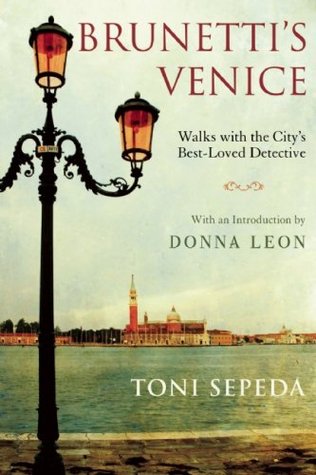
Venice is a city I think I know fairly well, and each of Leon’s novels takes me there on another holiday. An American, she was a Professor of English Literature at Venice University, and she clearly casts herself as Paola, Guido’s wife. What we end up with is a series of novels where the plot is almost secondary, sometimes even thin, but the reader doesn’t mind because there are so many other things to enjoy – the interplay between familiar characters; the politics and society of Venice; Guido and Paola’s own literary preferences; Venetian cuisine; but above all the city itself. There’s even a book of walks called Brunetti’s Venice where you can trace the steps of the great man for yourself. (I’ve done a couple. How sad is that?)

Living in a tourist hot-spot like Edinburgh, you’d think I’d find it easy to weave the city into my books. But there are so many outstanding crime writers who also live here – Kate Atkinson, Ian Rankin and Alexander McColl-Smith to name just three – that I feel rather in awe of their skills. And because writers still have to concentrate on plot, characters, pacing and all the other aspects of a novel, they also have to be careful that describing ‘scene’ isn’t perceived by the reader to be mere padding. That’s especially dangerous if your reader is from your own home city; they probably don’t need to be given a guided tour.

You might not even have heard of Donna Leon, because the only TV series that’s ever been made of Commissario Brunetti’s mysteries was in German. More surprising still, Leon has expressly forbidden her novels ever to be translated into Italian – she’s completely unknown in Venice itself. That might be the secret. The reader needs to feel they’re off on holiday, and it’s not much fun trying to escape in your own town. I think we all learned that during the pandemic.

Thank you so much, Gordon, for this fascinating tour of Italian crime!

Also by Gordon Lawrie:

Self-Publishing: The Total Beginner’s Guide

The Midnight Visitor

The Discreet Charm Of Mary Maxwell-Hume

Four Old Geezers And A Valkyrie

100 Not Out

and more! All available from Amazon and good book shops.

***


Some small happy things – people watching again!

These days it’s quite hard to find something positive in the world. Life is tough. Even 2020 and the onset of covid is enough to fill me with a gentle nostalgia, those seem like fun times compared to right now. But kindness and goodness is not dead and gone, no matter what we read in the media or see on TV. If your mental health is at an all-time low, as many of us are finding, just look around you and you will find small things to make you smile.

Today I saw:

An elderly man ask a young mum struggling with a screaming toddler if she was okay. He wasn’t complaining about the noise. He wasn’t telling her how she should raise her kid. He just asked if she was okay. She said she was, thank you, and told him that her child had just been vaccinated and was crying because of that. But the man’s simple kindness made me happy. Because sometimes we just need someone to ask, right?

And as I was waiting for my other half, a woman–a total stranger–asked me about something I was holding – bird food (as usual!). ‘Is that stuff any good?’ she asked me. ‘Because my sister-in-law bought some for my dad’s garden, and it’s like sawdust. The birds won’t touch it.’

I told her the birds that come to my garden wolf it down like crazy. ‘I’ll get some,’ she said, so I told her where I got mine.

‘It’s a bit pricey, ‘ I warned her.

‘That doesn’t matter,’ she said. ‘My dad’s 96, and watching the birds gives him so much pleasure, it’s worth it just to make him happy.’

Aww. Obviously that small encounter warmed my heart too.

As my mum used to say, good things come in threes–when we got back to our car, the rain had started, and everyone was in a rush to leave. A young dad and very small girl cute in her school uniform, arrived to get into the car next to ours, and the dad said to the little one, ‘We’ve got to get home quick, I’ve left the washing out!’

I smiled. He wasn’t too worried, the child wasn’t being hurried or pushed along, they were just taking life in their stride, calm, relaxed, happy. As I said, small things, nothing earth-shattering, but the mundane minutiae of everyday life. That’s what makes me smile.

Actually there were more than three–the cafe owner where we went stayed back a few more minutes after closing to make a cup of tea for a late customer, an elderly woman. The staff in the shops I visited were cheerful and friendly.

So that was a good day. I had a lovely chatty  lunch with my family, the sun shone (briefly) and I saw at first hand some simple things that showed me that there are good people in the world, and not everything is horrible. And I thought I would tell you.

Next week, I promise, it will be more about writing genre fiction.

***


Autumn brings renewal

I know I say this every year, but for me, it is not Spring, but Autumn and Winter that form my season of creativity. I have no idea why this is. I don’t know why, but for me, autumn is not the season for rest and consolidation, but of flights of imagination taking wings. I get quite excited about the approach of autumn and winter. Maybe it’s the cuddly jumpers, I don’t know.

It seems as though the rest of the world is full of new life in the Spring. Is it because I’m an October baby, my lifecycle naturally goes from Autumn onwards? Or because when we lived in Brisbane, October was in the Spring? But how can five years there undo the habits of the other fifty-six years I’ve lived in the Northern Hemisphere? Or maybe it’s because for parents everywhere in the UK, Autumn is when the children go back to school and you at last get two minutes to sit in silence and just enjoy hearing – nothing. Ah, bliss!

New ideas are taking shape, even before the old ideas have been put to bed. I’m thinking about what I want to say in a new story. I’m having a wonderful time creating book covers, and though I’m struggling to come up with new titles, I have some ideas to mull over.

I’m always drawn to old stuff, I’m drawn backwards into the past. I’m thinking of long print frocks, ladies in beads, feathers in their hair, tea-dances, afternoon picnics on wide sweeping lawns, croquet. I’m thinking of couples dancing on a veranda under the stars, the doors open to let out the soft lamplight and the music from the gramophone. The music is softened by distance and the soft evening breeze ruffles hair.

I’m thinking rural, villagey, fields, water, trees. I’m thinking of sorrow and haunting, of deeds never talked of, of the guilty secrets of the past. I’m thinking of shame and sacrifice, I’m humming old pastoral songs and rhymes, Scarborough Fair, children’s songs and folk songs, ‘Bobby Shafto(e) Went To Sea, He’ll Come Back And Marry me… Bonny Bobby Shafto(e).’ Or the old folk song and pop hit from the 70s, Whiskey in the Jar – ‘When I was going over/the Cork and Kerry mountains…I saw Captain Farrell and his money he was counting…’’

I’m remembering the duplicitous nature of the minstrel, wandering, legitimately able to plant one foot in each camp, never on any side but his own. A useful means for conveying information, often ill-gotten. And he can sing out in public everyone’s secrets, and how can you stop a man doing that?

I’m thinking of myths and legends, hillsides cloaked in mist, an unseen bird calling in the gloom, of the soft insinuating sound of the wind, like a sigh, like a breath, or like a dragon’s terrible approach. I’m thinking about the returning home of the prodigal, how we carry the past with us, inside, even when we are looking forward and moving on, something draws us ever back.

I am thinking, staring at the falling leaves, driven across the grass by a pushing wind, I’m lost in my thoughts. I am thinking of long ago, of people who may not have existed, but who could come into being in my imagination. I see images in my mind, people, objects, places, and weave stories about these imaginary characters.

I am thinking of a man at a window staring out, his mind working on things he cannot put into words. What should he do? Has the time for action finally arrived?

I’m thinking of a woman, always waiting, wringing her hands in front of the window, her own shadow cast out across the lamplit stones of the yard. When will he return? Will he ever return? The waiting woman. The unspeaking man.

I’m thinking of a boy coming over the hill. Of grass, green, long, dewy. Of the sun, soft, golden, gentle as a mother’s hand, just touching his hair, his shoulder of his white cotton shirt. How long has he been away? How much has changed? Will anything ever change?

If I never have another new idea, I’ve already got enough to keep me writing for the next twenty years. I only hope that’s possible.

‘Now fades the glimmering landscape on the sight,/And all the air a solemn stillness holds.’ Thomas Gray’s Elegy.

Autumn – not for sleeping but for creating anew.

***

Doors of the imagination

Believe it or not, behind that silk-covered chair is a silk-covered door which houses a stunning ‘secret’ bathroom built specially for King George V in 1925, and never used by him, because his visit was cancelled.

When is a door not a door?

Ok I know we all know that old joke. But when I was walking around a beautiful country house recently, I was struck (not literally) by all the different styles of door, and I thought about what they could mean.

(I should just quickly add that I was completely convinced I’d written a previous blog post about doors/portals, but after wasting half an hour trying to find it, I’m now convinced it must have been a dream…???)

Doors. The thing is, a door is an everyday piece of equipment, if I can put it like that, and yet it contains the power to take us from one place, from the present, to a different place, the future. We know that when we open a door, we can move from one space to another.  Sometimes it’s as if we were moving into another world.  In fantasy literature, doors are seen as portals or magical spaces of transition.

But even in a country house, the door takes us from one sphere of life to a completely different one, say, from the sumptuous drawing room into a back hallway used purely for the convenience of staff, or from a dusty, intriguing library out into a beautiful garden.

Doors are ordinary, and yet special. In books, or TV shows, or films etc, doors have the power to transform our lives purely because they exist. All the time you and I are on this side of the door, and the door is closed, we can’t be absolutely certain what we will find if we open the door. It might be that we will find dinner is ready and on the table, or we might find a fairytale castle perched on a precarious mountain-top.  A bit like Schrodinger’s Cat, we can’t be sure until we open the door which of the alternatives are actually before us.

What if we can’t even open the door?

What if we find something unexpected, even unwelcome, on the other side of the door?

We won’t know until we open it. And by then, it could be too late.

In real life, we will open the door and find the washing machine has finished our towels, but in literature, in the country of our imagination, we could be anywhere.

Sometimes doors show you not just the next room, but the one after that and the one after that. You are looking through them all at once as if they are a series of views, of points of interest on a tour.

So literature has a lot to tell us about doors, it seems. I’ve only shared a small number of door-related quotes here, if you are desperate, I’m sure you will find more. Or maybe you’ll catch yourself watching a little more closely as the characters in your current reading material or viewing material each have their entrances and their exits, and move on the stage of your imagination. Like me you might be struck by just how often a character moves through a door and ‘something’ happens.

And lastly, I hope you won’t mind me adding my own work into this illustrious company:


***

Marsali Taylor’s The Shetland Sea Murders blog tour

This week, I want to share with you the third in a series of three mystery/crime-genre blog tours to celebrate new books. This week I was honoured to be asked to take part in the blog tour for Marsali Taylor’s new novel The Shetland Sea Murders. This worked very well for me as I’d been planning to read some of Marsali’s work for quite some  time.

Here’s a little bit of what her book is about:

Marsali Taylor returns with the ninth gripping mystery in her Shetland Sailing Mystery series.

While onboard her last chartered sailing trip of the season, Cass Lynch is awoken in the middle of the night by a Mayday call to the Shetland coastguard. A fishing vessel has become trapped on the rocks off the coast of one of the islands.

In the days that follow, there’s both a shocking murder and a baffling death. On the surface there’s no link, but when Cass becomes involved it is soon clear that her life is also in danger.

Convinced that someone sinister is at work in these Shetland waters, Cass is determined to find and stop them. But uncovering the truth could prove to be deadly…

Other reviewers said:

‘Definitely the best of the Cass Lynch series yet!’ 5* Reader Review

‘The beautiful descriptions of Shetland life, traditions, it’s landscape and even language bring everything to life.’ 5* Reader Review

‘This series gets better and better’ 5* Reader Review

‘A beautifully written story, with descriptions so vivid you can smell the sea and beautiful countryside.’ 5* Reader Review

The perfect lockdown read for anyone who longs to be back on the sea.’ 5* Reader Review

My Review

As I said, I’ve been aware of Marsali’s books and planning to read them for some time now. So this was my first experience of this series, and I wasn’t too sure what to expect.

I was a bit worried to begin with because of the boating stuff. A lot of the story takes place or a boat, or has information to do with boats or things like weather and tides etc. I’m a confirmed landlubber. I like to be on a boat, on a nice sunny day, when all I have to do is stand on the deck and daydream, I’m not a ‘storm’s a-coming, haul in the mainsheet’ kind of boater… So I was concerned I would either find the references to boating or shipping or whatever it is (please excuse my ignorance) too complicated or well, boring, actually. But I’m happy to report that when the boating bits became ‘hardcore’ – towards the end of the book – I was gripping my lines and staring into the mist like a true-born shipping type person. It was tense, let me tell you. And I was right there in the midst of it with the spray on my face, hanging on to every word.

This is an absorbing mystery, and chock full of a sense of place. The story is set, as the series title and this book’s title suggest, in and around the Shetland Isles. Everything is described with affection and an attention to detail that just brings it to life. It also helps that there is a glossary of Shetland linguistic phrases at the back of the book.  There is also history, and Girl Power.

The story is also an immersive experience. As the events of the story unfold, you as the reader are drawn into not just the minds of the characters but their lives and relationships too. When you’ve finished, there is that time lapse sense of unreality when you look up and realise you’re not out on the ocean or on a Shetland isle, but in your sitting room snug at home.

I give this book an unhesitating five stars. Highly recommended.

You can find out more about Marsali Taylor and her work on her website:

www.marsalitaylor.co.uk

Or follow her on social media at:

FACEBOOK https://www.facebook.com/MarsaliTaylorAuthor

TWITTER @marsalitaylor

*

#THESHETLANDSEAMURDERS

***