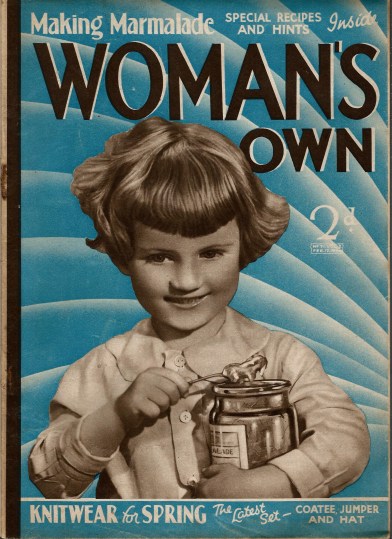
Holiday reading

This week, I’m being spoiled rotten by another kind author’s contribution of a blog post. So I shall immediately, and with gratitude, hand over the reins to Gordon Lawrie:

Gordon Lawrie was a secondary teacher in his native Edinburgh for 36 years until he could no longer resist the challenge of writing a novel. His first awful attempt remains buried undiscovered in a safe place, but a couple of romantic comedies followed before his first crime novel, The Midnight Visitor, appeared in March 2022. In addition, he is the Founding Director of Dean Park Press, which provides services for self-publishing authors, and the editor of the online publication Friday Flash Fiction.

 He has his own website, www.lawrie.info  where you can find lots more embarrassing information about him, as well as a great deal of free stuff to read. He also has a Twitter account: @thesaucers where he sometimes says more than he should about the government of the day, golf, birdwatching and his beloved Hearts football club.

 I’m pretty addicted to crime fiction. I think it might my need for escapism, but I also enjoy being challenged in a non-confrontational sort of way. I’m addicted to Wordle, too.

I’ve written a handful of novels now, some of which have been better than others. What seemed to work best for me was romantic comedy, but there’s little money in romcoms unless Danny Boyle or someone equally famous decides to turn your novel into a smash hit starring Hugh Grant. No, crime fiction is the way to go if you’re trying to make a living from your writing. Crime – whether it’s a detective thriller or a courtroom drama – not only holds out the prospect of a modest income; there’s half a chance someone will try to use the characters to turn your stories into a TV series. That’s why I started to write my DI John Knox/Sister Mary Maxwell-Hume mysteries. Shameless, I admit it.

But be under no illusion, crime writing is hard. There are so many strands to keep track of: the plot, of course; the characters; the pace; maintaining the general suspense; and of course the reader has to feel satisfied by the eventual solution. Ideally, the reader should end up feeling like the detective’s sidekick, wondering how they managed to be so stupid as to miss the giveaway clues that were the key to solving the mystery. Keep your Booker or Nobel Prizes. Writing a crime novel is the true Everest of literature.

Crime writing, though, is far from homogeneous. Readers of Caron’s blog will be familiar with her cosy country-house whodunnits (that’s an official term, not an insult, by the way). Or perhaps you prefer Raymond Chandler-style hard-boiled thrillers, usually told in the first person to allow the writer to make acerbic observations on the social circles in which he – it’s almost invariably a ‘he’ – moves. There’s a whole genre of historical crime fiction, whether it’s Brother Cadfael in a monastery, or the exceptional Bernie Gunther series mostly set during and in the aftermath of Nazi Germany. There are any number of “noir” crime thrillers: Nordic noir, tartan noir, Icelandic noir and so on. Recently, Richard Osman and others have written successful crime novels with comedy overtones. My fellow Edinburgh author Olga Wojtas is currently having lots of success with a bonkers time-travel comedy crime series. Her librarian protagonist is sent back in time to solve assorted mysteries (the latest being to exonerate MacBeth and discover who really killed King Duncan). Janice Hallett’s The Appeal is written entirely in emails and texts. There’s plenty of choice.
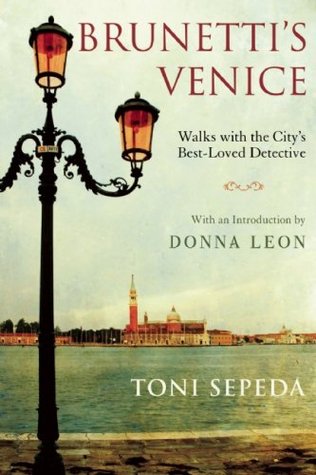
But although I’ll read virtually anything, my all-time favourite crime genre is what I’d term “holiday crime”. Set in some lovely location that I’m either familiar with, or would like to go to, I’m transported there as I turn the pages. I particularly like the ones set in Italy – Andrea Camilleri’s Inspector Montalbano series set in Sicily; Michael Dibdin’s Aurelio Zen set in various cities; but above all Donna Leon’s Guido Brunetti series set in Venice.

Venice is a city I think I know fairly well, and each of Leon’s novels takes me there on another holiday. An American, she was a Professor of English Literature at Venice University, and she clearly casts herself as Paola, Guido’s wife. What we end up with is a series of novels where the plot is almost secondary, sometimes even thin, but the reader doesn’t mind because there are so many other things to enjoy – the interplay between familiar characters; the politics and society of Venice; Guido and Paola’s own literary preferences; Venetian cuisine; but above all the city itself. There’s even a book of walks called Brunetti’s Venice where you can trace the steps of the great man for yourself. (I’ve done a couple. How sad is that?)

Living in a tourist hot-spot like Edinburgh, you’d think I’d find it easy to weave the city into my books. But there are so many outstanding crime writers who also live here – Kate Atkinson, Ian Rankin and Alexander McColl-Smith to name just three – that I feel rather in awe of their skills. And because writers still have to concentrate on plot, characters, pacing and all the other aspects of a novel, they also have to be careful that describing ‘scene’ isn’t perceived by the reader to be mere padding. That’s especially dangerous if your reader is from your own home city; they probably don’t need to be given a guided tour.

You might not even have heard of Donna Leon, because the only TV series that’s ever been made of Commissario Brunetti’s mysteries was in German. More surprising still, Leon has expressly forbidden her novels ever to be translated into Italian – she’s completely unknown in Venice itself. That might be the secret. The reader needs to feel they’re off on holiday, and it’s not much fun trying to escape in your own town. I think we all learned that during the pandemic.

Thank you so much, Gordon, for this fascinating tour of Italian crime!

Also by Gordon Lawrie:

Self-Publishing: The Total Beginner’s Guide

The Midnight Visitor

The Discreet Charm Of Mary Maxwell-Hume

Four Old Geezers And A Valkyrie

100 Not Out

and more! All available from Amazon and good book shops.

***


Some small happy things – people watching again!

These days it’s quite hard to find something positive in the world. Life is tough. Even 2020 and the onset of covid is enough to fill me with a gentle nostalgia, those seem like fun times compared to right now. But kindness and goodness is not dead and gone, no matter what we read in the media or see on TV. If your mental health is at an all-time low, as many of us are finding, just look around you and you will find small things to make you smile.

Today I saw:

An elderly man ask a young mum struggling with a screaming toddler if she was okay. He wasn’t complaining about the noise. He wasn’t telling her how she should raise her kid. He just asked if she was okay. She said she was, thank you, and told him that her child had just been vaccinated and was crying because of that. But the man’s simple kindness made me happy. Because sometimes we just need someone to ask, right?

And as I was waiting for my other half, a woman–a total stranger–asked me about something I was holding – bird food (as usual!). ‘Is that stuff any good?’ she asked me. ‘Because my sister-in-law bought some for my dad’s garden, and it’s like sawdust. The birds won’t touch it.’

I told her the birds that come to my garden wolf it down like crazy. ‘I’ll get some,’ she said, so I told her where I got mine.

‘It’s a bit pricey, ‘ I warned her.

‘That doesn’t matter,’ she said. ‘My dad’s 96, and watching the birds gives him so much pleasure, it’s worth it just to make him happy.’

Aww. Obviously that small encounter warmed my heart too.

As my mum used to say, good things come in threes–when we got back to our car, the rain had started, and everyone was in a rush to leave. A young dad and very small girl cute in her school uniform, arrived to get into the car next to ours, and the dad said to the little one, ‘We’ve got to get home quick, I’ve left the washing out!’

I smiled. He wasn’t too worried, the child wasn’t being hurried or pushed along, they were just taking life in their stride, calm, relaxed, happy. As I said, small things, nothing earth-shattering, but the mundane minutiae of everyday life. That’s what makes me smile.

Actually there were more than three–the cafe owner where we went stayed back a few more minutes after closing to make a cup of tea for a late customer, an elderly woman. The staff in the shops I visited were cheerful and friendly.

So that was a good day. I had a lovely chatty  lunch with my family, the sun shone (briefly) and I saw at first hand some simple things that showed me that there are good people in the world, and not everything is horrible. And I thought I would tell you.

Next week, I promise, it will be more about writing genre fiction.

***


Notebooks as far as the eye can see…

Well, maybe not quite that many, but I certainly have a large number of them!

Like many people I have something of a notebook fetish. Don’t get me wrong, I’ve never (yet) met anyone in a dark alley who has glanced all around, and on me delivering the correct password (‘Narrow feint!’) then proceeded to open their raincoat to reveal notebooks in rows and rows of pockets, but let’s just say we can’t rule it out.

Not that I buy the super expensive ones with the magnetic closure or the little extra pockets at the front and back for – what? I can only imagine it’s more notes??? No, my notebooks are of the strictly practical and affordable type, that way I don’t feel bad for writing line after line of ‘What on earth am I going to write?’ or ‘Day 27: still haven’t written anything’. I am easily intimidated by superior quality notebooks, so I am content with Pukka Pads and Notemakers: good solid notebooks that won’t let you down.

We’ve had a massive clear-out at home recently – in fact we’ve had one large and two small skips outside to take away all our old junk that we’ve hoarded in the loft, the

shed, the various rooms of the house, and bizarrely, in the storage unit under the bed.

You know, ‘decluttering’ can be so addictive, you can end up by throwing out all sorts of stuff you had no intention of getting rid of. But the therapeutic effect of space clearing is so good you just can’t help yourself. I did however, hold on to a small box of old notebooks, because these are full of ‘amazing’ ideas and notes about forensic crime scenes, or how bodies decompose or how to clean up lots of blood that I felt I had to hold on to these ‘just in case’.

Yes, before you ask, I do still have my husband. He did not go in the skip. Neither did any of his toys tools/hobby equipment.

I used to have over 1,000 books in my office–which is really the little boxroom bedroom of our house. They lived on four bookcases. And the floor. And on all the little gaps between the shelves. And on the window sill. And the desk… Now, I only have two bookcases, and after one week, there are still no books on the floor. See, I can be organised! I’m not Marie-Kondo-organised, but let’s just say if you wanted to borrow a copy of A A Milne’s Chloe Marr, it would only take me half an hour of searching the shelves of my two bookcases before I remembered it had gone in the skip because the mould on it triggered my asthma, and all the middle pages were brown and falling out. Yep, it was a really old, falling-to-pieces copy. (Maybe a good excuse to by a new copy?)

(note to self: remember I still haven’t put books in alphabetical order by author’s surname – which is why it takes me half an hour to figure out I haven’t got something particular.)

Small, adorable and not at all annoying quirks of mine: I hate it when I have to divide books by the same author onto separate shelves. Sigh. If only all my Agatha Christie’s could budge up a bit to make room for the four books that won’t fit. It’s like splitting up a family.

Useful and interesting things I recently found in my old notebooks:

Great ideas for band names:

Rumble Bucket or maybe Rumble Pumpkin. I feel their repertoire would be mainly folk songs and the odd medley of Lonnie Donegan songs.

Jamzz – boy band from Nottingham

BizR – boy band from Matlock

Density’s Angels – girl band from Belper

Angel’s Dancities – girl band from Stoke on Trent

Great book titles:

Octavia Splendid and the… (insert name of weird item here) (sounds like a 1950s school story!) ( Or Harry Potter fan fic) (Would also make a great pen name if I was bold enough to go for it!)

A Gripping Madness

Strictly something: Strictly Confidential; Strictly Between Us, Strictly Business, Strictly Prohibited. (But these sound more like erotica titles than mysteries…)

Great pen names to try:

Marjorie Maynard ( I have a feeling she’d write about her time as a nurse during WWII)

Kym Spiers (gender neutral term, I bet she/he/they write fantasy)

Michael P Maynard (Marjorie’s brother, writes westerns but he’s a well-to-do Brit who’s never even been on a horse)

Edvard Spein – def writes Scandi-noir with cringe-inducing sex scenes.

Haralddottirs Dottirsdottir – writes Scandi-noir with no sex scenes, but lots of waves crashing onto beaches and tons of geysers erupting.

There have been some advantages to all this decluttering:

  1. WeBuyBooks sent me some money for the books they agreed to buy from me. Thanks guys!
  2. I now have actual space on my desk, there is room for me to sit there and do work!!!!
  3. I now have an excuse to reclutter.
  4. I feel so much happier now I can see the floor again and remind myself that the carpet is still that yucky beige colour.
  5. There are now only 27 spiders in my office instead of the 346 there originally. Less competition = more flies for everyone.
  6. I can reach the window. This will probably lead to the arrival of more spiders.

Marie Kondo might not be proud of me, but at least she’d have to admit I gave it my best!

But I still prefer to sit in a caff and stuff my face whilst pretending to write

***

Autumn brings renewal

I know I say this every year, but for me, it is not Spring, but Autumn and Winter that form my season of creativity. I have no idea why this is. I don’t know why, but for me, autumn is not the season for rest and consolidation, but of flights of imagination taking wings. I get quite excited about the approach of autumn and winter. Maybe it’s the cuddly jumpers, I don’t know.

It seems as though the rest of the world is full of new life in the Spring. Is it because I’m an October baby, my lifecycle naturally goes from Autumn onwards? Or because when we lived in Brisbane, October was in the Spring? But how can five years there undo the habits of the other fifty-six years I’ve lived in the Northern Hemisphere? Or maybe it’s because for parents everywhere in the UK, Autumn is when the children go back to school and you at last get two minutes to sit in silence and just enjoy hearing – nothing. Ah, bliss!

New ideas are taking shape, even before the old ideas have been put to bed. I’m thinking about what I want to say in a new story. I’m having a wonderful time creating book covers, and though I’m struggling to come up with new titles, I have some ideas to mull over.

I’m always drawn to old stuff, I’m drawn backwards into the past. I’m thinking of long print frocks, ladies in beads, feathers in their hair, tea-dances, afternoon picnics on wide sweeping lawns, croquet. I’m thinking of couples dancing on a veranda under the stars, the doors open to let out the soft lamplight and the music from the gramophone. The music is softened by distance and the soft evening breeze ruffles hair.

I’m thinking rural, villagey, fields, water, trees. I’m thinking of sorrow and haunting, of deeds never talked of, of the guilty secrets of the past. I’m thinking of shame and sacrifice, I’m humming old pastoral songs and rhymes, Scarborough Fair, children’s songs and folk songs, ‘Bobby Shafto(e) Went To Sea, He’ll Come Back And Marry me… Bonny Bobby Shafto(e).’ Or the old folk song and pop hit from the 70s, Whiskey in the Jar – ‘When I was going over/the Cork and Kerry mountains…I saw Captain Farrell and his money he was counting…’’

I’m remembering the duplicitous nature of the minstrel, wandering, legitimately able to plant one foot in each camp, never on any side but his own. A useful means for conveying information, often ill-gotten. And he can sing out in public everyone’s secrets, and how can you stop a man doing that?

I’m thinking of myths and legends, hillsides cloaked in mist, an unseen bird calling in the gloom, of the soft insinuating sound of the wind, like a sigh, like a breath, or like a dragon’s terrible approach. I’m thinking about the returning home of the prodigal, how we carry the past with us, inside, even when we are looking forward and moving on, something draws us ever back.

I am thinking, staring at the falling leaves, driven across the grass by a pushing wind, I’m lost in my thoughts. I am thinking of long ago, of people who may not have existed, but who could come into being in my imagination. I see images in my mind, people, objects, places, and weave stories about these imaginary characters.

I am thinking of a man at a window staring out, his mind working on things he cannot put into words. What should he do? Has the time for action finally arrived?

I’m thinking of a woman, always waiting, wringing her hands in front of the window, her own shadow cast out across the lamplit stones of the yard. When will he return? Will he ever return? The waiting woman. The unspeaking man.

I’m thinking of a boy coming over the hill. Of grass, green, long, dewy. Of the sun, soft, golden, gentle as a mother’s hand, just touching his hair, his shoulder of his white cotton shirt. How long has he been away? How much has changed? Will anything ever change?

If I never have another new idea, I’ve already got enough to keep me writing for the next twenty years. I only hope that’s possible.

‘Now fades the glimmering landscape on the sight,/And all the air a solemn stillness holds.’ Thomas Gray’s Elegy.

Autumn – not for sleeping but for creating anew.

***

Doors of the imagination

Believe it or not, behind that silk-covered chair is a silk-covered door which houses a stunning ‘secret’ bathroom built specially for King George V in 1925, and never used by him, because his visit was cancelled.

When is a door not a door?

Ok I know we all know that old joke. But when I was walking around a beautiful country house recently, I was struck (not literally) by all the different styles of door, and I thought about what they could mean.

(I should just quickly add that I was completely convinced I’d written a previous blog post about doors/portals, but after wasting half an hour trying to find it, I’m now convinced it must have been a dream…???)

Doors. The thing is, a door is an everyday piece of equipment, if I can put it like that, and yet it contains the power to take us from one place, from the present, to a different place, the future. We know that when we open a door, we can move from one space to another.  Sometimes it’s as if we were moving into another world.  In fantasy literature, doors are seen as portals or magical spaces of transition.

But even in a country house, the door takes us from one sphere of life to a completely different one, say, from the sumptuous drawing room into a back hallway used purely for the convenience of staff, or from a dusty, intriguing library out into a beautiful garden.

Doors are ordinary, and yet special. In books, or TV shows, or films etc, doors have the power to transform our lives purely because they exist. All the time you and I are on this side of the door, and the door is closed, we can’t be absolutely certain what we will find if we open the door. It might be that we will find dinner is ready and on the table, or we might find a fairytale castle perched on a precarious mountain-top.  A bit like Schrodinger’s Cat, we can’t be sure until we open the door which of the alternatives are actually before us.

What if we can’t even open the door?

What if we find something unexpected, even unwelcome, on the other side of the door?

We won’t know until we open it. And by then, it could be too late.

In real life, we will open the door and find the washing machine has finished our towels, but in literature, in the country of our imagination, we could be anywhere.

Sometimes doors show you not just the next room, but the one after that and the one after that. You are looking through them all at once as if they are a series of views, of points of interest on a tour.

So literature has a lot to tell us about doors, it seems. I’ve only shared a small number of door-related quotes here, if you are desperate, I’m sure you will find more. Or maybe you’ll catch yourself watching a little more closely as the characters in your current reading material or viewing material each have their entrances and their exits, and move on the stage of your imagination. Like me you might be struck by just how often a character moves through a door and ‘something’ happens.

And lastly, I hope you won’t mind me adding my own work into this illustrious company:


***

More vintage magazines for women

Last year I posted a couple of articles about women’s magazines from the 1930s. (If you missed them, you can find them here.)

Over the last two weeks I’ve been fortunate enough to acquire two more vintage magazines aimed directly at women. what impressed me about these was first of all, that this magazine – Woman’s Own – is still in circulation and massively popular today. The second thing I noticed is that there really isn’t a lot of difference between the WO of 1934 and those of 2021.

Have women’s concerns changed very much in 90+ years? I’m not sure they have. for many women, the home and family is still one of the most important things in life, and I’m not saying that in a patronising way, nor ignoring the fact that women today have many more opportunities to have a career, and that the concept of ‘the family’ is miles different – and rightly so – to that of the 1930s.

But at rock bottom, many women are interested in and still worry about how to care for, manage or improve their relationships, their attractiveness, their budget, and their partners and children.

My Woman’s Own mags are from Feb 1934 and this week’s copy – by chance I nabbed a ‘diet special’. Here are a few snippets that struck me as interesting:

Hubby Management: It’s the wife’s job to make her home as welcoming as possible to induce the man (and man ONLY!) to stay at home instead of going out gallivanting. tips are given on how to do this, though the mags expert – whoever that was, possibly (we don’t know!) a bloke – comments that some men will always stay out and shouldn’t get married in the first place. Too late if you’ve got one of those, girls!

We have the readers’ letters, essentially a problem page. My faves are ‘should cousins marry?’ (Surely they know the answer to that?) and the ‘worried wife’ letters. I feel for the worried wife. She knows exactly what the answer will be but doesn’t want to admit it. Poor woman. Did she sling him out? Or – as I feel is more likely – did she just suffer in silence?

There’s a load of fashion tips and ideas, mostly, I was interested to note, clothes you could make at home. This magazine is aimed at the upper working class and lower middle class, women who have a little money but not enough to buy off-the-peg items and certainly not bespoke. ‘Home economy’ was one of the watchwords of the day, and it included apparel.

I personally think this looks absolutely horrid, and a cross between a Christmas panto costume and something out of Red Riding Hood. This one below is slightly nicer, but again, still all your own work.

Although the models in the designs look about 35 to 40, in fact some of these are aimed for teenagers from 14 years of age. not much difference in those days between what mums and their daughters were wearing.

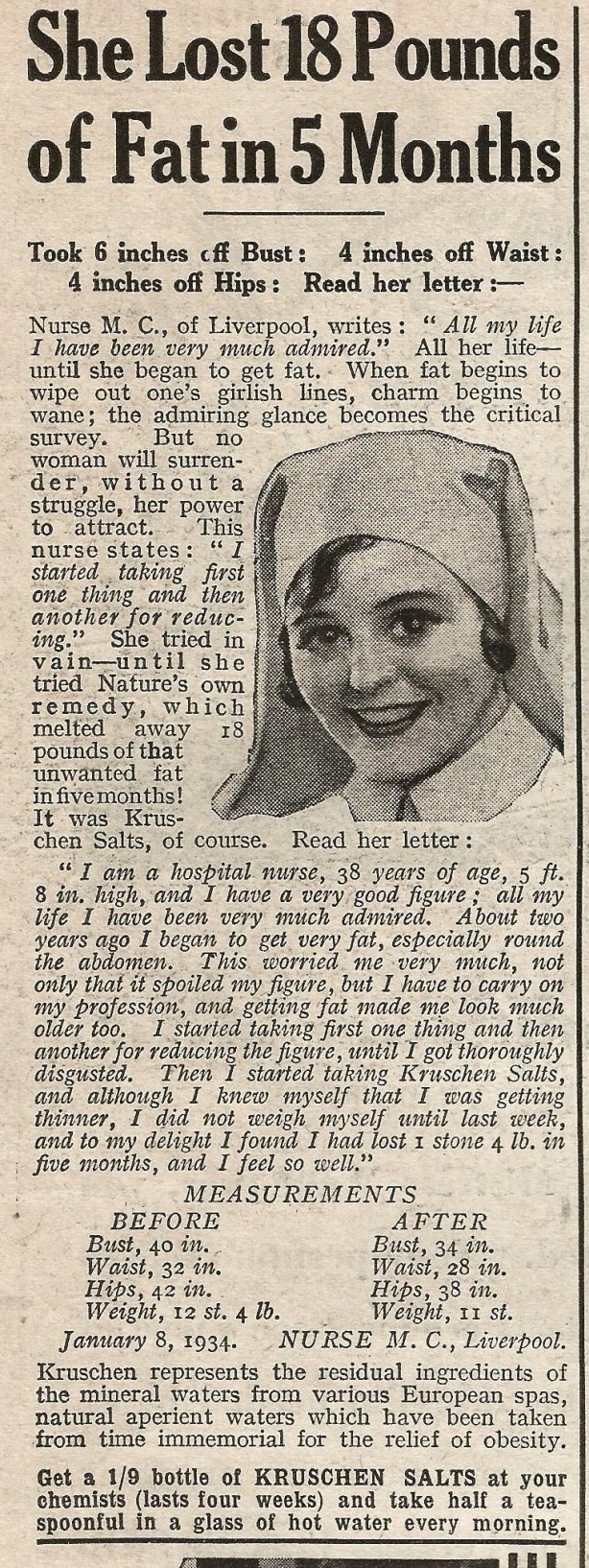
And of course, the eternal battle with the scales. I was interested to see things haven’t changed much here either, although some of our modern ingredients – chorizo and the whole gluten-free plan would have been completely alien to women of the 1930s.

Looks like this lady – a nurse, not a nun as I first thought – was following the crap-yourself-thin diet. 18lbs was a good result! Was she just a bit constipated after Christmas? All those mince pies…

Looking good appears to be a perennial issue for many women. We want to keep our looks as long as possible, after all, and keep ourselves in good condition. So I suppose it’s not surprising magazines for women contain so many hints, tips and advice. With the growth of city populations, the expansion of the suburbs, many women would have been cut off from their usual channels of information: mothers, grandmothers, aunties. Equally, magazines adopt a sisterly or motherly tone to offer the advice so desperately needed in those times. Today, magazines are more likely to have a friendly, conversational tone, inviting you to confide and share like a friend coming alongside to offer a sympathetic ear.

I’m in awe of the fact that this magazine has been around so long. It’s fascinating to read that the same ideas preoccupied women before my mother was born, as they do now. We may have Smartphones, the Internet, Netflix and Just Eat, but at the end of the day, we still want to look good, feel good, and keep our man where we can see him.

***


Persistence is futile – I mean – essential


I think I may have written about this topic before, but I feel it’s one of the most under-estimated skills any writer can have. (Persistence, I mean, not repeating yourself, I do that all the time. Actually that is useful too, for helping me to remember things through repetition…)What is persistence?

To me persistence means a dogged determination to the point of stubbornness to keep going, overcome resistance in yourself and the world around you, to press on towards a goal you have no tangible proof you will ever reach. It means turning your back on discouragement, detractors, self-doubt (which most writers have in abundance?, laziness, weariness, even pain and illness to MAKE yourself achieve something specific or reach a certain goal.

The scariest moment is always just before you start. After that, things can only get better.”
― Stephen King, On Writing: A Memoir of the Craft

Why is persistence a useful tool to have in your arsenal? What does it contribute to your life or work?

Persistence:

  • is character-building – you come to realise you are capable of more than you may have believed initially.
  • is prioritising – you realise that the most important things in life don’t come without you working hard for them.
  • you learn to persevere, and build resilience and inner strength.
  • you learn to trust yourself and believe in yourself.
  • you come to value the results of your hard work.
  • when times are tough, you have previous experience to draw on to get you through.

How to be persistent:
  • Eat well, sleep well, take care of yourself, allow yourself down-time.
  • Develop a routine. Routines can enhance creativity, rather than block it or stifle it. A routine means you are mentally prepared at a certain time to undertake a specific task. that means half the work is done already!!
  • Keep a journal to record your feelings, even the negative ones. Allow yourself to rant or wail if need be. Don’t forget to record your successes, though, as these will keep you going during tough times when you feel like nothing is working.
  • Talk to people who understand and support you. You don’t need to be alone in the middle of your struggle.
  • Set manageable goals, even if it means doing a larger number of smaller tasks rather than a few big tasks. Breaking a large task or goal into small pieces is the key approach. By chipping away at a large task bit by bit you will make progress – it may not be easy to see the results right away but it is easier to work this way in the long haul, and achieving many small goals is excellent for your confidence. This is also a great way to talk yourself into tackling what feels like an impossible or overwhelming job.
  • Don’t listen to your negative thoughts. Learn to recognise then ignore your inner critic who tells you things like: ‘this is a waste of time’, ‘you’ll never be good enough’, or ‘it’s too hard for you’, and that old favourite, ‘not everyone is destined to succeed’. This is probably the hardest thing to overcome, and really requires you to laugh at the inner voice or negative thought and say ‘so what, I’m going to do it anyway.’
  • Roll up your sleeves, grit your teeth, and get on with it. Don’t wait until you are ‘in the mood’ or feel inspiration strike. Nine times out of ten, inspiration waits for you to make the first move. Show the universe – and yourself – that you are going to do this.
  • Reward yourself and feel proud of your achievements. And don’t whatever you do, punish yourself if you feel you have fallen short of your goal. Remember too that pride in a job well done is not a sensation that you necessarily get right away. If you have been engaged for a long time on a demanding project, it can take quite a while to recover, then feel a sense of satisfaction. Be patient, be kind to yourself.

Basically persistence is being super stubborn, and refusing to give in or back down. Find what you want to do and do everything in your power to do it.

Just remember, you can do anything you set your mind to, but it takes action, perseverance, and facing your fears.

Gillian Anderson

***


Reblogged: I am interviewed at Maureen’s Lifestyle

Many thanks to Maureen Wahu at Maureen’s Lifestyle for this interview following her review of The Spy Within: Dottie Manderson mysteries book 6 last week.(you can check out the review here)

Caron Allan Interview

What inspired the Dottie Manderson series?

I’ve always loved the glamour of Golden Age mysteries, and so I wanted to try my hand at something like that. But I wanted to have a young protagonist as most of the books I’d read had older, spinster ladies as detectives. But I didn’t want to write anything too sweet, or too separate from the real world. So in my books, yes, there is glamour and romance, and the bad guy or gal always gets caught (though sometimes not immediately) but there is also heartbreak and the harsh reality of life not being easy, especially as my chosen era of the 1930s is so close to the war.

What is the hardest part of your writing career?

I suppose it’s juggling all the different aspects of being a writer in today’s world – the social media, obviously, I know everyone says they struggle with that, but also all the technical things – covers and document formatting, creating promotional materials, then remembering to share them, setting up a blog and remembering to create something new most weeks. And then remembering to do actual writing too, and stick to my deadlines. So much to do!

Would you ever use a pseudonym?

I always use a pseudonym. In fact have have several, but the only one that I’m using at the moment is Caron Allan. I wanted to use a pen name because to begin with, it gave me the space and privacy to completely mess up without feeling ‘exposed’. And also, I felt my real name was dreary and unromantic!

When writing a series how do you determine where a book should end and it’s sequel should start?

It’s not always easy, and I’m not very good at it, but fortunately because I write mysteries, that kind of gives a natural end, when the perpetrator of whatever dastardly deed is unmasked and taken away in handcuffs, or however they exit the story, it seems right to just have a short wrap-up and end the book. Though I do have ongoing story-lines – mainly the romantic side of things – that continue through the books and aren’t resolved immediately. In book 1 Dottie, my protagonist, is only 19. I think 19 in the 1930s was a lot younger than 19 today in many ways, and so we see her growing and maturing through the books, coming to understand the world, and relationships, but she is very idealistic and so she can be led by her emotions, and is sometimes bruised by life. She’s not perfect, she’s on a journey, and I like that about her. I don’t want to read about or write about a heroine who doesn’t change, and especially one who doesn’t have depth and dimensions to her character.

Who were your biggest critics and cheerleaders in writing this series?

My family are a huge support, my daughter especially is a massive practical help as well as my cheerleader, as writer herself she knows where I’m coming from. I have a couple of very special friends who are also writers and who are so helpful and encouraging.

If you could go back in time which historical figure would you like to meet?

Oh dear, that’s quite hard. I know we’re always supposed to say Marie Curie or someone incredible like that, but maybe just meet my great great grandmother? How did she cope in the late nineteenth and early twentieth century with all the domestic responsibilities and none of the labour-saving devices we have today? Plus she had six kids, and i only had two, so I am in awe of the women of that era. I’d like to meet Agatha Christie, and Patricia Wentworth when they were in their story-writing heyday, and get as many tips as I could, and also express my admiration for their work.

What should we expect from your upcoming series?

Well I will continue my Dottie Manderson mysteries: Book 7, Rose Petals and White Lace will be out around November 2021. In this book, we will see Dottie trying to find out who wants to get a local tea-shop closed down, and why. It’ll be a gentler mystery for Dottie after the previous couple, but nevertheless there will be at least one fatality, and if you’re not a fan of creepy-crawlies, this might not be for you!
I also will be launching a new series, set in the 1960s this time, and featuring the daughter of Dottie’s sister as the detective-protagonist – these will be the Miss Gascoigne mysteries, and begins with A Meeting With Murder. Diana Gascoigne has been ill and goes to the coast for some good sea air to recover, but obviously there are dire doings afoot and she will want to find out who killed an elderly disabled woman. the Diana books will be a little different to the Dottie books, as we know, the 60s were a time of growing freedoms especially for women, and Diana is not an ingenue like Dottie, but a little older, a little wiser and more aware of the difficulties that a woman can face, and she wants independence and more autonomy in her life. But she has the same determination to seek justice and truth.

Would you ever consider writing a biography of your life?

LOL, that would be so boring! I’m not adventurous or glamorous and I’ve done very little with my life other than sit with cats reading or writing. I really don’t think it would sell!

Do you ever experience writer’s block? Sometimes. I don’t agree that it’s not a real thing. I usually find it stems from discouragement, fear or being overtired. I tend to push myself, and I’m always thinking of plots and story ideas, so I get quite mentally tired, and don’t always remember it’s okay to just do nothing and relax. Maybe I need to watch my cats even more than I do! I find rest, music and mundane chores help.

How can your fans reach you and connect with you?

I can be found on twitter: @caron_allan or instagram: @caronsbooks or through my blog, caronallanfiction.com and I’m also on Facebook, but I have to confess I don’t go on there very much, I’m more of a Twitter person.

Find all of Caron Allan’s books on Amazon.

Thanks for stopping by!

Thank you, Maureen, it was fun!

***


Alliteration and her sisters 

Round the rugged rock the ragged rascal ran. (rock not included)

Round the rugged rock the ragged rascal ran.

We all know that one, don’t we? Though I usually get rugged and ragged back to front. I have to remind myself that whilst a rascal can be rugged or ragged, a rock can pretty much only be rugged.

As we learned in junior school, alliteration is putting together words with the same initial letter. In the case of the above phrase, R, the pirate’s favourite letter.  This repetition is the foundation of our childhood tongue-twisters. English is not the only language to have these:

French ones:

Les chaussettes de l’archiduchesse, sont-elles sèches? Archi-sèches. (translation: The archduchesses socks: are they dry? Very dry.)

Ces cerises sont si sûres qu’on ne sait pas si c’en sont. (translation: These cherries are so sour, we’re not sure if they are (cherries).)

German ones: 

Schnecken erschrecken, wenn sie an Schnecken schlecken, weil zum Schrecken vieler Schnecken Schnecken nicht schmecken. (translation: Snails are shocked when they lick snails because to the surprise of many snails, snails don’t taste good).

Der Grabengräber gräbt die Gräben. Der Grubengräber gräbt die Gruben. Graben Grabengräber Gruben? Graben Grubengräber Gräben? Nein! Grabengräber graben Gräben. Grubengräber graben Gruben.  (translation:  The gravedigger digs graves. The ditchdigger digs ditches. Do ditchdiggers dig graves? Do gravediggers dig ditches? No!
Gravediggers dig graves. Ditchdiggers dig ditches.)

So now you know! Feel free to use these at virtual-parties, to amaze and impress your friends.

Amuse your cat with a large repertoire of tongue-twisters in various languages…

Alliteration can be a useful literary device when writing, and like most literary devices, it is used to make the reader feel, view or interpret your writing in a particular way by creating a mood or appearance. But use it sparingly. The problem with any literary device, is that all too easily it can draw attention away from what you’re writing and turn the focus to how you’re writing. This will distract your reader from your story in the same way you can sometimes fail to see the puppet-show because you’re focusing on the strings.  Having spent all that time gently leading the reader to suspend disbelief, you don’t want to ruin things by breaking the spell now.

Here are a few more literary devices:

Sibilance is the repeated use of an S sound, or a hissing sound. You put together words with lots of S, SH and soft C sounds: Sid’s silly scented snake slithered smoothly across the shiny façade. Unlike with Alliteration, the repeated sounds don’t have to be confined to the beginning of the word.

Assonance is the repeated use of vowel sounds: cut jug, heed beat,   or the same or similar consonants with different vowels: jiggle juggle, dilly-dally.

Consonance is the repetition of matching consonant sounds: ruthless cutthroats, repeated reports. It can quickly descend into Alliteration if only the initial letter(s) are repeated!

”A soldier’s life is terrible hard,’ said Alice.’

These are used to create a certain mood, or an attitude, or making the reader see a character or setting in a particular way. These can also imbue your writing with a poetic or lyrical quality. You might want your readers mesmerised by a particular scene if you are going to follow it with something spectacular: the calm before the storm effect.  Think of movies where there is a soft love scene before the hero goes into battle.

In fact most poetry contains one or more of these devices. Think of Wordworth’s poem I Wandered Lonely As A Cloud, with all the repeated Ls, the Hs, the Ds, the long vowels of wandered, lonely and cloud.  Or  Buckingham Palace by A A Milne, with its repeated lines and rhyming words. 

Or in this, one of my favourite short poems, there is a clever mixture of all these devices – see if you can spot them!

Song by Christina Rosetti 

When I am dead, my dearest

Sing no sad songs for me;

Plant thou no roses at my head,

Nor shady cypress tree:

Be the green grass above me

With showers and dewdrops wet;

And if thou wilt, remember,

And if thou wilt, forget.

I shall not see the shadows,

I shall not feel the rain;

I shall not hear the nightingale

Sing on, as if in pain:

And dreaming through the twilight

That doth not rise nor set,

Haply I may remember,

And haply may forget.

These literary devices can have a unifying effect, making all parts fit together with a repetition of shared letters and sounds, or by ensuring the reader remembers certain sounds or words. But like all good things, in prose it needs to be used in moderation.  Don’t make your writing just a collection of tongue-twisters!

***

The reading writer or the writing reader

We are surrounded by words. They are there on the side of your breakfast cereal packet, full of persuasive ideas or nutritional information. They are on the wall of the lift as you make your way from car park to shopping mall. ‘In case of emergency DO this or DON’T do that…’ They are on our clothes – a logo, a designer’s name; they are on the label – how to wash the garment, the size, the fabric constituents.

As I say, we are surrounded by words. We as humans have come a long way from the days when we communicated through pictures. The concept of communication fascinates me. Why do we communicate? Is it to know our allies from our enemies, or to form friendships, assist pair-bonding, or create a safe environment for our children? We developed words because if a buffalo or something similarly huge is rushing towards you, no one’s got time to whip out a slate and chalks to create a nice little scene to indicate the usefulness of running away. So words are more efficient, maybe.

But words change us. From our earliest days on the planet, gazing fondly at our mothers, we learn words. We learn how to physically say them by watching and listening, and we learn what they mean by observing consequences and effects.

We connect not just words together to form a sentence, but ideas together to create a narrative or story. We might hear the words, ‘Let’s go to the mall’, but what we really hear are ideas based on prior knowledge of that as a situation. ‘Let’s go to the mall’ becomes a narrative: ‘Let’s go to the mall – where we will walk about the shops, talking as we go, laughing and enjoying being together, and discussing life issues or relationships, or personal goals and dreams, where will we notice and comment on the latest trends, where we will exchange currency (or more likely swipe a small piece of plastic) for new goods, that we can then take home and discuss at length, creating a new shared experience. Whilst at the mall we will likely go and get some food somewhere, so it will become a social event, we will sit and eat, and talk some more, possibly on a deeper emotional level, and this day will become part of our shared memories and we will often revisit the occasion in our thoughts, and enjoy the time over and over again, and the whole experience from beginning to end will enhance our relationship and sense of closeness.’

It doesn’t always work like this. Sometimes we have a row as soon as we get there, sulk all the way round the shops and come home later frustrated and disappointed, still in a frosty silence. The great tapestry of human experience!

Where am I going with this? It’s just this: simply, words are key to the storytelling of human life, whether an ordinary trip out to buy new jeans, or whether we are sitting curled up in our favourite armchair reading words on a pages, pages bound together in one book, a book enclosed by a hard or soft cover, possibly enhanced with a relevant image on the front.

This is not the first time I’ve pondered on the weird and truly wonderful impact of words on my life. At the moment I’m wrestling with the final edit of my novel The Spy Within, (coming soon to an internet store near you), but I’m making time to read. In the last few weeks I’ve read my dear friend Emma Baird’s romance, Highland Chances, and another good friend’s Paul Nelson’s Cats of The Pyramids, yet another writer friend’s book Undercover Geisha, by Judith Cranswick. I’m now reading Mary Stewart’s The Wind Off The Small Isles, as well as P G Wodehouse’s A Damsel In Distress, and dipping in and out of non-fiction books: The Great British Bobby by Clive Emsley, and The 1960s fashion sourcebook by John Peacock. 

Each of these books will leave a lasting imprint on my life. I’ve blogged before about how what we read–especially when it’s something we love–leaves its mark on our soul, a fragment of its written beauty that will see us through the hard times. And this year has been one of hard times, hasn’t it? I think in the coming months we will all need as many beautiful phrases, sweet or witty situations, dastardly intrigues and happy-ever-afters as we can get our hands on.

Happy reading!

***