The bath that came in from the cold: the rise of the modern domestic bathroom: part 2

A baby bath now used for logs for the fire

I’ve been re-reading a great book about domestic life: ‘If Walls Could Talk: An Intimate History of the Home’ by Lucy Worsley. I highly recommend this book for a fascinating, very accessible history of the home. Of bathrooms she says, ‘Bathrooms are now…the only rooms…with a lock on their doors, yet the activities that take place within did not always require privacy’.

The full immersion of the body into water was more of a ritual for spiritual purposes or for political allegiance than it was to do with getting clean. Soldiers would cleanse themselves before going off to the crusades – it was a setting aside of the physical and the spiritual self for the express purpose of going into battle for God. Knights bathed before receiving the    conveyed upon them.

The concept of a room set aside (more or less) for the sole purpose of cleansing the body is a relatively new one. Previously, bathing was a communal, social activity. In the medieval times, both sexes enjoyed bathing in public bathhouses. It was not done to cleanse the body but for fun and relaxation. You could even get a meal sent in to you, and a few pints of ale from a nearby inn. Unfortunately the bathhouses where you could bathe, drink and be merry rapidly acquired a reputation for naughty sexual shenanigans, and it wasn’t long before bathhouses became brothels, pure and simple. There were other concerns too: sharing water with a large number of other people meant that bacteria lurked, and bathing became more likely to infect your body, not less. Bathing began to be regarded with suspicion and distrust, and consequently, people stopped doing it.

This gave rise to the private wash in the bedroom. We have probably all seen the large jug sitting in a matching china bowl on a washstand, a vital piece of furniture. Hot water was carried up from the fires of the kitchen or scullery by panting maids who must have had biceps and shoulders like a modern action movie hero. These days we still see these jug sets in homes, guest houses and boutique hotels, no longer for daily use but for decoration, used to convey a sense of homely comfort and traditional values.

But with bathing out, the emphasis was on the wearing of clean clothes. Underwear was invented, and it became the norm to change the clothes more often. Washing was done in the dim recesses of the servants areas of the large country house, with households employing one, two or sometimes a whole team of laundresses for this particular work. Labour was cheap, clothes were not.

And it wasn’t all about the nasty germs that you might pick up from bathing, nor about having enough staff to fill a bath or run up and down with hot water. From the middle of the nineteenth century more than half of Britain’s population were living in cities. The sheer logistical demands of bringing fresh, clean water into the cities was a nightmare. Remember these places still had open sewers until the beginning of the 19th century. Water, when piping began, was often rusty, or tainted, or just not available due to the inefficiency of the system or the lack of proper distribution. Piped water was often only available at set times, so households had to either manage without, or get used to collecting and storing it until needed. This all required management and planning.

But from the Regency period onwards bathing, at home and beyond, again began to be seen as an important part of everyday life across all social strata. If you watched the new adaptation/reimagining of Jane Austen’s unfinished work, Sanditon on TV recently, you would have enjoyed the sight of gorgeous young men emerging from the sea after a swim – naked, of course, but perilously close to where the ladies are bathing from bathing machines in a ridiculous array of clothing to swim in. In Jane Austen’s wonderful work Pride and Prejudice, the precocious Lydia says, ‘I’m sure I should love to go sea-bathing,’ whilst her mother responds with ‘A little sea-bathing would set me up forever.’

There were still concerns about the dangerous effects of the action of the sea having a stimulating effect on women in particular, as ‘everyone’ knew that women were hysterical creatures at the best of times, and any kind of physical enjoyment was to be strictly controlled. I wonder if the birth rate went up nine months after a trip to the seaside? I guess that depends on whether or not ladies spotted someone like Sidney Parker (aka Theo James!) ambling out of the sea with not a stitch on.

Jane Austen’s works are so popular these days.

In Northanger Abbey, Catherine Morland travels to Bath with Mrs Allen to take the waters for their health, and in doing so, they are participating in the huge trend that was sweeping the nation: it was once more a good and healthy thing to do, not to mention a vital aspect of the social calendar for the well-to-do. To go to Bath, to see and be seen in the various rooms of the spa was on everyone’s to-do list. Science – or natural philosophy as it was then called – touted the benefits to mind, body and spirit of warm water containing salts and minerals. They didn’t just bathe in it, either. It was drunk by the pint.

But what if you were too poor to be able to be seen at a trendy spa?

The poor, or even middling wealthy, could of course, always swim in the sea, or lakes and rivers, and were arguably less at risk of the rapid rise and fall of fashionable opinion. New coastal resorts sprang up from the Regency era onwards, and from the middle part of Victoria’s reign the railways took even the less well-off to the coast for a day’s relaxation, walking swimming and sandcastle building. But even at home, the tin bath would come out and be filled with hot water for getting off the week’s grime and starting a new week fresh and clean. Ish.

Faith played a part here. Religion determined your bath night. Did you believe that Sunday or Saturday was the sabbath? Was the start of the new week Sunday or Monday for you? Because that dictated which day of the week your family had their weekly bath. For many, the end of the week was Sunday, and that was bath night, but there were large numbers for whom Saturday was the last day of the week and Sunday the first, so they had their bath on a Saturday night. Scandanavian languages still carry this concept in the everyday word for Saturday – in Swedish it’s lördag, in Danish and Norwegian it’s lørdag, and in Icelandic it’s laugardag (which is the closest to the language of origin). But they all mean the same – pool or bath day. There was also a sense that bathing was a social duty – one had to consider the people aroudn one, and the idea of smelling bad to others was abhorrent.

That long ditch in the middle of the street is the communal open sewer

For most people who were brought up C of E (Church of England/Anglican) Sunday remained the day when you had your weekly bath. And there was a strict order to who got to have the bath: starting with either the eldest or the ‘man of the house’ or main bread-winner (usually all three would have been the father of the family), and proceeding down the chain to the youngest. All using the same water. Can you imagine the state of the water by the end? There is a reason we have an old saying ‘Don’t throw out the baby with the bath-water.’ I’m guessing the water was so murky it would be hard to tell if anyone was left in there, though I sincerely hope no mother would accidentally leave her baby int he water and forget about it. (Said the woman who once took a picture of her baby in her new coat, then left the house, and was halfway into town before remembering the baby was still lying on the sofa… sorry, Darling!)

In 1918, a law was passed in Britain to the effect that all new houses had to have hot and cold running water to a bathroom. But of course, this had no impact on the millions of older homes. Only as finances allowed would bathrooms be added to the terraces and villas across the nation. These days if you buy a Victorian home, you will find either a bedroom or two have been sacrificed to provide bathrooms, or a bathroom has been added on as a built extension to the back of the house, often downstairs.

Fast forward to the Second World War, and hot water was rationed – or rather the coal that was usually the means of heating it, and individuals were only supposed to use a depth of four inches of water per day in their baths. I’m not sure how anyone hoped to regulate this, or how much it contributed to the war effort, but like a lot of things at that time, it gave the community as a whole a sense of ‘doing our bit’ and made people think they were helping their nation to win the fight.

So that’s it, from there we went to actual baths in actual designated bathrooms, and the concept of a daily shower quickly became a normal part of our cleansing ritual.

I want to close with this lovely item. I took this picture at Calke Abbey, Derbyshire. It’s a portable or travelling shower bath. The bamboo supporting canes can be removed, and the water tank at the top taken off, so that the traveller is left with conveniently-sized separate sections that can be readily reassembled on arrival at the destination. Always supposing you haven’t left vital screws, nuts or bolts etc on the dining room table at home. I like to think of it as a kind of IKEA device, with a Scandanavian-sounding name. Maybe The Lördag?

next week – the loo!

***


The rise of the domestic bathroom: My childhood in the 60s

As you will know if you’ve been to this blog before, I’m a bit of a history nut, and in particular I love the history of the private home. I mainly write mysteries set in the 1930s, although I set my books in other eras too from time to time.

But the few short years between the World War I and World War II bewitch and intrigue me. These were the years that really created the world as we know it now, and the legacy of those years is still widely felt and experienced today. (To read a bit more about how I see this era, please click on this link to read a blog post from last year)

Because of my daft preoccupation with the first part of the twentieth century, I visit a lot of English country houses and I take LOADS of pictures. I’m particularly interested in the more ‘basic’ aspects of life. I want to know about how meals were created, how houses and clothes were cleaned, and how people cleaned themselves. So I thought I’d tell you a bit about my childhood, and also next week, a bit about the rise of the modern domestic bathroom.

I was born in 1960 in the South of England. Contrary to many peoples’ view, this was not a time of universal comfort and modernisation. Not that I was particularly aware of it as a child, but looking back now, I can see we were very badly off by modern standards. Yet we were not alone, and I doubt if our experience was a rare one.

From when I was about three, or a little younger, we lived in what can only be described as a bedsit, though in those days we gave it the grander name of a one-room flat. Mum and I slept, cooked, and relaxed in that one room in an old house, with many other such rooms. If you read books written in the 40s, 50s and 60s, you will often come across mention of these grand old houses gone down in the world and divided up into flats or bedsits. Larger private homes became unmanageable without a staff to run them, and after the first world war, wages rose, and labour was scarce, lured away by the higher wages and often shorter working weeks in the factories. We lived in one of those grand old houses, a handsome very square, white-washed Georgian villa over four floors.

We were on the first floor ( second floor to you guys from the States), and our room faced out the back where there were the remains of a beautiful garden. Our neighbours on the same floor were two men sharing a room. They were British but called themselves Pierre and Rene, and they worked as hairdressers. They were young, noisy and seemed to have a lot of fun. They gave me gifts and sent postcards whenever they went away. I realise now they were a gay couple. But not then. Then, we thought they were just good friends. Really good friends…

Next door to them was ‘Uncle’ Harry, an elderly refugee from the former Yugoslavia. He’d been living there for fifteen or so years, since the war ended. He gave me tinned fruit and cream as a treat, and told me stories. I think he was lonely. He had lost his family in the war. He proposed to Auntie Zonya regularly but sadly she always turned him down. It was normal for children to call adult friends Auntie or Uncle, even if they were no such relation.

Across the hall was Auntie Zonya. I adored her. She was a strong influence on my early years. I have written a number of short pieces about her, including Jazz Baby, Patrick’s Irish Eyes, Big Knickers, and others. More importantly, she bought me my first cat.

There were others too, who were out for most of the day or kept to themselves, so we didn’t know them so well as these four. Upstairs in what used to be the servants’ quarters in the attic, was Miss Lilian, who was the owner of the house, and I was always told to behave and be polite when she came down to our floor, as she had the power to throw us out onto the street. I remember her as seeming incredibly old, with very white wavy hair, and not much taller than me. I’d love to know more about her life and whether she remembered the house in its prime, when it was all for one family. There’s never a time machine around when you need one.

There were people who lived downstairs in the basement too, but I only slightly knew the couple with the little girl who I played with occasionally. They had windows that were below the level of the garden, with little dug-outs around them to bring in the light. These were presumably the old kitchen, scullery etc of the house when it was in its heyday.

There was a shared bathroom on each floor. I remember we shared our bathroom with at least three and sometimes more other families, though usually these families consisted of single people or couples.

It wasn’t unusual to be on the loo or in the bath and someone else needed to use the facilities. It wasn’t unusual for there to be no hot water because someone else had used too much for their own bath. (No shower!) Most of the time when I was having a bath, someone would come in to shave, or wash, to rinse some clothes, or to use the loo–not a pleasant experience for either of us!

One friend in the house–my Auntie Zonya–used a chamber pot until well into the late 60s. I found it (empty I hasten to add) under her bed once and thought she was putting out cups of tea for an invisible giant. (I was an imaginative child) I only found out what it was when I asked her where the saucer was, as the ‘cup’ was shaped and patterned just like a huge teacup. I’d say that the fact that I didn’t know what it was shows that usage of chamber pots was in decline by the 60s, although clearly not completely done away with.

Even when we moved from there to a house–one bedroom upstairs and a kitchen/sitting-room downstairs, with a toilet in the backyard under a lean-to roof and with no light and loads of spiders–we still had no bath of our own. That was around 1966 or so. But it was private, and cosy, and I remember I loved that house. I was about 6 when we moved in, and only about 7 when we left, so we weren’t there as long as it seems in my memories. It’s gone now: that and the house next door–that belonged to a blind gentleman who was a piano-tuner–were bulldozed to create something a bit nicer. Auntie Zonya lived in the house after us, when we moved on. She said the piano-tuner’s house was haunted. Then again, she said that about everywhere.

Hot water had to be boiled. Baths were not available at all–we didn’t have one of those old-fashioned baths you see in period dramas. We had a plastic washing-up bowl and used to put hot water in it, stand in it and wash ourselves down. I had long hair. Washing that was a nightmare. We used to take a torch out to the loo when we needed it. As a lean-to shack, the loo had no light, no windows, and was freezing cold – even in summer. And the spiders…

When we moved into a council flat (again, for those from outside the UK, I mean an apartment complex in social housing/government housing for the needy/low-income families) we had a big dining/sitting room, a separate kitchen, two bedrooms. AND–drum roll please–a bathroom!!!!!!!! Not to mention under-floor heating. (That was blissful) We had to go to the flat to clean it the week before we moved in as the previous occupants had left it dirty, and this gave us the perfect excuse to have a hot bath, which seemed to us the height of luxury and I can remember it even now, more than fifty years later.

The most exciting part of this house, apart from the bathroom, and the two bedrooms, was the coal door next to the front door. Basically if a thief timed it right they could get into the flat through this coal door and take whatever they wanted (not that we had anything!) and leave by either the front door or the coal door. Not a great feature from a security point of view. As an avid Famous Five reader, I loved the idea of the coal door giving absolutely anyone access to our home.

From there, we entered the modern world of running hot water, central heating and baths, then showers, of washing machines, then tumble driers, fridges, freezers, microwaves, toasters and colour television, computers, the Internet, eBooks and self-publishing…

But long before I came into the world, the common approach to washing, going to the loo, and in personal grooming had undergone massive changes. Read more next week!

***


‘Features’ of the 1930s.

That’s an A5 notebook for comparison – Betty’s Paper was so much smaller than I expected.

I’m back to Betty’s Paper again. I wanted to have a look at the features that are inside the magazine.  Tell me what you think – do they seem very ‘now’ to you? I was a little surprised by how similar these mags were to the ones we read today. I’m not sure if I expected something different, and if I did, what exactly? Seems like they nailed the art of selling and entertaining even then.

The first thing that caught my eye with these and with some of the others I’ve seen, is that alluring offer of a ‘Free Gift’ emblazoned on the front. That sent me straight back to the 70s and my copies of Jackie and other magazines designed for teenage girls. There was often a free eye-shadow, or a lip gloss or something. They still do that, dont’ they? That was usually the only reason you bought the mag – that and the pin-ups inside! Can I confess right here and now that I had a massive poster of Ben Murphy from Alias Smith and Jones on my bedroom wall?

So an offer of a ‘platinette ring’ with a ‘sparkling stone of sapphire blue’ is going to lure us in with our hard-earned cash, isn’t it? I love the creativity displayed just in that little offer – platinette – sounds a teeny bit like platinum – so it’s bound to be good! I wonder how many girls were told, ‘Marge, it’s just gilt, love.’ And Marge, faithful to Betty’s Paper unto her dying breath would immediately retort, ‘It’s not gilt, it’s platinette!’ And not just any old platinette, either, it’s got a sparkling stone of sapphire blue in it. (Blue glass to you and me.) Free gifts always had a massive appeal, and would undoubtedly have sold loads more copies of the magazine, at small cost to the publisher. Another ‘free gift’ of note from another issue: A butterfly-shaped dress ornament. I bet that was taken out and admired repeatedly, but never worn – because how many opportunities does a hard-working girl get to go out dolled up with a butterfly on her frock?

But apart from the free gift, what features did Betty’s Paper offer? A few weeks ago I touched on the ads which offered all manner of fortune-telling and astrology. But just like today, for the readers of 1930s Betty’s Papers, the combination of both astrology and celebrities were a heady mix.

There is a double page spread on exactly this topic: ‘Confessions of a Hollywood Fortune Teller’. It’s quite clearly a gossip column under another name, and yet again, I take my metaphorical hat off to the cunning and crafty imagineers who created the content for Betty’s. They knew how to get people’s attention. If I could only bottle that stuff…

We start with a section about a girl called Ruby. You’ve never heard of her, right? Me either. Her name was Ruby Keeler. The article goes on to say ‘It’s hard to imagine a lovely talented girl accepting stardom reluctantly and being doubtful about it, isn’t it?’ (as if we’d know) and then, ‘She had come to Hollywood not as a star but as a star’s wife. That was all Ruby wanted to be. She was completely happy just to be Mrs Al Jolson.’ Oh ok, now I’m interested. But I’m a bit of a cynic and I couldn’t help laughing when I read: ‘She had never quite got over the thrill of realising that anyone so famous and splendid as Al could have wanted her–a night-club and vaudeville dancer. ‘I think you’re marvellous,’ he told her.’

Aww bless. Lifestyles of the rich and famous.

Are you a lonely, single night-club and vaudeville dancer? You too could meet someone famous and splendid who will admire you and call you marvellous for no reason other than that you’re young, blonde, beautiful, and can dance and sing. Just write in to Betty’s Paper and you might win a lovely undie set. We promise not to use your real name and address unless you win. Or are featured in our loveliest readers competition.

Seriously, I hope they were happy.

The bit about Ruby ends with, ‘Ruby became a star–rather reluctantly–and although she’s a bigger star than Al these days, I’m thankful to say that it hasn’t spoilt her married happiness in the least.’

(naughty snigger: a comment later on: ‘I sometimes think that Dick is out of place in Hollywood.’)

Another feature in very much the same vein is ‘Untold Love Stories of The Stars’ – the byline says, ‘Intimate Gossip About Hollywood’s secret romances’. Not any more. Secret, that is. they talk about Joan Crawford, June Clyde, and of course, Ginger Rogers, Hollywood’s sweetheart.

”When I marry Lew, I’ll have to learn how to cook,’ Ginger said seriously.’ (Lew Ayres – yes I’ve never heard of him either. Soz Lew.) The caption to the photos of them (two separate ones – obviously Betty’s Paper’s Authority on Hollywood didn’t get close enough for a pic of them together) says ‘Ginger Rogers and Lew Ayres are married now, but kept the gossipers guessing for nearly eighteen months!’ They should have called in the person who did the Fortune Teller of Hollywood article.

I was thrilled to discover Betty’s did a problem page! None of that Ask Auntie stuff. the page is called ‘It Helps To Tell’ then adds, ‘write to Betty about that problem that simply won’t come right.’ The bait? Another freebie of course! this time a cute camisole and french knickers or something like that. ‘This Lovely Undie Set For A Reader’s Problem’. It doesn’t say one each, so I imagine this is for the most exciting, I mean, the most unfortunate problem of the week. All names and addresses will be strictly in confidence, we’re told, but send in your name and address, just in case you win the prize!

What kind of problems do the worried readers of 1935 have? Well, it’s boys, obviously. A worried 18-year-old from Manchester writes, ‘I’m in love with a boy who doesn’t notice me.’ Reading between the lines, it’s clear that said boy, having only recently discovered girls, is now walking out with that fast piece from number 26. ‘On no account,’ Betty cautions, ‘dear, must you do anything to steal this boy away from this girl he has chosen.’ Find someone new, is Betty’s wise advice. Other problems – ‘My friend and I are both unhappy in our home lives and want to go into service in London. We are both eighteen.’ Oh dear. That immediately triggers my maternal WTF response. Two young girls going off to London all alone…????? Take a deep breath, concerned mums, and read on:

What does Betty say in response? ‘First, dear, yes, you are quite old enough to go into service. As a matter of fact, there is a great demand for girls of your age (I bet there is!) But you will find it easier to obtain a position if you first obtain some experience int he province. Your local employment exchange will help you to do this.’

Phew. Looks like Worried of Bradford will stay out of trouble a wee bit longer, then!

Thanks Betty’s Paper for all the fun of yesterday, which seems so remarkably like the fun of today. My conclusion: we haven’t changed a bit. I hope you enjoyed this trip into the 30s. I loved it.

Ben Murphy — because – why not???

The red and gold thoughts of Autumn

For me, it is not Spring, but Autumn and Winter that form my season of creativity. I have no idea why this is. I don’t know why, but for me, autumn is not the season for rest and consolidation, but of flights of imagination taking wings.

It seems as though the rest of the world is full of new life in the Spring. Is it because I’m an October baby, my lifecycle naturally goes from Autumn onwards? Or because when we lived in Brisbane, October was in the Spring? But how can five years there undo the habits of the other fifty-four years I’ve lived in the Northern Hemisphere? Or maybe it’s because for parents everywhere in the UK, Autumn is when the children go back to school and you at last get two minutes to sit in silence and just enjoy hearing – nothing. Ah, bliss!

New ideas are taking shape, even before the old ideas have been put to bed. I’m thinking about what I want to say in a new story. I’m having a wonderful time creating book covers, and though I’m struggling to come up with new titles, I have some ideas to mull over.

I’m always drawn to old stuff, I’m drawn backwards into the past. I’m thinking of tea-dances, afternoon picnics on wide sweeping lawns, I’m thinking of couples dancing on a veranda under the stars, the music softened by distance and the soft evening breeze.

I’m thinking rural, villagey, fields, water, trees. I’m thinking of sorrow and haunting, of deeds never talked of, of the guilty secrets of the past. I’m thinking of shame and sacrifice, I’m humming old pastoral songs and rhymes, Scarborough Fair, children’s songs and folk songs, ‘Bobby Shafto(e) Went To Sea, He’ll Come Back And Marry me… Bonny Bobby Shafto(e).’ Or the old folk song and pop hit from the 70s, Whiskey in the Jar – ‘When I was going over/the Cork and Kerry mountains…I saw Captain Farrell and his money he was counting…’’

I’m remembering the duplicitous nature of the minstrel, wandering, legitimately able to plant one foot in each camp, never on any side but his own. A useful means for conveying information, often ill-gotten. And he can sing out in public everyone’s secrets, and how can you stop a man doing that?

I’m thinking of myths and legends, hillsides cloaked in mist, an unseen bird calling in the gloom, of the soft insinuating sound of the wind, like a sigh, like a breath, or like a dragon’s terrible approach. I’m thinking about the returning home of the prodigal, how we carry the past with us, inside, even when we are looking forward and moving on, something draws us ever back.

I’m thinking too of that moment when you come home and you know someone else has been there. Someone who shouldn’t have been there. The stillness—too much—and the silence that waits. Your house feels guilty, complicit, hushed as if someone had been speaking and just this moment stopped when you opened the door.

I am thinking, staring at the falling leaves, driven across the grass by a pushing wind, and I am thinking of long ago, of people who may not have existed, but who could come into being in my imagination. I am thinking of a man at a window staring out, his mind working on things he cannot put into words. I’m thinking of a woman, always waiting, wringing her hands in front of the window, her own shadow cast out across the lamplit stones of the yard. When will he return? Will he ever return? The waiting woman. The unspeaking man.

I’m thinking of a boy coming over the hill. Of grass, green, long, dewy. Of the sun, soft, golden, gentle as a mother’s hand, just touching his hair, his shoulder. How long has he been away? How much has changed? Will anything ever change?

If I never have another new idea, I’ve already got enough to keep me writing for the next twenty years. I only hope that’s possible.

‘Now fades the glimmering landscape on the sight,/And all the air a solemn stillness holds.’ Thomas Gray’s Elegy.

Autumn – not for sleeping but for creating anew.

***

Stories for a 1930s audience.

Last week I took a look at the kind of advertising you might have found if browsing through an issue of Betty’s Paper, a popular magazine from the 1920s through to (I think) about the 1940s. It’s hard to find out much about the mag without doing some hardcore research (it might come to that), but I know it was at its peak in the 30s, and there are still quite a few issues left to be snapped up if you’re of a mind to buy this kind of memorabilia.

Betty’s Paper wasn’t the only one around. There was also Peg’s Paper (1919 to 40) English Woman’s Journal (1850s to 1910), The Gentlewoman (1890 to 1926), The Freewoman (1911 to 1912), The Lady’s Realm (1890s to 1914), Time and Tide (1920s to 1970s), Woman’s Journal (1920 to 2001) to name the most well known. There were others, often with a more targeted purpose, for example, campaigning women’s suffrage and letting women know what was happening in various groups. Mostly magazines were aimed at middle and upper class women, but Peg’s Paper, and Betty’s Paper were aimed at working class women, and had less educational and more purely entertaining content than other magazines.

Betty’s – and Peg’s – contained short fiction, sometimes as serials, that thrilled the imagination, and owed a great deal to the cinema. There were fashion and style tips, using actresses of the era as role models, and holding them up as examples of the right look to emulate, very much as all the media do today. We looked at the ads last week, and I concluded that, again just as now, many were fixated upon appearance: looking slim, budget fashion that stood up to scrutiny, easy health fixes for people who lived busy lives, working hard and with little time or money to spend on themselves. Perfect for the factory and domestic girls of the 1920s and 1930s.

But what were the stories like that were every week there to tantalise our girls as they took a quick tea break or read for ten minutes before going to sleep?

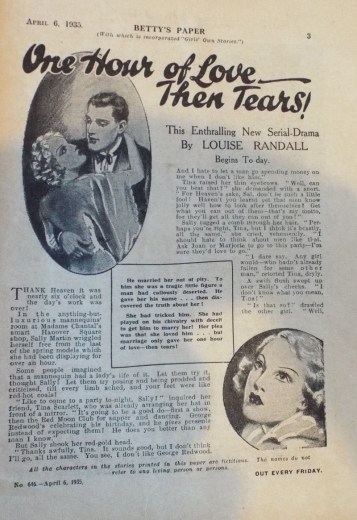
Firstly, I noticed that the stories were illustrated, a bit like a children’s comic. I know that still happens today, but these struck me as being more dramatic. The men often seem to loom over the women in a authoritative almost aggressive manner. The men also look very old compared to the younger-looking women. Pretty sure all these heroines are about 20 and all the heroes are about 48.

The headlines and taglines too were melodramatic and leaning towards the scandalous. I presume this was a good way to draw in readers and get them to spend their cash – Betty’s Paper was tuppence ‘Every Friday’. When wages were paid weekly in cash, I imagine this was one of the first ‘treats’ a girl would get herself before going home and giving most of her money to her parents.

Anyway – on to the stories. I’ve only got two issues (at the moment hahaha) but between these two issues of 36 pages each, there are eight stories, and seem to be serialised in two or three parts. Some of them masquerade as ‘real life stories’ (see me next week for more…) but the rest are presented as written by ‘well-known’ lady authors. The sensational headings are guaranteed to pique the interest of any normal woman: ‘One Hour of Love Then Tears’, ‘The Sin That Came Between Them’, ‘When Men Are Dangerous’, ‘But She Was Blamed’, and my particular favourite, ‘Back Street Blonde’, tagline ‘she was born to be a man’s girl’.

They read a bit like cautionary tales – be careful, be cautious, be modest, they seem to say. Keep away from MEN. And like Mary Bennett in Pride and Prejudice, they seem to hint vaguely at the dreadful fate that awaits a woman without virtue. This was probably useful information for a young woman with a little bit of her own money able to go out with her friends in the evening in the wicked city and not come home until – ooh – ten? eleven o’clock? The stories are about trying very hard to make a marriage work, about being honest, and morally upright, about protecting your home and family. So they are aspirational, inspirational and improving. But they can be a bit juicy, as this picture seems to show: ‘Guy held her close in his arms. ”I don’t care about anything else–I want you, Dawn,’ he whispered.” Oh Dawn, get out girl, while you can!

Mostly I’m in awe of the writers. Week after week they turned out 5000 words or maybe more, and (I assume) got paid for it. I’ve tried Googling some of the authors whose work features in these magazines: Denise Egerton (Secret Bride), Louise Randall (One Hour of Love – Then Tears), Stella Deans (The Sin That Came Between Them), Cynthia Loring (But She Was Blamed), Jasmine Day (Back Street Blonde). Of these, I’ve found a number of books from the 50s and 60s by a Denise Egerton, and they appear to be romance genre, so maybe it’s the same woman? I haven’t been able to find out anything about the others–who knows–maybe they were all Denise? Or possibly all these ‘lady writers’ were simply the pen names of a grizzled editor with pages to fill and a talent for writing totes emosh romance? I can picture him, tapping away at his typewriter until all hours, cigar ash spilling all down his shirt. I bet his real name was something like Isaac Peabody.

I think these stories offer an intriguing insight into the values and aspirations of working women in the 1920s and 1930s. They’ve actually been the subject of study in a number of British and American dissertations and publications, for example, Peg’s Paper was looked at in Class and Gender: The ‘Girls’weeklies’ by Billie Melman,  a section in ‘Women and The Popular Imagination in the Twenties.’  And in this article in The Guardian by Kathryn Hughes. 

But lest we forget, what they really were was an escape from the drudgery of everyday life for women with little opportunity to do anything other than dream.

***


A shameless plug to a captive audience.

The use of advertising media to sell products to customers is not something new, it’s been around for a lot longer than I ever realised. I think I vaguely knew that advertising ‘must have’ been used before I became fully aware of it in the late 1960s or early 1970s, and I suppose that most of us have seen those hilarious TVs shows featuring ‘how we used to be’ commercials from the 50s and 60s, showing a happy smiling housewife holding up a box of laundry detergent, or a pipe-smoking father in a suit sitting behind a newspaper.

A few years ago, it was so popular to collect old advertising boards, usually made of tin, or printed onto postcards, calendars, place-mats, mugs, mouse mats, you name it. Pears Soap ads appeared on tea-towels and even t-shirts. You know the ones? With the Millais-inspired pics of Victorian children, rosy-cheeked and curly-haired, with frilly collars or petticoats?

But until recently I hadn’t imagined that advertising was rife in the earlier part of the twentieth century, and I’m now convinced, even before that.

Last month I finally caved in and bought a few items I had been looking at a while – and I’m warning you now that this means you will have to look at these over the next couple of weeks. I’ve now received some gorgeous vintage items from Messrs eBay and Etsy.

These included two copies of Betty’s Paper: a magazine aimed at (young) (working class in the main) women from 1935, and one copy of The Picture-Goer. I love this vintage stuff, and as you know, I’m a bit obsessed with the 1920s, and even more so with the 1930s. I was so excited to get my hands on these items. And if you also like this stuff, they are usually not expensive, and there are quite a few of them around! But please don’t buy them all, there are still a few I’ve got my eye on.

Soon I’m going to have a more general look through Betty’s Paper, and maybe even, if you can stand it, through The Picture-goer. But right now, I’d like to take a quick look at some 1935 advertising, and what I discovered amongst the hallowed pages of these once avidly-read magazines.

Th first two pics I’ve shared are for ‘guidance from beyond our world’ – yep, clairvoyance was all the rage from the Victorian era up to…well, I think a lot of people still check their horoscopes and send for readings etc. Now we probably see more in the way of crystals and meditation, whereas back then it was quite literally written in your palm. Note that on the one hand a male figure offers information about the future in a pseudo-scientific manner, the maleness, the use of the title of professor adding authority to make the ad seem genuine and plausible. His odd kimono thingie is his robe of office, as is his hat. It all ties in with the late 19th century and early 20th century passion for culture and art from the ‘mysterious East’.

The second one, Madame Astral, looks far more like the contemporary modern young women’s look – if anything she looks like your sister who had a tent at the church fete last summer. So the reader is being invited to share a sisterly gossip about matters of the heart, just like a cosy and none-too-serious reading of the tea-leaves at home. Good old Betty’s offers coupons to give readers a discount!

I love this. We’d never do this today, would we? or would we? This is the Bettys’ Paper Loveliest Reader competition – complete with photos of the ladies, and… Wait for it – their names and addresses!!!!!!!!!!!!!!!!!!!

What on earth??????

It was definitely a different era. What, I ask myself, is to prevent any ruthless person rocking up to Miss Metcalf’s at 144 Wanstead Park Road, Ilford??? It seems naive in the extreme, but I can’t decide if that was perfectly okay for those days or was it the height of idiocy even then? Or was it Miss Metcalf’s design, in the hope that a gorgeous single man with a good income, good sense of humour, own home, would arrive on her doorstep with a bouquet of flowers and a pleasing smile? Mind you, the £10 prize money for the winner had to be a big bonus.

Speaking of a pleasing smile, in the corner of the Loveliest Reader comp page there was another ad – for toothpaste. Surely what we get from that is, if you want to be Betty’s Papers loveliest reader, and have strange men turning up at your door, you’d better follow the trend for wavy dark hair, perfect skin and you’d better have fabulous teeth too.

You can tell that Betty’s paper is all about appearance, inspiring women and showing them how to look Silver-Screen-great on a limited budget. In the first half of the twentieth century many young women were earning their own money and had disposable income for the modern commodities that science and technology had created.

So it’s no surprise that these ads are all about looking right. They address clothes, skin, hair and teeth, as well as the hope instilled by the stories and the ads for clairvoyant assistance. It’s all about looking as good as you possibly can – not for yourself, obviously, but so you can catch a man. These were not the days of sisters doing it for themselves.

When I first saw this next ad, with the woman drinking something and the slogan ‘slenderising and modish’ I assumed it was for some kind of diet or weight-loss supplement. But no. It’s for wool. To make your own slim-look sweaters and cardis. Not sure this ad would work so well today (leaving aside the fact that most women simply buy their woollens now) as it immediately sent me in the wrong direction. Or is that just me, coming to the ad with my 21st century eye? Again, here it’s all about looking right – and that means thin. Maybe nothing changes, after all.

Interesting that the slogan is a ‘quote’ from one Lady Georgiana Curzon – her title gives authority to her pronouncement, and yes, she is the wool manufacturer’s ‘fashion adviser’. Note also the family-empire sounding name – well, it probably was a family run business at least originally, but these days everything is General something, or Associated whatnot… no family businesses any more. Again, I feel, but this might be my contemporary perspective, but this sense of family-run, long-standing, aristocratically-endorsed seems to add to the authority and trustworthiness of the ad and the product.

Two more. One is an ad for the cheaper new stockings made from a man-made fibre rather than real silk. They ask,’Which is which?’And add that only your purse will know the difference. The use of the pictures of men to imply that males are looking at your legs, girls, and they’d better be worth looking at would doubtless have worked better if, a) they’d used different pictures of men and b) the men were actually facing the legs in question-or would that have been too risqué?

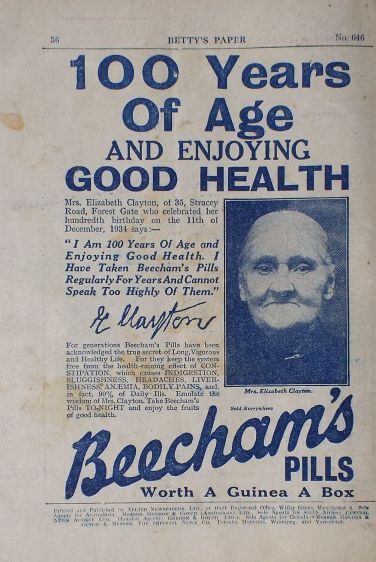
Lastly, my favourite ad of all. It made me spit coffee all over my t-shirt. Scroll down and take a look at the pinnacle of Betty’s Paper’s fine advertising material. It’s from the back page. It’s the one with the lady purporting to be over one hundred years old and still ‘enjoying’ good health.

Bless her. Mrs Elizabeth Clayton, she doesn’t look as though she enjoys anything. I know we all want to live forever, but this is funny. Again, I love the use of the lady’s address. Did people go there to marvel at the lady and her great age? Surely it’s fictitious, put in to lend credence to the advertisement? But part of me really wishes I could go there and witness the spectacle of Mrs Clayton enjoying life to the full and a hundred years old. I really hope it’s not just cynical advertising but that the old girl had a brilliant life and earned a fortune from companies using her face to astonish the world.


The anti-social writer

This is what I overheard in a café in town a while ago: “I find that writers aren’t very nice to work with. One or two are okay, but most of them…well, they very much like to keep to themselves, don’t they? And they don’t like the competition either. It would be nice to have a chat, you know, but most of them just won’t. You get the odd one who will say ‘Hi’, but that’s about it.”

Needless to say, my ears were flapping as I tried (surreptitiously) to hear every word and quickly write it down as I knew I would forget it, and at the same time I’m trying to look casual and eat a caramel-topped, cream-filled doughnut (definitely high on my mental list of priorities, I don’t get out much), and hoping they won’t turn round and see me writing down their every word. I decided Lady Number One must work in a theatre or something, and the café we were in was close to Quad in Derby, where they run both writing doobries and theatrical thingies. (Please pause here to marvel at my expert use of the English language.)

She went on to talk about how some of the actresses had been very moved by the speeches they had to deliver. Lady Number Two was her friend-from-another-workplace and just kept nodding and agreeing.

Now I freely admit that we are all entitled to our opinions…

But…

I apologise on behalf of all writers everywhere if we aren’t as good at chatting as you would like us to be. It’s not always easy talking to someone you don’t really know too well. Just give us another chance…

Quite often it can be difficult to shut a writer up. Once you get them started, they can talk for hours – all that time spent alone with a journal or laptop means they rarely see actual humans, let alone enjoy conversation. But it’s also often said that a writer is busy with an internal life others are not privy to, working away at the coal-face of a tricky plot or puzzling over the intransigence of a character.

But maybe, like everyone else, sometimes writers are just rude. Or shy. Or nervous. Or feeling out of their depth. Or worried. Tired. Or maybe even wondering if their wife is having an affair, or if the kids are in trouble, or yes, about their work, if their plot is shallow or their characters wooden. Maybe they are looking at you and thinking, ‘Wow he/she would be the perfect victim in my next book’. Or an arch-villain.

Do we hear people complaining about dentists not being chatty enough? No. All too often, anecdotal evidence – and TV comedies – tell us that dentists love to talk and only ever require an answer if your mouth is full of putty, fingers, sharp objects, or that scary sucky gadget.

And no one complains that hairdressers don’t talk. Or lawyers. Or retail assistants. Or window cleaners. Usually lack of conversation is a bonus in everyday situations. So why do writers have to be so chatty?

Is it because we’re ‘wordsmiths’?

(I hate that word – so pretentious! Imagine me up all night, filing and drilling and smoothing then peering myopically through a loupe at my carefully crafted, gleaming word. Congratulations, it’s a pronoun!)

But I can’t deny that words are my – our – profession. Does that mean I have to share them constantly? Does a banker hand out free cash to all their friends and acquaintances? If only! Do my marketing and publishing contacts promise me freebies to help me sell my books? Nope! Again – if only!

No. We all inhabit our little solitary worlds. It’s not because I’m a writer that I’m rubbish at making conversation with a total stranger. It’s because I’m a human being. There are loads of things I’m rubbish at, making conversation is only one of them.

***

To Bludgeon or Not To Bludgeon

Writing murder mysteries means that I constantly have to try to find a different, even grisly way to ‘eliminate’ my victims. Like a lot of writers of murder mysteries, my search history leaves a lot to be desired. Those who know me have sometimes remarked (thinking they were safely out of earshot) that I’m a bit weird. I’m not really. (okay, maybe I am a teeny bit odd, but in a nice way, right?)

I just overthink things and take them a bit too seriously.

Like weapons for example, and the various means of disposing of someone.

I know some writers go over the top to try out a new method of dispatching a victim for their books. They might talk to experts, spend time at chemistry labs researching poisons, do a short course on blood spatter analysis, or go to firing ranges or interrogate forensic specialists. They might purchase a raft of books on forensic stuff, or even, like character Gil Grissom in an early episode of classic CSI, get a pig’s carcass delivered to his place of work and proceed to inflict various atrocities on it. I don’t think I could do that. I’d be unable to forget it was (once) a living creature. I’m not a vegetarian, just a bit squeamish.

It’s quite easy, though to absorb this kind of thing via osmosis. TV shows, factual and fictional, go into the aspect of how a person died to a very useful extent. And as I said just now, there is plenty of literature on the subject, as my book shelves will attest. Then there’s the internet… And news media…

It used to be said that the female weapon of choice was murder. Is that still true in these days of equality?

I’ve poisoned a few people in my time. Fictionally, of course. But the blunt instrument is still my favourite. You can whack someone with almost anything.

Spoiler alert:

If you follow my Dottie Manderson series, you can look forward to a death by blunt object in the upcoming book, The Thief of St Martins. You can read a short taster HERE.

Does anyone remember that brilliant episode of Tales Of The Unexpected from years ago where the woman killed her husband with a frozen leg of lamb, then cooked it and served it to the investigating police officers. They ate the evidence! Fantastic. That’s definitely my favourite episode.

To date, in my books, I’ve had people stabbed, poisoned, die in various forms of road ‘accident’; they’ve been suffocated, executed, shot, strangled and bashed over the head. I like to vary it a bit, but it’s hard to get away from the old-but-good methods.

My murderous main character Cressida in The Friendship Can Be Murder books talks about how hard it is to come up with a murder weapon these days.

The Grandes Dames of the murder mystery genre, practising their art in the early and middle parts of the twentieth century—what one might term the ‘Golden Age’ of detective fiction—espoused the pleasures of poisoning. Fly-papers were meticulously soaked to extract their lethal properties, berries and toadstools were carefully gathered and sliced and diced and surreptitiously introduced into steaming casseroles and tempting omelettes. On every domestic shelf such things as sleeping draughts and rat poison and eye drops sat unnoticed and unremarked, and a home was not a home without at least a few jars of cyanide or arsenic sulking forgotten in garden sheds and garages.

But, sadly, these items are notoriously tricky to come by nowadays in our ‘Nanny state’.

Of course, one watches these TV programmes that explain all about the forensic process, so that one is pre-armed with useful information. Knives wielded by the left-handed protagonist cut quite differently to those employed by a right-handed person. Equally so the short protagonist and the weak slash feeble protagonist.

In addition the actual wound inflicted by a classic blunt weapon can yield so much information about not just the weapon itself but also the attacker—the approximate height, stance, and even weight and probable gender, for example, and the ferocity of attack is sometimes a gauge as to motive and psychology. Firing a gun leaves residue on one’s clothes, gloves, and skin, and, contrary to popular belief, it can be quite a job laying one’s hands on a firearm.

According to the Daily Tabloid, a gun may readily be obtained at certain pubs in our larger cities for as little as £30, usually from a gentleman going by the name of Baz or Tel, but the problem is, these tend to be the kind of establishments one would hesitate to enter in broad daylight, let alone late in the evening.

She’s got a point, bless her, and ‘fortunately’ she manages to find a way round these problems. I’d love to try flypapers! Maybe I’ll save that for my next book.

I’ve also been experimenting with a mad professor and an ‘infernal machine’. I might use that at some point. In another series–still not published yet–I’ve used a fetishist and a special piece of rope that he loves to moon over. Elsewhere I’ve had social leaders employ minions as an execution squad, and of course there’s another old favourite, the fall from a high place.

Most of my perpetrators are people who don’t usually make a habit of ‘this kind of thing’, they just find themselves pushed little by little into a situation where they feel they have no choice but to lash out at the person or persons who is putting them or their comfortable life in jeopardy somehow.

If there’s nothing new under the sun, it is at least pleasing to come up with a bit of variety, though bludgeon has, as Michael Douglas’s character says in A Perfect Murder, (based on Dial M For Murder, one of my all-time favourite films)  ‘a spur-of-the-moment ring about it’. I like the idea of a spur-of-the-moment crime, where the perpetrator loses control and spends a considerable amount of time trying to figure out how to get away with it. It’s not all about the victim, you know!

***

How To Get ImposterSyndromeForAuthors.version1

What is it?

Imposter syndrome is a widespread professionally recognised psychological disorder encountered by people in all walks of life, but here I am talking about us writers. It’s essentially a negative, destructive mindset that gets a hold of you and messes with your head. It makes you doubt yourself – more than doubt yourself – if left unaddressed. It convinces you you have no right to stand with your peers or to call yourself a writer. If you let it take a hold of your life, it’s then all too easy to find yourself in a deep well of misery and be unable to function.

I’m speaking from personal experience. It was many years before I realised it wasn’t only me, it was a quite common problem that many people have to overcome, not just once, but sometimes many times in their life. Let’s be clear, I’m not talking about the occasional, short-lived self-doubt everyone has, especially when trying something new. I’m talking about paralysing, life-altering, behaviour changing self-disbelief leading to a deep depression.

What are the signs of Imposter Syndrome?

Check these out, be honest with yourself. If you can say, ‘Yes, that’s me’ to a few of these, maybe you could do with some help to overcome these issues in your life.

  • You don’t see your own strengths. Not just modesty, you really think you’re useless.
  • You believe your luck is running out, that any success you’ve had was a fluke, and is about to leave you forever. You are convinced that it is only a matter of time until people realise you are not a real writer, painter, sculptor, dressmaker, teacher, secretary, doctor, politician, musician… and that you will be publicly denounced for the fraud you are.
  • You feel like you need to work harder than everyone else just to stay in place.
  • You can’t accept compliments, but always feel uncomfortable, even apologetic, and need to rationalise how you ‘accidentally’ did something good or right.
  • You shrug off success as a beyond your control, going-with-the-territory result of your hard work, rather than your ability.
  • You’re a workaholic.
  • You’re a perfectionist and feel you’re never quite finished with a project. When something is done, you see only the glaring flaws.
  • Failure is not an option for you. You feel humiliated, even ashamed when you have to back down or cancel any project you’re working on. You feel people laugh at you or despise you for failing.
  • You’re not comfortable with confidence. You feel awkward and fake when promoting your work or talent.
  • Comparisons undermine and upset your brief flashes of self-confidence, and stop you functioning.
  • You only see the negatives and the limitations of your work. You may have worked hard for years to achieve a certain level of ability, but you only see your shortcomings.
  • You downplay your role in projects or in helping others, saying things like ‘anyone would do the same’ or ‘I had so much help from others’.
  • You have irrational feelings and thoughts such as, ‘I’m useless’, ‘I can’t do it’ and even the dreaded, ‘I’m giving up’. This last is the worst, because you can lose a lot of creative, productive time, sometimes years, even a whole lifetime, because of this destructive mindset. I’ve also known people to destroy their work (I’ve done this) in the belief that it is trash.

So now we know what it is, how do we deal with it?

The important thing is to remember you’re not the only one with these kind of thoughts. I recently read somewhere that ‘experts’ (no idea who) say as many as 70% of people suffer from this disorder. 70%. It’s possible that out of ten people you know, more than half have the same sense of inadequacy and fear that you do, or I do. That’s a lot!

So it’s obvious that it’s not just—YOU—this problem isn’t something that only affects you. Does that help? It helps me A LOT to know that huge numbers of other writers feel the same as me. Just knowing that means that it’s not just me, therefore a lot of my thoughts have to be false.

Some things we can do:

  • Know and acknowledge your strengths. Not everything you do is wrong or weak. Realise that you have assets and talents. If you don’t know what they are, ask your friends, family or trusted colleagues what they think are you best qualities or your biggest abilities. They will surprise you by seeing things that you didn’t even know were strengths. Hold on to what they tell you, write it down to look at when old doubts come back to haunt you.
  • Share your feelings, don’t keep them bottled up inside, afraid to tell anyone how you feel. Often people will respond with compassion, support and even, ‘Yes, I worry about that too’. If they don’t, find another person to confide in, someone who ‘gets’ you.
  • Count your blessings. Old school but it always helps to realise that there are many good things in your life. Start small, it is usually the small things in life that bring joy, rather than the big things. This attitude helps you to develop and keep a positive mindset.
  • Make large projects or tasks manageable by breaking them down into components or sections—this will help you to feel less overwhelmed and less daunted by what you have to do.
  • Grow to understand that it is not a failing to fail. EVERYONE fails sometimes, and you cannot go through life without that. So don’t fear it, but embrace it as an opportunity to learn and grow, and to connect with others as you are open about your fears and your failings.
  • Recognise that you are always changing, always learning. Learning is not something we only do at school. Our whole lives are about moving on and increasing our abilities. Just because you struggle with something now, that doesn’t mean you will always struggle with it. There is always room to develop and to build on skills. So be kind to yourself and give yourself permission to learn new things.
  • Don’t be afraid to admit if something isn’t working for you and give up on it. you will always learn something from any abandoned project. Don’t let it stop you from trying again with something else.
  • Learn to accept compliments without shrugging them aside. Learn to say nice things, positive and nurturing things, to yourself. Refuse to allow mean thoughts about yourself and your abilities to flourish. Try to avoid comparing yourself with others. No one is the same. No one can be the same.
  • Don’t let other people criticise you in a negative way. No one has the right to do that, and it’s usually born out of jealousy or guilt. If someone attacks you in this way, verbally, or on social media, however they do it, walk away, literally or virtually. Cut it off before it gets into you and eats away at your newly acquired self-esteem.

I hope this has helped. You can contact me if you want to talk more about this subject.

Further reading you might find useful:

https://www.psychologytoday.com/gb/blog/real-women/201809/the-reality-imposter-syndrome

https://www.themuse.com/advice/5-different-types-of-imposter-syndrome-and-5-ways-to-battle-each-one

https://impostorsyndrome.com/10-steps-overcome-impostor/


***

Gold or silver?

I found these notes in an old journal. I had been pondering the attributes, from a writer’s point of view, of gold and silver, and how whether as metal or colour, they are portrayed in literary works.

Gold is the colour of royalty, of quality, of the authorised, and acknowledged, of states and state, religions and churches and faiths, of the accepted and acceptable, of righteousness.

Gold is pure, incorruptible, reliable, ‘pure gold’, good, honest and forthright.

Gold is given in blessing and to enrich, it is security, savings and wealth. Gold is warm and appealing. It is masculine, and constant; the colour of the noonday sun, giving life to all and sight to all. The ‘gold standard’ indicates a status achieved, a level of existence and compliance, of regularity and trust, and a line by which all else is measured. Gold is laid up for the righteous, we are told.

But silver? No. Silver is ‘other’. Silver is secretive and fleeting, it is mercurial and unremarkable in nature, and always not quite good enough: doomed to be second best. It changes hands easily, each time serving or claiming a new master.

Silver works its arts by night, it is hard, feminine and bright and although it’s the colour of small change, ready money, the easily-obtained (for some people, anyway), it really is a confidence trickster: appearing cheap and easy to get, but actually constantly demanding more from us, just that little bit beyond our grasp.

It is the colour of the stars and the light of the moon, alluring, beautiful, cold. Silvery and secret, sinister and elusive, it dances through the sky, always out of reach, now hidden, now displayed. The thirty pieces of silver, the betrayer’s coin, the turner of hearts and souls, the illicit, the unauthorised, the denied, or the denier.


These gorgeous images from Steve Bidmead, Arek Socha, Kevin Schneider and Patricia Alexandre, all at Pixabay.com 

***