Hold very tight please, it’s all change once more

The latest version – surely this can’t upset anyone? (Answers on a post card…)

I don’t like to change my book covers too often. As a reader and book collector, I understand how frustrating and disappointing it can be to have a nice little row of matching books and then, just before you get a full set, ‘someone’ decides to change the covers.

I changed my Dottie Manderson covers about a year ago.

The original Night and Day cover was this one, six years ago when the book was first published:

Remember this one? My first love.

I still love it, but people complained it looked too much like a romance and nothing like a mystery. So eventually, I changed it.

I tried this one:

And this one:

This one:

And finally settled on this one, which has to be my favourite so far.

But when you’re a self-published or Indie author, you have to make business decisions based on cold hard facts and not (as I tend to) on gut instinct or warm fuzzy feelings. So when Amazon announced that following their new policy implementation, they would not now allow me to advertise my book with this cover (the one above) due to the depiction of ‘excessive gore’, I swallowed my pride and my emotional attachment to ‘my baby’ and went off to sulk cry create a new cover. Because you’ve got to advertise, right? How else will readers discover my books?

So sorry, sorry, sorry, but I’ve had to change my covers yet again.

But it’s quite hard to think of a cover image that suits the genre but doesn’t depict blood splatters, weapons, women in the middle of a scream, cadavers, all that kind of thing. I’ve seen loads of covers lately which show a building. that seems to be a new trend, and certainly it’s a safe way to go. In addition, you need an image that looks good as in black and white as it does in colour, is clear and easy for the eye to interpret in a tiny thumbnail size. It’s hard to find the perfect image.

I brooded over images of old-fashioned street lamps dimly lighting a patch of pavement.

I browsed silhouette after silhouette of ‘vintage women’ images. Most of them were either Edwardian era or 1920s flappers. So I freely confess I ran out of ideas.

Then, I thought, ooh what about the chap Dottie finds at the beginning? He was wearing evening dress…

So the new cover idea was born as soon as I set my eyes on this:

Hopefully it’s simple, easy to understand, eye-catching and also makes readers think, if not of the 1930s, then at least ‘not now’. And if not exactly exuding mystery, then hopefully their first thought won’t be, ‘ooh I can’t wait to read this sci-fi or this romance’. In any case, I can’t possibly offend anyone with this, can I? There’s no gore whatsoever, and I’m hoping this cover will live for a while before needing to be updated.

Now I’ve just got to change all my advertising material and social media stuff. This could take a while!

Image by Tani T at Shutterstock: https://www.shutterstock.com/g/tanitk

***

Marsali Taylor’s A Shetland Winter Mystery blog tour

Author Marsali Taylor photographed onboard her yacht in Aith Marina, Shetland, Sep 2005

Welcome to Marsali Taylor’s A Shetland Winter Mystery blog tour! this is to celebrate the release of Marsali’s new book which comes out next week on the 9th December, published by Headline Accent.

This is the second time I’ve participated in one of Marsali Taylor’s blog tours. To read the previous one, please click HERE.

About Marsali Taylor

Marsali Taylor grew up near Edinburgh, and came to Shetland as a newly-qualified teacher. She is currently a part-time teacher on Shetland’s scenic west side, living with her husband and two Shetland ponies. Marsali is a qualified STGA tourist-guide who is fascinated by history, and has published plays in Shetland’s distinctive dialect, as well as a history of women’s suffrage in Shetland. She’s also a keen sailor who enjoys exploring in her own 8m yacht, and an active member of her local drama group.

Don’t forget to check out these other sites for more info!

About A Shetland Winter Mystery

It’s the dark nights in the run up to Christmas, and sailing sleuth Cass Lynch’s first night on dry land is disturbed by strange noises outside her isolated cottage. Tiny footprints in the moonlit snow trail from her front door before mysteriously disappearing. Soon Cass learns others were visited by the same tiny feet in the night.

It looks like ingenious local teenagers playing tricks – but what happens when festive games turn deadly?

Cass soon finds out as a schoolboy disappears, leaving only a trail of footprints into the middle of a snowy field. She’s determined to investigate, but uncovering the truth will also put her in danger . . .

Review

I hadn’t heard of trows before, but I kind of get what they are: little people, pixies, sprites or maybe leprechauns. They are–surely–mythical–but it is fascinating to read about them because I think we all know someone who genuinely believes in this kind of thing. and the rest of us kind of want to believe, especially during the long winter evenings when we snuggle up with a book, ready to leave this world for one that happens in our imagination.

So I really enjoyed the opening part of the book where the trows were visiting houses, capering about, using their magic to play tricks, to create spectacles and generally mess with everyone’s heads. It’s exactly the kind of thing you can imagine getting completely out of control very quickly, like a trick or treat at Hallowe’en, with each new escapade attempting to outdo the one before.

Imagine one big amazing trick or event–and it’s more or less an open secret who was really behind it–not the trows after all, but local kids out for a bit of cheeky fun. And then one lad doesn’t come home… Where can he get to on a small island?

How long do you wait before calling in the police? It was clear only the boy’s mother thought there was anything amiss, and yet… and yet… It’s all too clear that something else is going on–two somethings actually, and both malicious, threatening. Pretty soon everyone is in a panic trying to find the teenager.

And then news comes in of a dead body, pulled out of the water…

There is a sense of claustrophobia, in spite of the wide open spaces here. I feel like everyone is looking at their neighbours and wondering, ‘Was it you?’ It’s tense, it’s slow-moving but finely tuned, you almost feel like holding your breath in case someone knows you’re watching. A sheer joy to read, and definitely one for a winter’s evening or two.

Highly recommended!

To help you get even more out of this series than just the sheer pleasure of reading it:

  1. Create a wall-chart to check off which kilt Gavin is wearing in each scene.
  2. Take a tot of your favourite alcoholic beverage whenever you read the words Cat or Kitten. (I had a Cat called Kitten once…)
  3. Create another wall-chart, this time of all the people mentioned in the books and all their familial and social connections. I think you will find, as I have, that these characters feel like people you actually know.
  4. Learn all the vocab for any sailing-related activity.
  5. Learn all the different types on knot and practice them in case you ever need to use them ‘in real life’, whatever that is.
  6. Learn all the Shetland words contained in the glossaries or at the beginning of chapters.
  7. Consider pestering Marsali (but in a nice way, don’t make her miserable or you will be her next victim, nor do we want her to put Gavin in jeans/business suit) to write the next book.

You can buy A Shetland Winter Mystery here.

And don’t forget to follow the author on these social media:

AUTHOR WEBSITE

SOCIAL MEDIA LINKS:

FACEBOOK https://www.facebook.com/MarsaliTaylorAuthor 

TWITTER @marsalitaylor 

#ASHETLANDWINTERMYSTERY

A writer’s guide to naming characters

“That which we call a rose

By any other name would smell as sweet”

William Shakespeare – Romeo and Juliet.

Shakespeare’s suggestion that names are not important is hopelessly wrong for writers. Who hasn’t sat, staring at a blank sheet of paper, agonising over what to call a character? And if it’s your protagonist, that only makes it harder. Without a character, you have no story.

Occasionally a name for a character just comes to me: Meredith Hardew from a book I plan to release next year, A Meeting With Murder: Miss Gascoigne mysteries book 1, and Cressida Barker-Powell from Criss Cross: Friendship can be Murder: Book1 published 2013 (whose name was a deliberate mutation of Parker-Bowles). These are names that sprang fully-formed into my consciousness as I began to write the story. I couldn’t even think of calling any of those people anything else. In fact this whole opening piece came to me in a flash, and I had to run to a stationer’s to buy a notebook to write it down before I forgot it. (Now I just put it into a note app on my phone! Ah technology, I love you so much.)

At forty-six, Meredith Hardew, with her handsome features, trim figure and excellent dress sense, was frequently taken for at least ten years younger than her true age. Not that she was in the habit of seeking out flattery, for she was one of those women who never thinks about herself, what she’s wearing or how she looks. She was far too busy running errands for someone or other.

Coming 2022

But it doesn’t always work out like that. I can spend hours, days even, agonising over the right name for a character. There are times when I have delayed starting a new story because I can’t seem to find the right name for my protagonist.  Though equally, when I am writing a first draft, I sometimes can’t remember the names I’ve already given my characters. I have even written several thousand words with varying numbers of capital XXXXs to denote each character, just to avoid abandoning the story and messing up the ‘flow’. But it can get confusing. In these circumstances I often have to write long explanatory notes to myself of who the person is, as well as the XXXXXXs. There’s usually a Mr XX, a Miss XXX and a Jeffrey X, or a Gladys XXXX, so it gets a bit muddled. But it does help me keep writing.

However, I can’t always trust myself when a name does just spring into my head. Like the time I wanted to call my main character Ben, then I needed to give him a surname. Sherman. Hmm, I thought, Ben Sherman sounds really good. It’s as if those two names were meant to go together somehow. What a great, natural-sounding name for a character, I thought. It sounds just like a real person. Which should have been my clue. So I told my daughter about my new hero Ben Sherman. She rolled her eyes heavenward in what can only be described as her ‘For God’s sake, Mother!’ expression. Turns out there is a real person, a famous designer, with that name. I was right, it did sound just like a real person. Oh well. Back to the book of baby names again.

That lightbulb moment when you realise your character has a famous person’s name.

Names can be absorbed by osmosis from society or culture, and we don’t always know where they’ve come from. I usually check my friends’ names on Facebook or for authors on Amazon to be ‘on the safe side’. I don’t want to use a well-known person’s name especially if my character is not a very nice person! I had also written five chapters of the Miss Gascoigne story before I realised that two of the main characters were named Meredith and Edith. Edith had to become Sheila. You need to keep the names quite dissimilar to avoid confusion, unless that is germane to your plot. Never feature, for example, Jack Peters and a Peter Jackson in the same book. I’ve known it happen, and the confusion accidentally created by the author seriously impacts on the enjoyment of the story! You can’t suspend belief if you spend all your time trying to remember who is who. At least, don’t do that if there is no deliberate intention to confuse the reader.

Names go through trends. So if you’re writing historical fiction, don’t give your character a modern name. If in doubt, turn to a census of the time for ‘in’ names or look to the royalty of the day. Equally if you’re writing modern stuff, don’t give young characters the names of your parents’ generation, few little ones these days or for the past 20 or 30 years have been called Barbara, Sandra, Hazel, Nigel, Richard, etc. They have a slightly ‘previous generation’ sound to them. However, go back a bit further to the grandparents’ generation and you’ll hit all the names that are now so ‘on-trend’: Jack, Alice, Freddy, George, Emily, Henry and so on. I hope in the next generation after this one, my name will be back in again!

When it came to creating character names, Dickens was a master. He used names to ridicule his characters, to reveal societal trends and attitudes, and to denote characteristics or personalities. Think of Gradgrind and M’Choakumchild in Hard Times, you can’t imagine them being good people, or warm and caring. These are hard names for hard people. Or think of Uriah Heep, Mr Cheeryble, Squeers. He also used another technique that is still useful for writers today. He used to take names that were ordinary and just slightly change them, creating something different and yet somehow familiar. Thus Philip became Chilip.

it can take a while to work things out…

That always makes me think of Suzanne Collins’ Hunger Games heroine, Katniss Everdeen, or of Margaret Attwood’s novel, The Handmaid’s Tale – the woman Offred was the ‘property’ of Fred. Also for fabulous names it is impossible to beat Alistair Reynolds’ Pushing Ice character, Chromis Pasqueflower Bowerbird. So writers, don’t be afraid to play around with names and have fun. Changing one letter or the order of the letters can make a world of difference, and this works especially well with Sci-fi or Fantasy character names. Maybe Isaac can become Istac or Casai, Sophie can be Phosie, Mary can become Maare, John could become Hjon, Dohn, Joon.

In writing fiction, the names of your main characters are essential to the reader’s enjoyment and for creating a convincing world. Just make sure they are not the names of a successful designer.


See, easy!


***

Marsali Taylor’s The Shetland Sea Murders blog tour

This week, I want to share with you the third in a series of three mystery/crime-genre blog tours to celebrate new books. This week I was honoured to be asked to take part in the blog tour for Marsali Taylor’s new novel The Shetland Sea Murders. This worked very well for me as I’d been planning to read some of Marsali’s work for quite some  time.

Here’s a little bit of what her book is about:

Marsali Taylor returns with the ninth gripping mystery in her Shetland Sailing Mystery series.

While onboard her last chartered sailing trip of the season, Cass Lynch is awoken in the middle of the night by a Mayday call to the Shetland coastguard. A fishing vessel has become trapped on the rocks off the coast of one of the islands.

In the days that follow, there’s both a shocking murder and a baffling death. On the surface there’s no link, but when Cass becomes involved it is soon clear that her life is also in danger.

Convinced that someone sinister is at work in these Shetland waters, Cass is determined to find and stop them. But uncovering the truth could prove to be deadly…

Other reviewers said:

‘Definitely the best of the Cass Lynch series yet!’ 5* Reader Review

‘The beautiful descriptions of Shetland life, traditions, it’s landscape and even language bring everything to life.’ 5* Reader Review

‘This series gets better and better’ 5* Reader Review

‘A beautifully written story, with descriptions so vivid you can smell the sea and beautiful countryside.’ 5* Reader Review

‘The perfect lockdown read for anyone who longs to be back on the sea.’ 5* Reader Review

My Review

As I said, I’ve been aware of Marsali’s books and planning to read them for some time now. So this was my first experience of this series, and I wasn’t too sure what to expect.

I was a bit worried to begin with because of the boating stuff. A lot of the story takes place or a boat, or has information to do with boats or things like weather and tides etc. I’m a confirmed landlubber. I like to be on a boat, on a nice sunny day, when all I have to do is stand on the deck and daydream, I’m not a ‘storm’s a-coming, haul in the mainsheet’ kind of boater… So I was concerned I would either find the references to boating or shipping or whatever it is (please excuse my ignorance) too complicated or well, boring, actually. But I’m happy to report that when the boating bits became ‘hardcore’ – towards the end of the book – I was gripping my lines and staring into the mist like a true-born shipping type person. It was tense, let me tell you. And I was right there in the midst of it with the spray on my face, hanging on to every word.

This is an absorbing mystery, and chock full of a sense of place. The story is set, as the series title and this book’s title suggest, in and around the Shetland Isles. Everything is described with affection and an attention to detail that just brings it to life. It also helps that there is a glossary of Shetland linguistic phrases at the back of the book.  There is also history, and Girl Power.

The story is also an immersive experience. As the events of the story unfold, you as the reader are drawn into not just the minds of the characters but their lives and relationships too. When you’ve finished, there is that time lapse sense of unreality when you look up and realise you’re not out on the ocean or on a Shetland isle, but in your sitting room snug at home.

I give this book an unhesitating five stars. Highly recommended.

You can find out more about Marsali Taylor and her work on her website:

www.marsalitaylor.co.uk

Or follow her on social media at:

FACEBOOK https://www.facebook.com/MarsaliTaylorAuthor

TWITTER @marsalitaylor

*

#THESHETLANDSEAMURDERS

***

Style and The Solitary: Miriam Drori’s murder mystery blog tour

Yes folks, I’m doing it again! This is a great time of year for releasing a new murder mystery, it seems, and this week I’m really happy to share my review of Miriam Drori’s mystery novel Style and The Solitary.

Here is a short blurb to get you in the mood:

An unexpected murder. A suspect with a reason. The power of unwavering belief.

A murder has been committed in an office in Jerusalem. That’s for sure. The rest is not as clear-cut as it might seem.

Asaf languishes in his cell, unable to tell his story even to himself. How can he tell it to someone who elicits such fear within him?

His colleague, Nathalie, has studied Beauty and the Beast. She understands its moral. Maybe that’s why she’s the only one who believes in Asaf, the suspect. But she’s new in the company – and in the country. Would anyone take her opinion seriously?

She coerces her flatmates, Yarden and Tehila, into helping her investigate. As they uncover new trails, will they be able to reverse popular opinion?

In the end, will Beauty’s belief be strong enough to waken the Beast? Or, in this case, can Style waken the Solitary?


My review of Style and The Solitary

The characters: Asaf hasn’t got any friends. Even at work, hardly anyone knows him. Asaf is struggling to cope with social interactions and just wants to get on with his work and be left alone. In spite of this, he goes to work on this particular day carrying a note as a reminder to himself that things are about to change.

Unfortunately when Asaf is discovered with a dead body in his office building at the start of the working day, that note of his doesn’t help at all.

As he gets caught up in what surely has to be the worst situation you can imagine,  the reader is able to know Asaf’s thoughts. We know that he is not the bad guy he’s believed to be, and it’s so easy to develop a sense of empathy for him.

And it’s not only the reader who has sympathy for Asaf’s plight. Co-worker Nathalie also passionately and completely has faith in his innocence. And she is determined to prove him innocent. Her flatmates are roped into helping Nathalie in her quest to find out the truth and exonerate Asaf.

This is a gentle, humorous and compassionate story about people and how they are. It is a book that embraces difference and encourages acceptance and respect. The mystery is almost secondary to the development of the relationships in the book.

The backdrop: I think this is the first novel I’ve ever read set in Jerusalem, so this was new and exciting for me, a kind of travelogue wrapped into the story. Although the details of the setting do not overwhelm, the location makes a welcome extra character, complementing and reflecting the many layers of history, culture and social interaction that come together to make the story.

I recommend this book.

Quick note: with no graphic violence, no bad language and no graphic sexual content, this book would make a great read for mid-teens and up, or anyone who enjoys a ‘clean’, gentle romantic mystery.

Miriam has a website, do click the link below  for news and views, I know Miriam would love to hear from you.

Miriam’s Blog

Miriam, where can readers find you on Social Media if they want to know more, or to follow you?

There are quite a few choices here – readers would be so welcome to follow me on any or all of these platforms:

Facebook 

https://www.facebook.com/miriamdroriauthor/


Amazon page: 


 https://www.amazon.co.uk/Miriam-Drori/e/B00L11J6D4/


Goodreads


https://www.goodreads.com/author/list/4829682.Miriam_Drori


Pinterest


https://www.pinterest.co.uk/miriamdrori/


Twitter

https://twitter.com/MiriamDrori


Instagram 


https://www.instagram.com/miriam.drori/


Wattpad


http://www.wattpad.com/user/MiriamDrori


#styleandthesolitary


***


Unravelling by Helen Forbes: welcome to the blog tour!

This week I’m excited to tell you about a newly released book by Scottish crime writer Helen Forbes: Unravelling.

To celebrate the release of her new book, Helen is undergoing the trauma exciting challenge of a blog tour. There will be loads of things happening to promote Helen’s new book Unravelling, including reviews, news and freebie giveaway – get in quick for that one!

Here’s a bit of what it’s about, then I’ll tell you what I thought.

Incarcerated in the gloom of a Highland asylum, a young mother finds illicit love. And death.

Kate Sharp’s family is a mystery. Her mother, Ellen, disappeared into the shadows of Craig Dunain psychiatric hospital when Kate was a child. When her grandmother dies, Kate is desperate for answers. What were the circumstances of her mother’s life and death? Who is her father?

Kate’s not the only one trying to uncover the truth. The remains of two bodies with murderous injuries have been found buried in the forest next to the former hospital.

And someone else is searching for answers, and he will stop at nothing to find them.

As the tale of Ellen’s tragic unravelling unfolds, the secrets that led to her death are exposed, along with the shocking truth about Kate’s father.

Unaware of the danger stalking her, Kate continues her search. 

Will she find the answers? And can she save her own life?


My review:

If this was on a popular online store, I’d give Unravelling five stars.

First of all let me just say, I’m not very good with writing reviews – I tend towards the brief, so I’m trying to be more expansive here.

I read it in three sittings: session one was out of mild curiosity – was this a book I felt I could get into, was it the kind of the thing I would enjoy? I find it hard to take part in a blog tour if I haven’t genuinely engaged with the material – I don’t want to lie to my readers. So I quickly read the opening 30 or 40 pages.

The second reading session was a panicked, ‘Eek I almost forgot and there’s only four more days until my post is due out…’ so I read another 50 or so pages, thinking, I like how this is unfolding, I’m definitely intrigued, I’m confident I am going to love this book.

The third sitting, with 250+ pages to go was one of those, ‘I don’t care how long it takes, I am not putting this book down for anything except Rege-John Page or Theo James.’ I mean, I was hooked.

Reader, I devoured it.

And this is my conclusion:

Unravelling by Helen Forbes is an engrossing, claustrophobic psychological thriller. It was tense at times, and sorrowful. The insights into serious mental illness were so emotive, and I admit I blubbed. It was compulsive too – as I said, I just had to read on, I had to know.

The ending was swift and satisfying, and hopeful.

For me, I felt that Kate’s story was in a way a – not redemption exactly – more a second chance for Ellen. I can’t explain (words are my job too! Rolls eyes.) It was the pay-off that we the reader got after the long personal journey of self-discovery of both Ellen and Kate.

I enjoyed the style. To begin with I was a little confuzzled by the shift in points of view, but got used to it, you can identify the narrators easily enough. I think it was a bold move to separate Kate’s story into two halves and put Ellen’s story in the middle. I’m not sure I’d have made that choice myself, but I think it works, though when I came back to the second part of Kate’s story I had to quickly ‘revise’ what had happened in the first part. But I think it worked, and as I say, I was hooked – it was definitely an unputdownable, engrossing read, and I highly recommend this book!

Do check out Helen Forbes’ website – link here – to find out about the DI Joe Galbraith books, also set in Scotland, and about the author herself. 

You can also catch up with Helen and all her news on the following social media:

Facebook 

and

Twitter

And please review the book if you love it – let other readers know what’s good! You don’t have to write an essay – just a quick comment of  ‘Loved it’ or ‘highly recommended’ – it’s okay to be brief, because every little helps as they say. Thanks!

@https://www.facebook.com/Helen-Forbes-Author-457783327732599


***


More vintage magazines for women

Last year I posted a couple of articles about women’s magazines from the 1930s. (If you missed them, you can find them here.)

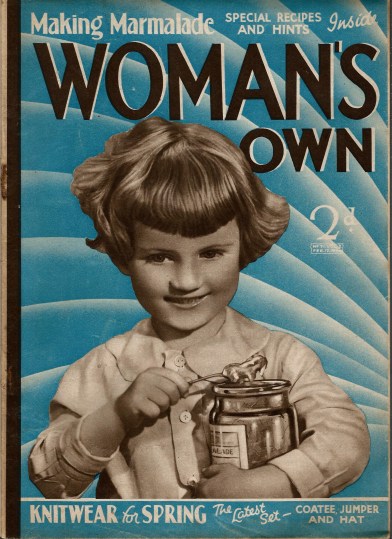
Over the last two weeks I’ve been fortunate enough to acquire two more vintage magazines aimed directly at women. what impressed me about these was first of all, that this magazine – Woman’s Own – is still in circulation and massively popular today. The second thing I noticed is that there really isn’t a lot of difference between the WO of 1934 and those of 2021.

Have women’s concerns changed very much in 90+ years? I’m not sure they have. for many women, the home and family is still one of the most important things in life, and I’m not saying that in a patronising way, nor ignoring the fact that women today have many more opportunities to have a career, and that the concept of ‘the family’ is miles different – and rightly so – to that of the 1930s.

But at rock bottom, many women are interested in and still worry about how to care for, manage or improve their relationships, their attractiveness, their budget, and their partners and children.

My Woman’s Own mags are from Feb 1934 and this week’s copy – by chance I nabbed a ‘diet special’. Here are a few snippets that struck me as interesting:

Hubby Management: It’s the wife’s job to make her home as welcoming as possible to induce the man (and man ONLY!) to stay at home instead of going out gallivanting. tips are given on how to do this, though the mags expert – whoever that was, possibly (we don’t know!) a bloke – comments that some men will always stay out and shouldn’t get married in the first place. Too late if you’ve got one of those, girls!

We have the readers’ letters, essentially a problem page. My faves are ‘should cousins marry?’ (Surely they know the answer to that?) and the ‘worried wife’ letters. I feel for the worried wife. She knows exactly what the answer will be but doesn’t want to admit it. Poor woman. Did she sling him out? Or – as I feel is more likely – did she just suffer in silence?

There’s a load of fashion tips and ideas, mostly, I was interested to note, clothes you could make at home. This magazine is aimed at the upper working class and lower middle class, women who have a little money but not enough to buy off-the-peg items and certainly not bespoke. ‘Home economy’ was one of the watchwords of the day, and it included apparel.

I personally think this looks absolutely horrid, and a cross between a Christmas panto costume and something out of Red Riding Hood. This one below is slightly nicer, but again, still all your own work.

Although the models in the designs look about 35 to 40, in fact some of these are aimed for teenagers from 14 years of age. not much difference in those days between what mums and their daughters were wearing.

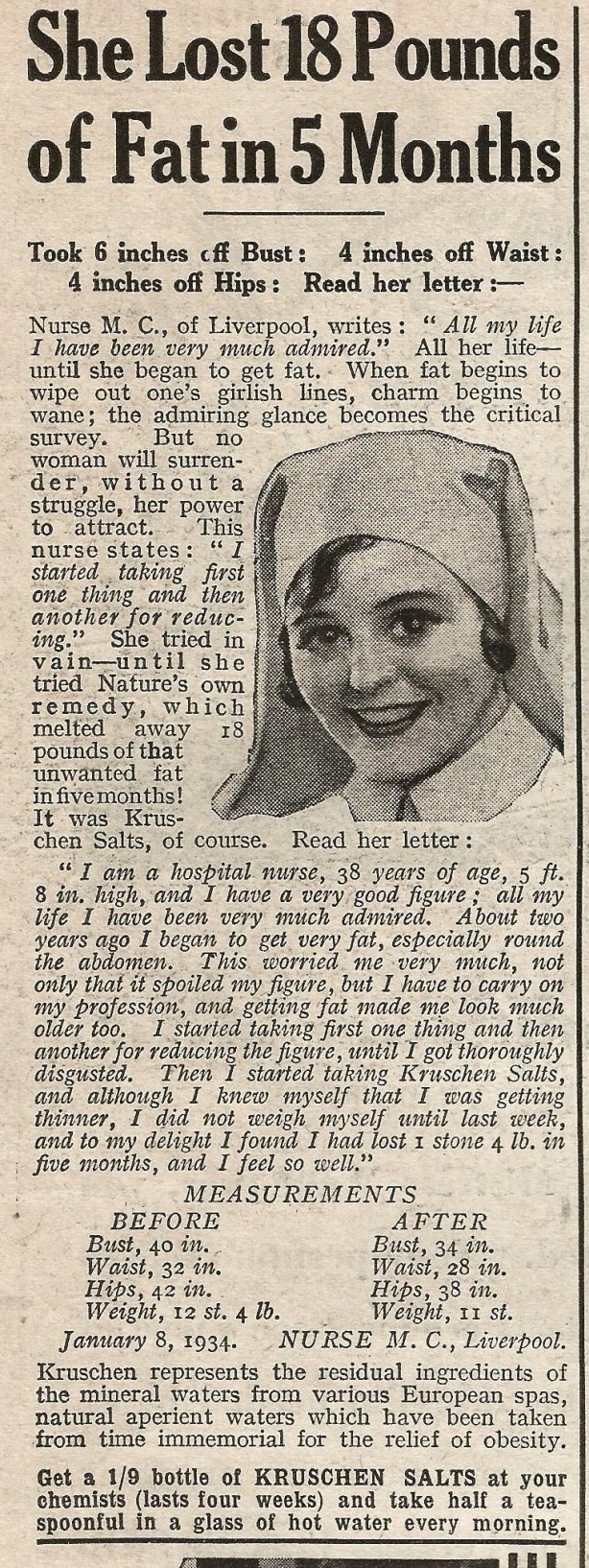
And of course, the eternal battle with the scales. I was interested to see things haven’t changed much here either, although some of our modern ingredients – chorizo and the whole gluten-free plan would have been completely alien to women of the 1930s.

Looks like this lady – a nurse, not a nun as I first thought – was following the crap-yourself-thin diet. 18lbs was a good result! Was she just a bit constipated after Christmas? All those mince pies…

Looking good appears to be a perennial issue for many women. We want to keep our looks as long as possible, after all, and keep ourselves in good condition. So I suppose it’s not surprising magazines for women contain so many hints, tips and advice. With the growth of city populations, the expansion of the suburbs, many women would have been cut off from their usual channels of information: mothers, grandmothers, aunties. Equally, magazines adopt a sisterly or motherly tone to offer the advice so desperately needed in those times. Today, magazines are more likely to have a friendly, conversational tone, inviting you to confide and share like a friend coming alongside to offer a sympathetic ear.

I’m in awe of the fact that this magazine has been around so long. It’s fascinating to read that the same ideas preoccupied women before my mother was born, as they do now. We may have Smartphones, the Internet, Netflix and Just Eat, but at the end of the day, we still want to look good, feel good, and keep our man where we can see him.

***


Interview with Debaleena Mukherjee, poet and writer of observational life pieces

This week I’d like to welcome Debaleena Mukherjee to my blog.

Debaleena and I go way back. We’ve never met (who knows, maybe one day?) but have been friends for years. We first met online through a shared love of murder mysteries. Talking about books led to talking about family, work and cake. The important things in life! Debaleena has also been a staunch supporter of my writing, and I am proud now to be able to do the same. Debaleena writes poetry, the first volume of which was published a few months ago by Blue Rose Publishers.

Debaleena, welcome. It’s amazing to have this conversation with you! Congratulations on publishing your first book of poems, I’m sure there will be many more. I wasn’t entirely surprised when you announced the book was coming out – you’ve always shared such lively and passionate posts on Facebook and Instagram. Your powers of description are so vivid that I often feel as if I’m there with you. I particularly love your posts about the various festivals you celebrate.

But let’s move on. My first question is, What do you write?

I write poems; and I am now experimenting with short stories. It started with Facebook posts, Book Club reviews: that’s how we met, remember! I would write little notes about my day; like little letters to myself . Then I translated a Bengali poem for someone very close. And I could do it, although I’d been very hesitant and nervous about poetry. Poetry has always been “the impossible dream”. After that little translation, I got a bit braver. One night I started out very very tentatively. And I saw I could do it: very rough and cobbled together; but I could feel my thoughts in my words. My writing is just as  the title suggests – Ink smudged dreams: by the reading light. All written in the later hours of the night when I would drowse, browse and write. They are not about any coherent thoughts or convictions. They are more of inarticulate thoughts, emotions: ramblings you could say. So the poems were written.

There is a strong observational thread in your writing, so lovingly shared, that marks you out as a great writer. Question two, What were your earliest influences? What did you read as a child?

I’ve always been a bit of a dreamer; the cobwebs in my mind have never been swept away.  As a child I remember, I would  sit quietly for hours together, playing in my head. Now this head game was very interesting. I would imagine different scenarios- people, families, foreign countries I’d seen in photographs. I would spin stories in my head about people and places. Then I would imagine myself in castles and mansions. But it all had to be happy. This head game continued and I loved it. Later I would look at houses ; especially old houses; distant windows, silhouettes of people through the windows and concoct stories about their daily lives.

I really can’t remember a time when I didn’t read. Before I learnt to read, I would  love looking at illustrated books, magazines. I remember I had a book on dolls and I would look at it all day long. Then, once I learnt my ABC: I found the Ladybird series of fairy tales. Let me tell you the enchantment still remains as fresh as ever. Those covers! My favourite was The Beauty and The Beast. That started my life long enchantment with fairy tales. By the time I was ten, the Enid Blyton world became my world. I simply lived in those books. They were like a perpetual picnic life for me. Of course Nancy Drew, the Hardy Boys, school stories, they kept appearing in my life, and my head was a lovely place to visit. Then of course Mr. Rochester entered my life when I was twelve or thirteen – all ready to fall in love. By fifteen I got to know Mr. Darcy, whom – I know you’ll be shocked – I did not love. Mr. Knightley was my hero! Then  came Charlotte Bronte’s books- Shirley, Villette. And Louisa May Alcott. I used to imagine myself as Jo. We all do. I decided that Professor Bhaer would be my love for life. Until I read about some other character the next day, that is! Isn’t it delightful: to fall in love with so many heroes all at once! And I have a macabre taste for horror. So I wallowed in  gruesome murder mysteries. Then I was given an Agatha Christie book: The Man in the Brown Suit. After that there was no looking back. Christie led me to Victoria Holt, Bram Stoker, Sherlock Holmes and Father Brown. As well as a wide range of Bengali literature of all genres. I am also a fan of romantic fiction, esp the mean and moody hunks that are Mills and Boon heroes! 

We read very similar things as children and young people, it seems, I was into all those books too. I’ve already touched on this next question a bit, but, next question, do you believe your culture influences your writing, and if so, how?

Oh yes! My culture has a profound influence on my writing, as you can see in my poems. They are imbued with a sense of belonging to my land and my people in every which way. This is more pronounced in the sections in my book, The Prayer and Hymn to the Earth. I am writing about my way of life. I realised that I’ve chosen colours, comparisons, ambience that are totally inherent to my culture. I’ve grown up reading our mythological stories, the epics Ramayana and Mahabharata, as well as my parent tongue-Bengali literature- folk tales, fairy stories, poems. For me Gitanjali by Tagore is the ultimate prayer book.

I think culture can often be an almost hidden extra character in our writing. But looking ahead, what can we look forward to in the future from you?

Now that my mind block is gone, and I’ve tested the waters, I have become quite adventurous. Poems definitely. I’ve discovered this about myself that as I grow older, poetry grows more appealing. I find that I now can interpret life and emotions better through poetry. It is an instinctive response.

Like I told you – short stories. I am trying my hand at those. It’s very challenging but extremely interesting. And intriguing. Writing in someone else’s skin, creating another individual, different points of view: I find it extremely fascinating. I have to construct a short story, not just pour it out. So it is a constant process of study too. I have to keep going back to little research, references to literary devices, unity of time, place and action; and above all keep a firm track of all the threads.

Oh short stories are the slippery slope to novels! That’s exciting news for us! We’ve talked a bit about the books that influenced you, but who are your favourite authors? Do you have certain favourite books you return to again and again?

I am glad you asked “authors” and not “author”? You know we cannot have just one favourite. Ever. I of course love  re reading the classics like Jane Eyre, Emma, the Little Women series, Rose in Bloom. My comfort and enchantment lies in Mary Stewart’s books. I read them whenever I need a holiday of the heart. Elizabeth Peters is another favourite. I started reading Georgette Heyer pretty late in life, but I find her delightful. What shall I say about Patricia Wentworth! I adore Miss Silver and I still pine for Frank Abbot. One author who is a verbal illumination is Eva Ibbotson. I find her books poetic prose. I simply love medieval mysteries, and I keep discovering authors in this genre. Even more, I like the thrillers based on archaeological mysteries, religious relics, and mythological mysteries. And now: there’s Dottie Manderson. I am loving this return to the cozy mystery genre, very exciting and warmly familiar. Like I said, and I know you too agree: that one cannot have just one favourite.

Absolutely – and I know that like mine, your to-be-read pile is very substantial! What do you do when you are not writing or reading?

I am a homemaker. And not a very efficient one at that please! But I try. I do try! I cook. I cook traditional meals every day. Very often there are kitchen secrets that I dare not share. Of splattered oil, exploding blender. But yes, I prepare our Indian, especially Bengali cuisine ( that sounds so much more impressive than “food”). I enjoy baking, more so because I eat most of the cake myself. Music! That is my soul balm. I love to listen to oldies goldies: English, Hindi and Bengali. Instrumentals are my ‘go to’ solace when I am tired of words. And as I’ve been told “I have the spirit of enquiry”. Do you think it’s a polite way of saying I am nosy? I love people watching. My best pastime is to sit in a cafe and watch the world go by. As I watch people, I make stories about the passerby in my head. Another thing is that I haunt bookstores; especially old books, pre-loved books. All the obscure, dusty corners: I am very good at finding treasures there. Long drives with music in the car. I sit absolutely silent in the car and I soak up the peace and the purr of the car.

I’ve often heard you talking about the meals you prepare – your descriptions make the mouth water. But I remember that you used to be a teacher. How has that inspired you or helped you with your writing?

It gave me insight. That’s the crux of my teaching experience. I’ve learnt to probe into people’s minds and see stories there. Teaching young teenagers and college students made me more receptive and absolutely non- judgmental. That helps  when I write. I learnt from students and colleagues, that as a teacher I am not dealing with folders that you open at 9.am and shut at 5 pm. Everyday I found something new in my work. And that influenced my writing . Most of all it heightened my sense of humour as well as the perception of the Absurd in life. Not to forget teaching made me quite tech savvy about which I love preening and boasting.

Debaleena, it’s been an absolute delight and I’d love to talk more about these things. In the meanwhile, where can readers find your book?

My book: ‘Ink-Smudged Dreams: by the Reading Light is available as an eBook from Google Play, or from BlueRose Publishers online store, or for those readers living in India, from Amazon India and Flipkart . 

Thank you so much Caron for this wonderful and warm interaction. And for giving me this opportunity to talk to you. You’ve always been an inspiration. You encouraged me all the way. But I still envy you Dottie. Thanks so much for helping me reach out to readers with my Ink- Smudged Dreams: by the Reading Light. They’re just that- dreams, that as I penned down, the ink was not candid and clear; but smudged in places with tears, and vivid in places with smiles.

Thank You.

Debaleena, my pleasure xx

ABOUT  DEBALEENA  MUKHERJEE

Debaleena is a homemaker, who has also been a teacher and college lecturer over the course of years. She grew up in Jamshedpur and did her schooling at Sacred Heart Convent School,Jamshedpur, and Rajendra Vidyalaya, Jamshedpur. She has done her Masters and M.Phil in English Literature from Jadavpur University, Kolkata.She lives with her husband in Bangalore, and she  has a twenty four year old daughter. Reading is Debaleena’s way of life. That’s what she is always doing. She enjoys the moonlight and roses kind of music. She loves travelling to places from the pages of history text books. Haunting bookstores is her pastime. She loves going on shopping expeditions for shoes, bags, and bling.  Observing people as they go about their lives, fascinates her. At the end of the day she needs her recliner, her books, and coffee. With some cake.

ABOUT THE BOOK

Ink-Smudged Dreams: by the Reading Light is a collection of poems. Poems that reflect the many facets of my life: maybe any woman’s life. Certain moments, fleeting experiences, lasting impressions, unknown anxieties, silly apprehensions, humble realisations, intense joys and every hurt felt; these are the poems’ moods . And above all a growing perception that life is not about tomorrow: it is about today. But all these are not my consciously addressed ideas. Each day, they have gently enfolded me. Then in the quiet of the night, I would sit down and pour my heart out on paper. Drowsy, blurred, and very close to my heart. These are those ink-smudged dreams by the reading light. 

You can find Debaleena on Facebook as Debaleena Mukherjee from Bangalore, and on Instagram as m.debaleena

***


Reblogged: I am interviewed at Maureen’s Lifestyle

Many thanks to Maureen Wahu at Maureen’s Lifestyle for this interview following her review of The Spy Within: Dottie Manderson mysteries book 6 last week.(you can check out the review here)

Caron Allan Interview

What inspired the Dottie Manderson series?

I’ve always loved the glamour of Golden Age mysteries, and so I wanted to try my hand at something like that. But I wanted to have a young protagonist as most of the books I’d read had older, spinster ladies as detectives. But I didn’t want to write anything too sweet, or too separate from the real world. So in my books, yes, there is glamour and romance, and the bad guy or gal always gets caught (though sometimes not immediately) but there is also heartbreak and the harsh reality of life not being easy, especially as my chosen era of the 1930s is so close to the war.

What is the hardest part of your writing career?

I suppose it’s juggling all the different aspects of being a writer in today’s world – the social media, obviously, I know everyone says they struggle with that, but also all the technical things – covers and document formatting, creating promotional materials, then remembering to share them, setting up a blog and remembering to create something new most weeks. And then remembering to do actual writing too, and stick to my deadlines. So much to do!

Would you ever use a pseudonym?

I always use a pseudonym. In fact have have several, but the only one that I’m using at the moment is Caron Allan. I wanted to use a pen name because to begin with, it gave me the space and privacy to completely mess up without feeling ‘exposed’. And also, I felt my real name was dreary and unromantic!

When writing a series how do you determine where a book should end and it’s sequel should start?

It’s not always easy, and I’m not very good at it, but fortunately because I write mysteries, that kind of gives a natural end, when the perpetrator of whatever dastardly deed is unmasked and taken away in handcuffs, or however they exit the story, it seems right to just have a short wrap-up and end the book. Though I do have ongoing story-lines – mainly the romantic side of things – that continue through the books and aren’t resolved immediately. In book 1 Dottie, my protagonist, is only 19. I think 19 in the 1930s was a lot younger than 19 today in many ways, and so we see her growing and maturing through the books, coming to understand the world, and relationships, but she is very idealistic and so she can be led by her emotions, and is sometimes bruised by life. She’s not perfect, she’s on a journey, and I like that about her. I don’t want to read about or write about a heroine who doesn’t change, and especially one who doesn’t have depth and dimensions to her character.

Who were your biggest critics and cheerleaders in writing this series?

My family are a huge support, my daughter especially is a massive practical help as well as my cheerleader, as writer herself she knows where I’m coming from. I have a couple of very special friends who are also writers and who are so helpful and encouraging.

If you could go back in time which historical figure would you like to meet?

Oh dear, that’s quite hard. I know we’re always supposed to say Marie Curie or someone incredible like that, but maybe just meet my great great grandmother? How did she cope in the late nineteenth and early twentieth century with all the domestic responsibilities and none of the labour-saving devices we have today? Plus she had six kids, and i only had two, so I am in awe of the women of that era. I’d like to meet Agatha Christie, and Patricia Wentworth when they were in their story-writing heyday, and get as many tips as I could, and also express my admiration for their work.

What should we expect from your upcoming series?

Well I will continue my Dottie Manderson mysteries: Book 7, Rose Petals and White Lace will be out around November 2021. In this book, we will see Dottie trying to find out who wants to get a local tea-shop closed down, and why. It’ll be a gentler mystery for Dottie after the previous couple, but nevertheless there will be at least one fatality, and if you’re not a fan of creepy-crawlies, this might not be for you!
I also will be launching a new series, set in the 1960s this time, and featuring the daughter of Dottie’s sister as the detective-protagonist – these will be the Miss Gascoigne mysteries, and begins with A Meeting With Murder. Diana Gascoigne has been ill and goes to the coast for some good sea air to recover, but obviously there are dire doings afoot and she will want to find out who killed an elderly disabled woman. the Diana books will be a little different to the Dottie books, as we know, the 60s were a time of growing freedoms especially for women, and Diana is not an ingenue like Dottie, but a little older, a little wiser and more aware of the difficulties that a woman can face, and she wants independence and more autonomy in her life. But she has the same determination to seek justice and truth.

Would you ever consider writing a biography of your life?

LOL, that would be so boring! I’m not adventurous or glamorous and I’ve done very little with my life other than sit with cats reading or writing. I really don’t think it would sell!

Do you ever experience writer’s block? Sometimes. I don’t agree that it’s not a real thing. I usually find it stems from discouragement, fear or being overtired. I tend to push myself, and I’m always thinking of plots and story ideas, so I get quite mentally tired, and don’t always remember it’s okay to just do nothing and relax. Maybe I need to watch my cats even more than I do! I find rest, music and mundane chores help.

How can your fans reach you and connect with you?

I can be found on twitter: @caron_allan or instagram: @caronsbooks or through my blog, caronallanfiction.com and I’m also on Facebook, but I have to confess I don’t go on there very much, I’m more of a Twitter person.

Find all of Caron Allan’s books on Amazon.

Thanks for stopping by!

Thank you, Maureen, it was fun!

***


Interview with cosy mystery author Judith Cranswick

I’d like to thank Judith Cranswick, murder mystery author, for sharing her writing world with us. Hi Judith, thank you so much for coming along and allowing yourself to be tortured in this way! I understand you’ve got some great news to share with mystery book lovers?

Yes Caron that’s right. I’ve got a new book coming out TODAY! Blood Follows Jane Austen is a Fiona Mason Mystery. This time Fiona stays in England and takes her party on a tour of sites associated with Jane and her novels. Fiona’s problems include an antagonistic guest lecturer, a difficult passenger intent on upsetting all and sundry plus the usual dead body. Fiona’s relationship with MI6 chief, Peter Montgomery-Jones has once again become strained. He is busy dealing with the repercussions following the assassination of a central African leader, but she needs his help to prevent the wrong person from being arrested. Although it is the 7th in the series, it can be read as a standalone.

That’s exciting news. I have to admit I’ve already been lucky enough to read this book, and I loved it, so if any mystery fans are reading, you should definitely order it now by clicking this link!

Q1. In case anyone hasn’t figured this out by now, tell us what kind of books you write, Judith?

The quick answer is the kind I like reading. I love whodunits in the Agatha Christie style, lots of hidden clues, red herrings and a relatively small number of suspects.

I tend to call my two series travel mysteries, and they probably come under the cozy umbrella because you won’t find any excessive violence, bad language or sex in them. A touch of romance for Fiona but that’s it.

Having said that, my first published books were standalone psychological suspense novels. I enjoy writing them (I have a couple of ideas I’d love to tackle if only I had the time), but my readers are always telling me they can’t wait for the next Fiona or Harry and Aunt Jessica story.

Q2. What first drew you to writing mysteries rather than, for example, romance or fantasy/sci-fi?

The first novel I wrote was an historical novel, ‘The Tribune’ about a 4th century Romano-British soldier inspired by a trip to Chedworth Roman Villa. The second book was ‘Magic for a Magician’. I entered a fantasy short story competition, fell in love with my 7’2” magician and the story became chapter one. I couldn’t get a publisher interested in either of them.

In the early 2000s, I was reading a great many psychological suspense novels – writers like Nikki French, Barbara Vine, Minette Walters and Val McDermid. I loved the edginess of their novels. That gave rise to my ‘All in the Mind’ and ‘Watcher in the Shadows’ both of which won awards.

My then agent, suggested I try writing books with a series character which led to the first Fiona Mystery – ‘Blood on the Bulb Fields.’

Q3. What comes first for you, plot or characters?

Neither. I start with a scene such as a woman being mugged in an underpass (as in ‘All in the Mind’). How the main character reacts to the situation influences what happens next. I’m not a plotter and for me the fun of writing is discovering how the story line and the characters develop on the journey. Rather like Minette Walters, I never decide on my murderer until the final few chapters. I may have a vague idea who it will be midway through the book but then often change it right at the end.

Obviously, with my series books I do have my small core of main characters (who I hope continue to grow with each book) plus the country where the tour will take place, but from then on it’s just start writing. By halfway, I probably have some idea of where I want to end up, but it’s all very fluid.

Q4. Do you buy books as gifts at Christmas? Can you tell us about any surprises in the Christmas stockings this year? (we promise not to blab)

Choosing books for other people is difficult. I did when family members were small but then changed to book tokens. Only my son has a long wish list of books on Amazon and most of those are reference books.

Q5. What do you do when you’re not writing or reading?

I teach yoga and tai chi and in a usual year I would probably be doing several cruises as a guest lecturer. I began running writing workshops on board ship, then went to giving talks on writing, became a port lecturer and in recent years I’ve been asked to give history lectures. Ancient history is another of my passions.

My husband and I also take several holidays each year, mostly as research for my novels of course. (Well that’s my excuse.)

I spend my mornings either at the gym teaching or doing Pilates or Zumba, and two mornings line-dancing.

Q6. What’s next for your writing?

My next project is another Harry and Aunt Jessica novel set in Persia. Our last holiday, back in November 2019,was to Iran. It’s an amazing country, full of breath-taking architecture, Persian palaces and sumptuous mosques, and a fascinating history. Accompanying our trip was the same history lecturer who came on our Morocco holiday which is what gave me the idea for my first Aunt Jessica Mystery.

Q7. If you couldn’t be a writer, what would you do?

I became a published writer when I retired. I taught geography and eventually became a headteacher.

Q8. What’s the biggest challenge for you as a writer? What can be a struggle at times?

Even though I’m retired, finding time to actually write can be difficult. I don’t write quickly and on average it takes me a whole year to produce a book. Starting a book is never a problem but I’m not a plotter and I do tend to languish in the middle before I get to the final rush at the end. This last year, by far my biggest problem has been research. Long before I even work out the story line, I visit the area as a passenger on an organised tour, which forms the basic framework on which to develop the plot. This year, that just wasn’t possible.

Q9. Do you have a set routine when you’re writing? Do you set yourself a daily word count to achieve?

My best writing time is probably early in the day but, in normal times, I’m out every weekday and life does tend to take over. I may need to stop everything to research and prepare PowerPoint presentations for a lecture cruise. I spend on average six weeks at sea, but preparing the lectures takes at least as long. My overall plan is to write a book a year. The actual writing – first draft – stage takes five to eight months, then comes four major rewrites, then to my editor, major rewrite, beta readers, more rewrites then proof-reader. During the intensive writing stage, I probably have a daily word count of around 500 to 800, but nothing is set in stone.

Judith, it’s been so lovely to catch up with you and good luck with the new book.

Readers who want to know more about Judith and her books can follow this link to Judith’s blog where she posts a lot of insights into her books and especially, the journeys that inspire her highly popular books.

Happy Reading!

***