Criss Cross: Friendship Can Be Murder: book1

My cozy mysteries set in the 1930s, along my two books from the 1960s mystery series, tend to outsell my original series, the Friendship Can Be Murder series to a considerable degree, and so I often go months without mentioning or even really thinking about my first few books.

They aren’t ‘literary’ – none of my books are. And as they are written in the form of diary entries, in the first person, I realise that they are not a popular choice point-of-view-wise.

But nevertheless, I have a great affection for them. I mean, often I look at these books, and think, ‘What was I thinking, I must have been mad!’ and other times, I’m just really grateful that I took the plunge and published them, and I learned so much that was invaluable when I came to publish my later books.

Book 1 – Criss Cross – was published in February 2013 – eons ago! And so I thought I would share a snippet from that book. It might pique your interest, or it might not, but I’m just showing it some love for the first time in a long while.

To set the stage, Cressida, a very wealthy lady who is married to Thomas, has been pondering the practicalities of killing her mother-in-law. Needless to say, they don’t get on, and Cressida has decided the world would be a much nicer place without her mother-in-law in it. So she’s mulling this over in her diary.

I mean, the vast majority of normal people, people like you and I, we just instinctively know the correct way to behave. We apologise when someone else bumps into us, we begin every complaint with ‘terribly sorry to be a nuisance, but…’ We’re nice. Pleasant. We have a kind of in-built mechanism, straight as a line in damp sand, an invisible barrier which prevents us stepping beyond the realm of reasonable and acceptable behaviour.

Some people do not.

Some people never read the signs, they ignore all warnings and plough doggedly on, intent only on saying what they want to say and doing what they want to do. They don’t care about your feelings. They turn up unannounced and uninvited, they change your plans without considering your wishes. They don’t notice the look on your face, the halting of your phrase, they are oblivious to the cooling of the atmosphere around them. They never notice that infinitesimal pause before you continue to hand around the petit-fours, a fixed smile plastered on your face, inane pleasantries tripping off your tongue. Some people remain completely and utterly ignorant of all the signs.

Everyone else, metaphorically speaking, has grabbed their handbags and jackets, collected their madeleine-tins from your kitchen, tossed the keys to the Range Rover to their husbands, dashed out of the door leaving kisses still hanging in the air, and are already on the slip road to the motorway whilst That Person is still looking vaguely around as a few motes of dust drift gently down to the Axminster. They are wearing that idiotic expression that says, ‘Who? Me? What could I have possibly said?’ or even worse, ‘Well I only said what everyone else was thinking’.

And they are always, always, always completely unaware when they have outstayed their welcome.

There’s only one way to deal with people like that.

One way and only one way.

You have to kill them.

They never take the hint, you see. They fail to detect the slight frost in your demeanour as they witter on, insulting your loved ones, criticising your friends, your home, your life. Such people cannot be taught, changed or reasoned with. In the end, it’s just easier for all concerned if you get rid of them before they truly become a Nuisance and make everyone with whom they come into contact completely and utterly miserable.

And if that seems a little harsh, just think for a moment about what these people do to your self-esteem, to your inner calm, to your peace of mind. When the phone rings, these are the people whose voice one dreads to hear. One begins to dread all family occasions and holidays because of That Person. Frankly, it’s just not worth the emotional and psychological trauma of putting up with them. Life is quite challenging enough. And that is the stage I’ve now reached with Clarice.

So.

That said, it’s one thing to say to oneself, Monday, water plants, collect dry-cleaning, go to library, bake fairy cakes for the One-to-One day-centre fundraiser, and quite another thing to just sort of slip onto the bottom of your to-do list, ‘Oh and kill mother-in-law and get everything tidied up because dinner will be on the table at seven o’clock sharp due to drinks at eight-thirty at the Pearson-Jones’.

Things—unfortunately—just aren’t quite that simple.

The Grandes Dames of the murder mystery genre, practising their art in the early and middle parts of the twentieth century—what one might term the ‘Golden Age’ of detective fiction—espoused the pleasures of poisoning. Fly-papers were meticulously soaked to extract their lethal properties, berries and toadstools were carefully gathered and sliced and diced and surreptitiously introduced into steaming casseroles and tempting omelettes. On every domestic shelf such things as sleeping draughts and rat poison and eye drops sat unnoticed and unremarked, and a home was not a home without at least a few jars of cyanide or arsenic sulking forgotten in garden sheds and garages.

But, sadly, these items are notoriously tricky to come by nowadays in our ‘Nanny state’.

Of course, one watches these TV programmes that explain all about the forensic process, so that one is pre-armed with useful information. Knives wielded by the left-handed protagonist cut quite differently to those employed by a right-handed person. Equally so the short protagonist and the weak slash feeble protagonist.

In addition the actual wound inflicted by a classic blunt weapon can yield so much information about not just the weapon itself but also the attacker—the approximate height, stance, and even weight and probable gender, for example, and the ferocity of attack is sometimes a gauge as to motive and psychology. Firing a gun leaves residue on one’s clothes, gloves, and skin, and, contrary to popular belief, it can be quite a job laying one’s hands on a firearm.

According to the Daily Tabloid, a gun may readily be obtained at certain pubs in our larger cities for as little as £30, usually from a gentleman going by the name of Baz or Tel, but the problem is, these tend to be the kind of establishments one would hesitate to enter in broad daylight, let alone late in the evening.

Remember, it’s very difficult to get a decent glass of Merlot in this kind of hostelry, and one can’t just go in and hang about without making a purchase of some kind. If you do just go into the bar and stand or sit in a corner, the other patrons are likely to stare and nudge one another. They may even whisper to one another, ‘Wot jer fink er game is then?’ or possibly, ‘Oi Tel, woss up wiv er, she too good fer us or summink?’

This is especially the case when one gentleman approaches and states that he and his friend, Gaz or Stevo or even ‘Arrison would like to buy you a beverage of some description, usually a Mojito or similar, and you are forced to politely but firmly decline. They are apt to be offended.

And if you do order a nice glass of Merlot, there’s always a momentary look of confusion on the face of the Landlord as he tries to recollect whether he has a corkscrew within easy reach, or how long ago he opened the half-empty bottle on the back counter—was it recently enough to avoid the expense of opening a brand new bottle?

Then he’ll ask if you’d like ice and lemon. Might as well add a cherry-on-a-stick and a little umbrella! And there’s no point in trying to charge it to your Diamond Visa or Titanium Amex—they much prefer to deal with cash. It’s altogether a rather unpleasant experience.

In any case, Baz or Tel are always surprisingly suspicious when one asks them if it would be possible to purchase a small Eastern-European revolver, something with a fairly hefty slug but small enough to slip into a small Louis Vuitton clutch-purse, or at a pinch into a Mulberry shoulder bag, or even, and here I may be straying into the realms of fantasy or James Bond (same thing, I suppose), even into the top of one’s stocking.

The gentleman invariably looks a bit puzzled and says something along the lines of, ‘‘ere that sounds a bit dodgy Darlin’. I don’t do nuffin like that.’ Well, of course it’s a bit dodgy, one points out, one is illegally attempting to buy a gun in a corner of the car park of a fleabag pub at eleven o’clock at night, and paying cash into the bargain. How could one possibly see it in any other light than dodgy? It doesn’t matter if you offer them £100, £200 or even £500 at this point, they just walk away shaking their heads and saying, ‘screw that, I don’t wanna get cort up in nuffin dodgy.’

I ask you.

The criminal classes aren’t what they once were. But what other choices does one have?

A pillow over the face in the dead of night is liable to leave a filament of goose-down in the lungs of your chosen recipient. This will immediately be detected by any half-decent forensic examiner and blabbed all over the Car-Crash Telly channel in a late-night special called Toffs Who Kill or something of the kind.

A bit of a bump with the car in a quiet part of town on a wet Wednesday afternoon may lead to eyewitnesses or CCTV footage recording your number plate for posterity. For goodness sake, tiny fragments of paint from the wing of your vehicle may embed themselves in the depths of the wound you inflict, and these same may be delicately reclaimed by a steady-handed science-nerd in a lab coat wielding a pair of sterile tweezers.

Murder is a difficult road to travel. But one must bear in mind the old maxim that nothing worthwhile is ever attained without a struggle. Therefore it is imperative to be utterly committed, to be dedicated in one’s approach, to persevere in the face of adversity and to make copious notes so that one may learn from one’s mistakes. And of course, it goes almost without saying, each stage must be planned in intricate, even tedious, detail.

Today I went to my local stationer’s—It’s so vital, I feel, that one supports local businesses wherever possible—and bought two notebooks, a small index card box, a set of ruled index cards, and a rather nice fountain pen. My husband seems to be under the impression that I require these items to catalogue my shoe collection. Sweet! And not a bad idea… but first things first.

Now, I’ve worked out I have approximately six weeks in which to plan and carry out my little project, and still have time for a decent mourning period before we have to be in Scotland for the ‘glorious twelfth’, my Thomas’s cousin Jessica (lovely woman!) always has a house party. Actually this year it’s the ‘glorious thirteenth’ as the twelfth falls on the Sabbath, and one never shoots in Scotland on the Sabbath. Der! Thomas loves his shooting, so although I’m not a lover of messy pastimes, I always like to encourage him to relax and have a bit of fun. Stockbrokers work so hard, don’t they, and such high stress levels, one obviously doesn’t want them to crack up under the pressure!

***

Rewriting a novel – a nuts and bolts approach

(This post first appeared in 2017 when I was invited to do a guest spot on Pink Glitter Publishing for my dear friend and author Emma Baird.) And sorry, it’s another really long post this week…

I love rewriting. There, I’ve said it. I think I could be the only person in the history of the world who actually enjoys rewriting. In fact, I like it a lot more than writing the first draft. I hate that bit. Okay, maybe not hate. I love the thrill of writing the first 50 pages or so, when it’s all fresh and exciting, and it begins to unfold on the page. Love that. But…sooner or later I always hit the first-draft wall. I know it’s because I don’t plot. I’m a pantser. So sue me, I hate to plot. If I plan out my book, on some level I feel I’ve already told the story already and it loses it’s allure.

But that makes the initial experience of writing a draft rather an emotional, rivers-deep-mountains-high kind of affair. But… rewriting, oh that is a whole new thing. I LOVE rewriting. You are free from the ‘burden’ of creating and, taking a distancing step back from your work, you can begin to rethink, polish and tidy. I love to tidy. Sometimes I can only do this by laying all the pages out on the floor and wracking my brains over which order this mess is supposed to go in.

Hemingway famously said, ‘Write drunk, edit sober.’ I haven’t tried it, but it might work for you. I have to say, editing sometimes makes me feel like I need a little help…

Don’t revise as you go. I know there are always a few people for whom that system works, but trust me, it’s not for most people. You get so bogged down in the detail that you never progress. I know people who have spent literally years rewriting the same first three chapters and have never finished the book. It makes me so sad. Write the whole book, from beginning to end, always looking forwards, pressing on till you reach ‘The End’. If you can’t remember the names and places mentioned earlier in the story, just do what I do and put a massive X, or XX, or Mr Thingy, or What Was Her Name, The One With The Long Blonde Hair, in its place. Or refer to a list of names and places you create as you go along.

It’s so much easier to revise a whole book. Like creating a sculpture, you’ve got that solid block to chip away at. You’ve got the overall shape and idea to work on. Your book is your outline. (You can thank Mary Wibberley for that bit of advice in her book from decades ago, To Writers With Love.)

After finishing your first draft, don’t immediately start revisions. Unless you are on the clock and the deadline is almost on you (we’ve all done it), put the book away for as long as you can. This is the perfect time to write another book. Yes, really. Leave your first draft for at least a few weeks, ideally a few months, or even a year. You will need to approach it next time around with a good degree of detachment to get out of writer mode and into rewriter mode. Then, when you’ve finished the next book, while that is ‘maturing’, you can go back to the previous one. Or, if you’ve a) got all the time in the world, or b) you’ve decided to write a series and publish fairly close together, now could be the perfect time to write book three!

Gary Cooper pondering that tricky scene just before the end of chapter six.

So you’re ready to start. Read it. Don’t write, don’t type, don’t tweak, fiddle, twiddle or jiggle. Just read the whole story through from beginning to end. You are trying to get an overview, to reacquaint yourself with your story. Afterwards, make notes on how you felt about the book. Does the story hang together? Does the plot progress logically (unless an illogical plot is essential to your story)? Do you have that sensation of tripping up as you read—a bit like when you miss a stair and think you’re falling—that’s when there’s a problem, usually a plot problem. Try to pinpoint what it was that made you feel like that. Put a sticky note on the page, or if a computer file, highlight the section, or bookmark it, or make a note in the Track Changes feature if using Word.

If you’re frustrated by not being able to make changes as you spot them, or worried you might forget, again, as already suggested, make notes in the Track Changes feature of Word, or pencil notes in the margin, or use sticky notes if working with a paper copy, just don’t change the body of the book yet. Hopefully after rereading the whole book, you will be able to see the strengths and weaknesses of your draft. You will see what needs to go. If not, give it to a trusted friend or writing pal to read. Ask them to be honest and not just pat you on the back. Rewriting can feel very much like ‘fixing problems’ or putting right things that are wrong, and with this mind-set, this can be quite demoralising. Don’t get into this trap. Remember, you’re polishing, refining. Putting flesh on a flexible framework. It’s all good.

Save your original draft, and make a copy with a new version name, just in case in the end, you’re not happy with what you’ve done and need to revert and give it another go. Again, we’ve all done that, I think. Give yourself a fall back position.

Start tinkering. Start with the easy stuff like consistency of character description and behaviour, check the names, spellings, and personal details of all characters, check place-names are correct and consistent throughout. Then move on to point of view. With POV, consistency is everything. If you’re writing anything other than an omniscient third person viewpoint, then there will be things your main characters cannot know until it is revealed to them. Make sure you’ve nailed that.

Next, check for all those words you overuse. For me, that’s words like So, And and Also. A friend of mine uses Thus in almost every paragraph… it’s really annoying. If you use unusual words to describe something, don’t repeat them more than once (if that) as unusual words stick in the reader’s mind and break the wonderful spell you’ve created of suspending disbelief: the worst possible offence you can commit as a writer of fiction. Don’t rip your reader from the story and plunge them back into the real world. Make less use of unusual words such as coterie or Schadenfreude, these are words that stand out from the page, and stick in your reader’s mind. If you use clichés—please don’t—but if you absolutely must, do it just once, don’t repeat them. You also don’t need to show off all the big words you know. Nine times out of ten, the simple, direct phrase will work better than anything flowery, waffly or too complicated. Keep it simple.

And if like me you write books set in the 1930s or 1960s – check for anachronistic things – things that weren’t invented then, hadn’t been discovered, developed or couldn’t be done, differences of etiquette, speech patterns, all the stuff that has furious readers turning to Goodreads or Amazon and saying, ‘1*, couldn’t possibly get past the comment about using a zip! In 1920? Hardly!’ Because believe me, those little things make a big difference to a reader and can ruin the whole reading experience. If in doubt, ask someone, or ask Mr Google.

Brain boggle is a normal part of revising your book. Don’t worry about it. Have a nice soothing cuppa and relax for a bit.

Check hyphenation, apostrophe use, adverbs and speech tags. I don’t agree with the ‘don’t use adverbs, they’re evil’ approach, but use them sparingly. (See what I did there?) Keep metaphors and especially similes to a minimum, unless you’re writing poetry; they are also irritating. Don’t use fussy speech tags: he responded, she retorted, he espoused, she countered, etc. Once in a while is fine, but you don’t need to tag every speech, just enough so the reader knows who said what. The word ‘said’, 90% of the time, is the best speech tag there is, it’s invisible, the reader will pass on, aware of who is speaking but not bothered about how – that should be clear from the context and what they say. Again, keep it simple.

Tidy your grammar, get rid of typos and unnecessary repetition. Check your tense scenes or action scenes for long, meandering sentences that slow the reader down and take forever to read so that the reader can’t remember what you were talking about, and they have to go back to the beginning to reread, trying to figure out the meaning (like that, for example – four lines for one sentence??? Too much, unless you’re writing War and Peace). Check slow, reflective, emotional or romantic scenes for accidentally humorous clangers, (my often quoted, ‘and then he opened the door in his pyjamas’), or break-neck short sentences that rush the reader too quickly through the text.

Read it again. And again. Tweak as you go, now, but remember some changes will have a knock-on effect and need to be addressed multiple times throughout the book. Now pass the draft to your close friends/beta-readers/book group, for your first round of major feedback. You can’t, sadly, trust yourself entirely to write, polish, edit, proofread, proofread, edit and polish then proofread. you’ll need help. If affordable, get professional help, go with a recommended person or business, not someone you pluck from nowhere unless they have incredible feedback. Otherwise keep to a small trusted group of serious writers and readers who have excellent language skills and a kind, tactful way of letting you know when something’s not quite right. If you use more than one beta-reader, you might find they contradict one another – then all you can do is go with the majority and trust your gut.

Then—I hate to say it—you need to do it all again. I read somewhere that if you don’t hate your book by the time it is published, you haven’t done enough work on it, and believe me I’ve come so close to hating a couple of my books. Your book is not ready for your editor or proofreader until you are absolutely convinced that it’s perfect. Trust me, it won’t be. But it’ll be pretty close. Make sure you are not the only one to do the ‘extra final final proofread’ – you’ll definitely miss something.

As an editor, I’d say there’s nothing worse than getting a script that should be as close to release-ready as an author can make it, but turns out to be little more than a first draft. It’s like seeing a neglected child. And when you make your first sale or get a really wonderful review, it will feel like it was worth every minute.

***


Is the 11th too late for goalsetting?

For various reasons I’m a bit late to the What I Will Accomplish This Year 2024 party.

I have goals – quite lofty ones really, but who knows what I will have the time and energy to achieve? But if I decided, you know what, I’ll take a year out, the danger is I won’t achieve anything, and what’s the point of that?

So here we go – this is 2024 as I see it, part of the way through the second week of January. this is what i would want to do, in an ideal world, if the sky was the limit and i didn’t have cancer treatment to deal with.

  1. Finish and publish Dottie Manderson mysteries book 8: Midnight, the Stars And You. This has to be this year’s main priority in terms of writing, because people keep saying things like, you know, when is it out? There’s only so many times you can nod and smile and say, it’s coming, honest. There’s a teaser for it on here somewhere. If you fancy taunting yourself with something that is still four or five months away, here it is. I promise it’ll arrive eventually.
  2. Because I felt pretty down about the whole ‘by the way, you’ve got breast cancer’ thing, apart from working on the 2nd book of the Miss Gascoigne 1960s mystery series (which came out on Dec 8th) I started playing around with a book I wrote over ten years ago, purely for fun, and it’s actually almost ‘there’ – almost ready for publication, and so although it’s not part of any of my three series, I will very likely publish that in February, just for fun. It’ll just be a one-off, stand alone novel like Easy Living. This book is called The Cousins, and again, there’s a teaser and a bit of info here.
  3. Now I know last year, in a fit of optimism I started banging on about a new story in the Friendship Can Be Murder series, which has been out for over ten years and I kind of thought was finished at three books. And I have written quite a lot for that new book, but it’s nowhere near ready, and so, let’s be honest, it’s not likely to make an appearance in 2024, or if it does it’ll sneak out at the very last minute. I tentatively called that book Dirty Work, and I do hope to finish it and publish it over the next year or two, but there’s no date as yet.
  4. And then, my second main priority will be to get to work and finish and publish book 3 of the Miss Gascoigne mysteries. This will be Through Dancing Poppies, and I hope/plan/rashly promise it will be out in November of December of this year. You can bang on my door and demand it if I don’t deliver.
  5. My next German translation of a Dottie book is due out at the end of this month. If you love to read a novel in German, this could be perfekt for you! Keep your eyes peeled for Rosenblüten und weiße Spitze: ein Dottie Manderson Fall: Buch 7. Zitat aus Rosenblüten und weiße Spitze: Ein Dottie Manderson Fall: Buch 7

And by the way, if I seem flippant about the cancer, I’m not. But I am open to talking about it – as they say, fear of the name increases fear of the thing itself, and I refuse to live in fear. I trust the medical team at the hospital where I’m having treatment, in fact they’ve been blooming amazing, and I believe them when they say that ‘eventually’ I will be okay. And so many lovely people are praying for me… And if only we could get proper funding for the NHS I’d be a happy bunny. I believe passionately in a national health service – good health is not something that should be the preserve of the wealthy.

So that’s how my 2024 is looking right now. What are you doing with yours? Got any plans for world domination or maybe a nice holiday?

***

Poison in the Pen by Patricia Wentworth

I always love to reread old favourites. Poison in the Pen by Patricia Wentworth is just that: everything I love in one volume.

  • elderly amateur detective – check
  • hint of romance – check – though not as much as usual for Wentworth
  • cosy mystery – yup
  • clues – oh yes
  • red herrings – check
  • a host of daft characters – check
  • poison pen letters – what’d not to love? Though I was sad the letters weren’t quoted – too offensive, maybe?
  • increasingly exasperated professional detective – I love a stroppy copper who just wants to get home
  • the killer speaks

Now obviously I can’t tell you whodunit, or there will be no point in you reading it. So with the help of mime I mean, carefully edited text, I can comment. So take a look at this:

As you can tell from the title, this is a poison pen letter mystery. It’s set in an English village in the mid-1950s, so quite late as Wentworth books go, she’d been a published author since 1910, and sadly passed away at the beginning of 1961.

(Note to self, If I’d started earlier, I might have got 50 years of writing under my belt too… So envious.)

The village setting means we can guess at many of the situations and some of the characters here.

There’s a retired military man in a big house, he may have been a brilliant army Colonel but he is rubbish at relationships. he really wanted a dolly-bird half his age to look good on his arm and to make sure the house was tidy. Sadly, his chosen love is mainly interested in having a good time, and is fed up with her elderly husband, who is clearly BORING. (If he’s so smart, why did he choose her? Conveniently we can nod to one another sagely and say, as they do in the book, ‘There’s no fool like an old fool.’)

But – the fish-out-of-water over-dressed, colourful wife effortlessly puts everyone against her, not doing herself any favours by refusing to make herself pleasant or conventional. Wentworth describes her wearing of bright colours, making her literally the scarlet woman, giving her loads of make-up,  and making her determined to not give a damn. Here she is being interviewed by the police about her secrets.

But has she acted on these secrets, or the urge to get rid of her annoying husband and grabbing the money, to slope off into the bright lights with her boyfriend, who incidentally was about to be married to someone else… We need more information…

Almost the entirety of the rest of the cast are single ladies – widows and spinsters all – and all a bit bored with life in a village with insufficient scandal/bingo/internet facilities to keep them busy.

They knit. They sew. They garden. They care for children. They cook. They clean. And they are – let’s be honest – a bit too fond of a good gossip.

Cue the poison pen letters.

For me, the disappointing part of this story was that everyone was far too polite to let us know precisely what was written int hem. There are suggestions of infidelity, and immorality, and secret yearnings and guilty secrets, but no juicy details. Oh well, you can’t have it all, I guess. It’s enough for us to know that one poor girl has killed herself because of the letters, and two more deaths follow in quick succession, leading us to question the ‘suicide’ verdict of the first death.

Miss Silver, Wentworth’s elderly lady detective, comes to stay in the village under the guise of being a dotty but not very well off old woman in need of a change of scene. She knits her way through scenes and observes the inhabitants acutely. She dispenses kindness to those who need it, and has no truck with those who get a bit above themselves, especially overbearing men.

Miss Silver is a tricky character. She’s clearly not ‘elderly’ in our modern sense, I’d say she could be in her 60s in this book. She’s not frail, and her mind is a steel trap. She’s deeply religious, compassionate, and fierce about getting justice for those who can’t get it for themselves. She was in early life a governess, and she can kill an attitude with a single look. She has a couple of irritating quirks, but I think this is just the difference between early 20th century attitudes and now. I find her far warmer and more loving than Miss Marple, for example, and she is surrounded by people, many of them very much younger, who admire and love her. And with her understanding of human nature, she sees everything.

As I said before, I love a poison pen letter. Forgive me for plugging my own, here. In A Meeting With Murder, my character Dee Gascoigne is staying in a village where poison pen letters are doing the rounds. Dee doesn’t really see what the issue is with these letters. Her friend Cissie explains:

Dee still shook her head. ‘I just don’t see why people get upset. I mean, why can’t they just put the letters in the dustbin or on the fire and forget about them?’

Cissie smiled. ‘Think about it like this,’ she said. ‘Imagine you lived in a tiny little place like this, where you knew everyone. Then imagine one day you opened a letter, you didn’t know who it was from, for they never sign these poison pen letters. And when you looked at it, it said something like, ‘I know you killed your mother to get all her money’. Think how you’d feel, to get something like that. And you’d know that somewhere in the village was a person who really thought it was true, but you didn’t know who it was and you didn’t know how many others they’d tell. And suppose you were frightened everyone would believe them, and that they were all looking at you too. Suppose your friends began to hear rumours and believed them. Suppose they stopped speaking to you and began to avoid you…’

Dee stared at Cissie and her delicate colour faded from her face so quickly Cissie was afraid she had gone too far to make her point. She felt cruel. She reached out a hand to pat Dee’s arm. ‘There, there, dear, don’t let it upset you. I was just trying to explain…’

In a soft, distressed voice, Dee said, ‘But that’s horrible, I’ve never thought of it like that before.’

‘Exactly, dearie. But that’s the kind of wickedness these letters contain. Now imagine getting three like that in a fortnight. And everyone you know, everyone you meet, you’d look at them and think, was it you what sent me that? You’d feel like you was being watched, my dear, and you wouldn’t know where to turn or who to go to, nor would you be able to sleep for fear of what the next day would bring, and you’d wonder if people knew and if they thought it was true. Even I’ve had one. Accused me of stealing money out of the birthday cards that were put in the post. And I’ve never stolen a thing in my life.’ Cissie pulled her shoulders back and lifted her head, the very model of moral rectitude.

For me, it’s the psychological aspect of the poison pen mystery that is most intriguing. I LOVE the ‘why’? In Wentworth’s book, we reach the final unmasking of the killer who is, of course, the writer of the letters. In a near-perfect summation of the ‘otherness’ of a murderer, Wentworth manages it beautifully: (Anon is because I didn’t want to say who it was – no spoilers here!)

So go on, read an old-school favourite this Christmas, and lose yourself in your most-loved tropes, busybodies, and village settings!

Happy Christmas!

***

Routine – the nemesis of creativity?

I recently read somewhere that routine hinders the creative process. To really be creative, I read, we need to let go of organisation, routine and any kind of rigid preconceptions or framework, and allow ourselves freedom to explore in any direction and form that appeals to us.

I couldn’t disagree more strongly. If you think that routine is a hindrance and obstacle to being truly creative, I’d like to invite you to reconsider.

I suggest that it is routine that brings freedom and that freedom is often to be found within boundaries, not outside of them. Because parameters do one great thing for us, yes, even us creative types. They give us a sense of security. And if you feel secure, you can relax and have the freedom to be creative.

All art is created within boundaries. Or a framework of conventions, if you prefer to call it that. Mozart created wonderful music. Yes, undeniably, he was incredibly creative and had a flair for genius. But… Musical composition is, in many ways, one of the most rigidly ‘controlled’ art forms in that very deeply-held conventions dictate the agreed (not necessarily explicitly agreed) common elements that must be adhered to, in order to create any form of music. Sonatas have a specific set of rules, if you like. All sonatas have common elements that make them what they are. Similarly, concertos, arias, opuses and symphonies all have elements which dictate how they are created and underpin the very stylistic identity of a given piece of music.

Now I’m tempted to take a long detour at this point and show that this is exactly the same as the genre conventions in writing, that genres have their own conventions and that you can subvert or uphold these as you desire, but I won’t, as I’ve already waffled quite a bit, and I want to keep this blog-post fairly to-the-point.

Obviously we can all have an off-day. But you know when you are recharging and when you are simply wasting time or letting things slide.

Sometimes, I’ll admit, I do just go with the flow, letting words pour onto the page. There’s nothing actually wrong with that, but it doesn’t make for good reading, it rarely fits neatly into a novel, and I am a novelist, so that is what I need to write. Unfocussed, meandering writing, sometimes called ‘automatic writing’, is great fun, very cathartic and can help you to improve your writing overall. But for everyday ‘work’ writing, you need focus, not indulgence.

Within a framework, we have the freedom to be creative. Routine can be just such a framework. I’m actually not a very organised person with regard to my writing. But I have discovered that an established routine is my friend when it comes to cracking on with my WIP and meeting deadlines.

Why?

If you are organised, you can relax and focus on the job in hand. You make the most of your time, you crack on, (hopefully/usually) and have something concrete to show for it, so productivity is improved and you feel good about what you’ve achieved. Which makes it more likely you’ll do it again tomorrow. In addition, good output leads to increased experience, increased confidence and also positivity, and as many writers know, these are commodities that can be hard to come by.

Planned routine is anticipated, your subconscious inner writer is actually hard at work long before you sit down at your desk. You know what is expected, and what your intentions are. You’re prepared, in the zone. This means you ‘hit the ground running’ and are ready to go immediately with no need for warming up or getting yourself in the mood.

As I’ve said already, routine, planned writing leads to increased output and measurable results. You see the word count piling up and you see that you are moving towards your deadline or goal. This gives you the impetus you need to write through the tough sections of your book, those tricky little scenes and the mid-book blues, even through the ‘I don’t want to do this anymore’ sulks.

For me, one of the main advantages to this type of organised approach to work is that I remain ‘current’ with my WIP. I literally don’t lose the plot. By that I mean I don’t lose track of characters and plot strands and the atmosphere of the book the way I do when I’m here and there and all over the place writing whatever takes my fancy. The resulting draft is more seamless, the scenes transition more smoothly, and small details are less likely to be overlooked. I’m totally immersed in my story.

They say it takes six weeks to develop a new routine: three weeks to break old habits, and another three to establish new ones. Give yourself six weeks, starting today. Who knows, by the time we reach the New Year, you may be firmly in the Routine is my Friend camp.

***

A deleted scene from A Meeting With Murder: Miss Gascoigne Mysteries Book 1

This week, I’m away so I thought I’d do a quick and easy (for me haha!) post: It’s a deleted scene from A Meeting With Murder: Miss Gascoigne Mysteries Book 1 which is one year old!!!!!!!

In this scene my heroine and amateur detective Dee Gascoigne is trying to teach a few words of French to a rather well-to-do lady, Meredith Prescott so that she can greet her guests in their own language. Meredith, however has horrible attitudes to people from other nations and doesn’t really see why she should bother…

‘If you like, I could teach you a few basic phrases. It’s actually quite easy to learn just a few words to welcome your visitors. Then you could feel that you’d at least tried to meet them halfway. You know, get things off to a good start.’

‘Oh I don’t know…’Meredith said, wrinkling her nose. ‘I mean, really… It seems an awful faff to go through for a bunch of foreigners.’

Dee said nothing. Whether her feelings were there in her expression or Meredith really was interested, she didn’t know. But after a moment, Meredith said,

‘Oh go on, then, if it really is that easy, I suppose a few words in French can’t hurt.’

‘What? Now?’ Dee queried.

‘Yes, why not. It’s pleasant enough sitting here, and we’ve got to talk about something, haven’t we? Go on, try me.’

‘All right.’ Dee thought for a second, then decided to start with the absolute basics.

‘Let’s start with an easy one. Bonjour. It literally means ‘good day’ but can be used at any time during the day to greet someone. Just think of it as a way of saying hello. So let’s try it. Bonjour.’ She beamed encouragingly at Meredith.

Meredith was immediately sulkier than a whole class of fourteen-year-olds. Yet it had been her idea, after all. Dee could feel her smile freezing on her lips as Meredith said, with no effort to copy the accent or tone at all, ‘Bon jaw.’

‘Not bad for a first attempt,’ Dee lied. ‘Not bad at all. Let’s try it again. Watch my lips as I say it and try to copy the sound. The J is a softer j than we usually use in English. Think of the sound of the second g in garage, or the g in the word menage, also a French word. More of a Bonjour. Bonjour.’ She emphasised the J in the word.

‘Bon jaw,’ Meredith repeated, exactly the same as before.

‘Nearly.’ Dee made an effort to sound bright and encouraging. It was too ridiculous that Meredith already looked cross and bored.

‘I thought that was perfectly fine,’ Meredith snapped. ‘What else?’

Dee decided that most French people would probably decipher ‘bon jaw’ so she said, ‘At the end of the day, as a greeting or as a way to say goodbye to your guests, one would say ‘bon soir’. Bon soir.’

‘Bon saw,’ Meredith immediately responded.

Through gritted teeth, Dee said, ‘Not bad. Let’s have another go. Think of how you say the word Soirée, another French word. Bon soir. Soir. Bon. Soir. Bon soir.’

‘Bon saw,’ said Meredith without any effort, and yawned.

It was all Dee could do not to roll her eyes. ‘Excellent,’ she lied, thinking, who am I kidding, she’ll never use anything I teach her anyway. She’d rather die than learn something useful. She decided to make one last sally before giving up entirely.
‘Now, you’ll probably want to introduce yourself. So you might say, ‘Je suis Mademoiselle Prescott’, that is to say, I am Miss Prescott. Or you could say, ‘Je m’appelle M’selle Meredith Prescott’, which means…’

‘Oh stop, stop, stop!’ Meredith was holding up a hand, then she pressed it to her temple, frowning as though her head was aching with the effort. ‘This is all going far too quickly. You must remember that I’m a complete beginner.’

‘Yes, of course, Meredith, but if you’ll just…’

‘No! I will not be badgered in this way. It’s all too much. You’ve got to go slowly. I thought you knew how to teach?’

Dee apologised.

‘Anyway,’ Meredith added, ‘As I’ve said before, these foreigners really ought to learn to speak proper English before they come to our country. It’s bad enough just having them here, and all the extra work that makes.’

Dee sighed. Clearly the lessons were at an end.

Don’t forget – book 2 in this series, A Wreath of Lilies is available now to pre-order (eBook only, sorry) and is released on November 10th in eBook, Paperback, Large Print Paperback and Hardback editions.

***

Fairy tales: Not for the faint-hearted!

I remember as a kid I was a voracious reader. By the time I was 6 or 7 I was reading from a big book of fairy tales.


I remember standing in the kitchen of our flat in Tunbridge Wells and reading to the man who had come to repair our gas boiler. I can’t remember his face, but I remember the blue overalls – not a ‘uniform’ I had been aware of up to that point in my life. I adored this guy, he was friendly and patient and kind, and he told me about his dog. He dated my mum for a long while and I hoped they’d get married so we could be a family and live happily ever after. Sadly that didn’t happen and we moved away, which broke my baby-heart.

But he always used to say how much he enjoyed me reading the stories to him. Sometimes he had to stop his work to help me with the tricky words that were extra long or that I hadn’t seen before.

A while ago, I thought, let’s have a read of those old stories. I was in for a bit of a shock.

They are gruesome, aren’t they? And brutal! I can’t believe anyone ever thought they were suitable for a small child to read. (Not mentioning any names, but I’m looking at you over there in the corner, Brothers Grimm!) Were they cautionary tales to frighten children into good behaviour or what? yes, I know kids go through that gore-is-good phase but honestly!

People got chucked into barrels which were nailed shut and they were thrown into the sea. They got fed to wolves either deliberately or accidentally. Dropped into cauldrons of boiling water. Thrown down wells. Made to climb ridiculously high beanstalks. People’s bones were ground to make someone’s bread. Or people were locked into cages by witches and made to stick a finger through the bars so she could decide if they were fat enough to eat. Turned into swans. Turned into frogs. Turned into pretty much anything as a matter of fact.

But the characters of the stories try to do what they think is good: they turn sick people around in their beds to trick the devil, they try to get good fortune from fish, but still they get turned into roses and chandeliers, or have to run for their lives. And there are the musical animals or tiny people who can make shoes… but even so…

I mean, that’s dark, isn’t it?  Mwah ha ha!

***

So what has Agatha Christie done for us?

Agatha Christie is arguably one of the most well-loved authors of all time. And her books are still being published in new formats, turned into plays and TV series and mini-series, and of course films on the big screen, a hundred years after she first began her writing career. Her books regularly top the online bestseller lists and there have been spin-offs, recreations and fan fiction. You can even buy her ‘secret notebooks’, biographies and merchandise.
Between 1920 and 1973-ish she wrote 66 detective novels under her (first) married name, Agatha Christie, 6 non-detective novels as Mary Westmacott, and 14 short story collections. In addition a number of her works have been adapted for the stage, or were written as plays that have now been novelised.

But far from setting out to be a great author, she only started writing at all due to a bet with her sister, and a certain amount of boredom. Yet she has created some of the best and worst (sorry, but Parker Pyne and Mr Quin????) detectives in the genre, and some of the most devious and controversial plots to ever trick, misdirect and enthrall the reading public. If we sometimes today find her plots predictable or jaded, that is because we can easily forget that she and a handful of other trailblazers have, through their work, made us as readers more sophisticated and at the same time, have aroused expectations to fit the genre. If we can place the books in their original era, then they become even more fresh, more unusual and very, very clever.

So if you’ve been living on the moon, and haven’t read anything by Christie before, or if you’ve only lately come to detective fiction via some other nefarious genre, what are the five books you should read by Agatha Christie?

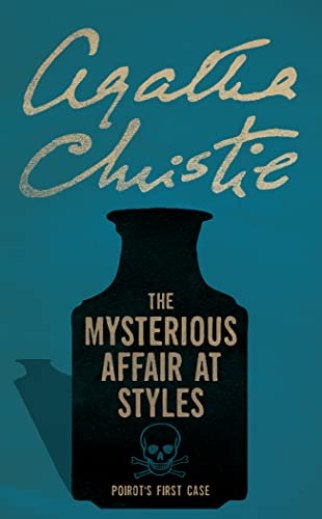
Well obviously you’ve got to read the first Poirot book, not that sequence is an issue with Christie as it is with many authors. But it’s always interesting to a) read an author’s first book, and b) read the first book to feature a well-known detective. So you absolutely must begin with The Mysterious Affair At Styles, published in 1920 and featuring Hercule Poirot. I would say he is the world’s foremost fictional detective (though fans of Sherlock Holmes would no doubt disagree). This is a phenomenal debut, and an intriguing mystery.

Christie famously disliked Poirot, and her dislike is clear in the rather comical, uncharitable description of him as he makes his first appearance in chapter two, meeting by accident the narrator of the story, his famous side-kick Hastings. Right from the outset, we note that Hastings always treats Poirot with a mixture of pity and affection. We are told: Poirot was an extraordinary-looking little man. He was hardly more than five feet four inches, but carried himself with great dignity. His head was exactly the shape of an egg, and he always perched it a little on one side. His moustache was very stiff and military. We are also told of his love of neatness bordering on obsession and, again as always, Hastings is at pains to point out that Poirot’s glories are behind him and he is past his prime. In fact, he’s past his prime for the next, what, thirty, forty years?

So Poirot is not in any shape or form the figure of a hero – he’s short, stout, he limps, he’s fussy and overly particular, and he’s older in years than a classic swash-buckling, overcoming-all-obstacles big-screen hero of that era or even our own. And he has personality flaws in the form of vanity and self-importance, and often, a deep lack of self-belief that I think most of us could identify with today.

But his strengths – oh they are good – he is an acute observer of humanity, he notices EVERYTHING, he understands human psychology, and his success lies in his deep thought processes and his use of logic to work out the details of a crime, that and a reliance on the everyday bigotry that overlooks the intelligence or usefulness of a foreigner on the part of many he comes into contact with.

So that’s Styles.

You also HAVE to read two other classic Poirot’s: Death on the Nile and Murder on the Orient Express. These have become such genre classics almost independent of their creator, and the TV series and various film versions have definitely assisted with that. These books have masterful plots featuring an ensemble cast, and represent neat variations on the country house theme by being a ship and a train. The exotic locations just add to the pleasure.

Miss Marple is one of Christie’s other detectives, and is almost as well known and beloved as Poirot. She is a single old lady who knits and gossips. She solves mysteries by the simple expedient of listening, asking questions and again, like Poirot, knowing a great deal about human behaviour. This is largely the result of her life experience, and the fact that she lives in a small community where everyone knows everyone. Like Poirot, she is often overlooked as a threat to the plans of baddies and evildoers. The best Marple book to start with, in my opinion, is again the book that introduces us to the character, a volume of short stories first published in 1933, The Thirteen Problems (or in the US this is called The Tuesday Club Murders). In this book, each of a group of friends tells of an unsolved murder they know about, and various solutions are put forward by the rest of the group, until in the end, Miss Marple, between counting stitches or casting on a new ball of wool, puts forward the truth, which is then acted upon and checked by someone who is a high-up legal chap. By the end of the book, the others now turn immediately to Miss Marple, knowing she will tell them the only true solution.

Two more famous Marple books, which are in a way companion pieces, are A Caribbean Mystery and Nemesis and are also excellent, showing her personality in her strength of purpose and determination to see justice done.

Okay, I know I said five books, and there they are (not really five but it’s not easy to choose between some of them…). And I can’t resist adding a bonus one: the extraordinary Death Comes As The End. It was published in 1945, and is a traditional-style murder mystery, but it is set in ancient Egypt, and the background was gleaned by Christie from her archaeological exploits with husband number two, Sir Max Mallowan. It’s a great story, full of fascinating detail, and it inspired me as a teenager to learn more about history of all eras.

And of course, you’ve got to read The Murder at the Vicarage, Lord Edgware Dies, my personal favourite, The Murder of Roger Ackroyd, and my ‘other’ personal favourite, Evil Under the Sun.

I hope that, having read all the above books, you might feel an impulse to go back and read the rest of her works. They are well worth the effort, and I am sure you will agree, not only are they entertaining and enjoyable, you will also feel that you have come to know the woman behind not just these works but the modern cosy mystery genre as a whole. Without Agatha Christie, I believe there would be no Midsomer Murders, no Vera, Shetland, no Line of Duty,  or Inspector Morse.

***

Telling myself it’s all okay and that I can do this…

I’ve been really stumped for ideas to come up with for a blog post or a newsletter lately. Mainly because I’m using all my creative energy and inspiration for the final edit/polish I’m currently doing on A Wreath of Lilies (out 8th December, lest we forget – all too soon for my comfort right now).

And these are the things I’ve realised about my story so far:

  1. There are too many people with a surname beginning with P
  2. There are too many people with a first name beginning with S
  3. As always with my books there are just – too many people. Soooo many people…
  4. Things happen in the story that have already happened.
  5. Things happen before they happened?????? How does that even????????????????? Yes I don’t know either.
  6. One chap’s wife changed name halfway through the book. My sympathies go out to the family in question.
  7. One dead body was dead so often in so many places, she/he must have been a triplet… Maybe even a quintuplet. (Note to self, a story about quintuplets would be awesome, if rather complicated.)
  8. I’ve got more criminals than crimes.
  9. I’ve got more police officers than criminals.
  10. Did I mention I have too many characters?
  11. My main protagonists have accidentally reversed their ages by a year. I wish I could do that IRL.
  12. I found my characters using jargon and slang that wasn’t around in that era.
  13. The police are using technology that wasn’t around in that era.
  14. If they all stopped drinking tea and gazing at one another, the crime(s) would get solved three days earlier.
  15. Pretty sure it will end up being okay though. Keeping everything crossed.

Quick sneaky peek:

Closer to hand, Dee was startled out of her thoughts by a man suddenly saying, ‘Ah, we meet again!’

Turning, she saw Clive Barton’s smiling face and she responded with a friendly, ‘Mr Barton, how nice to see you again. I’m here with Miss Marriott,’ gesturing as she spoke.

He nodded, looked disappointed, and murmured, ‘Excuse me, ladies.’ He went off and she saw him settle himself in a seat near the back of the room.

‘He’s too old for you,’ Miss Marriott said in a stage-whisper, taking Dee by surprise. Why was everyone so interested in her love-life? Although in Mrs Padham’s case, perhaps she had become so bitterly opposed to anyone having a love-life after she herself had been abandoned. Dee wondered vaguely why Mrs Padham’s husband Henry had left her. Perhaps she had nagged him the way she nagged her guests.

‘My goodness, I should think so,’ she said vehemently to Miss Marriott’s remark. ‘Not that I’m looking anyway.’

‘Taken, are you?’ Miss Marriott’s eyes bore into her, on the alert for any kind of response. Dee thought she may as well admit it.

‘Sort of.’

‘I see.’ Miss Marriott’s smile was triumphant.

It seemed likely, certain even, that there would be further questions later. But now, with the room packed and a number of people standing at the sides and at the back, the woman at the front stood neatly to attention at the table and rapped on the wooden surface with a teaspoon from the cup and saucer in front of her.

‘They get tea, I notice,’ Miss Marriott whispered resentfully. Dee simply nodded.

‘Good evening ladies and gentlemen. Welcome to this open meeting to discuss the proposal to move the graves from the existing burial site to a new position at the north end of the village. I am Cynthia Miles-Hudson, head of planning at Northeast Essex council. On my right, is the Honourable…’

‘There’s nothing honourable about Fast Eddie Windward!’ someone yelled from the back. ‘He’s as crooked as they come!’

A Wreath of Lilies eBook version pre-order


***

Coming 8 December 2023: A Wreath of Lilies: Miss Gascoigne mysteries book 2

I’m giving in to the long-suppressed urge to share a scene from the new murder mystery I’m currently working on. It will be called A Wreath Of Lilies – you may well have seen me banging on about it already. This will be the second book of my new-ish 1960s series featuring Dee Gascoigne as a private detective. If you haven’t already seen it, you can find out more about book 1 – A Meeting With Murder  – here.

Here’s the blurb-type thing (which may change…)

On her first ‘official’ investigator case, Dee Gascoigne is off to the village of Hartwell Priory, where locals are up in arms over the proposal to dig up the deceased ancestors buried in the local cemetery in order to make way for three hundred new houses.

As if things aren’t tense enough, a group of hippie-like ghost hunters arrive and hold a seance. A message from beyond the grave seems to indicate that a grave has been forgotten.

Or was it just an illegal burial?

This book will be out in October, and like all my books, will be available in eBook form, paperback and large print paperback, from Amazon, and regular-print paperback only from ‘other’ online retailers and libraries. Here’s a sneak peek, in case you’re interested, hope you enjoy it.

Dee Gascoigne was the only person in the train carriage. She had a newspaper in case she got bored, as it was a long, slow journey to Hartwell Priory, a village close to the North Essex coast. And if the newspaper was not enough, she had a novel in her handbag – the Agatha Christie book that she had wanted to read for some time and that she’d been given by her cousin Jenny as a birthday present. Next to the brand new copy of A Caribbean Mystery was the envelope Monty had given her. She had better not lose it. It contained some cash to pay for her expenses, and a couple of sheets of paper that outlined her new ‘case’. She used the word in her mind, and it thrilled her to the core – she was actually on a case. In addition to these she had a letter of introduction and a handful of business cards so that she could be confident in the face of any challenge to her – call it what it was – nosy questioning.

If there was something that could be called a ‘gift’ in Dee’s character it was her ability to ask far too many questions, and it was pleasing to know that these could now be asked officially on behalf of Montague Montague of London, legal services.

Only yesterday, Thursday September 2nd 1965, Dee had been sitting in Monty’s office, hoping almost against hope it had seemed, that he could help her.

It had been practically six months since she had left – or been asked to leave – her job as a modern languages teacher at a very nice school for very nice young ladies. Since then she had found herself at a loss over what to do with her life.

Then, in the Spring, she had been sent off to the seaside to convalesce after an illness and had stumbled into a murder mystery exactly like those she so dearly loved to read. (Here she glanced with fond anticipation at the little bit of the cover of A Caribbean Mystery that she could see nestling in the top of her open bag). She had helped her dratted sort-of cousin, Inspector Bill Hardy, to clear up the mystery, risking her own life and limb to do so, but was the man grateful? Not at all. ‘Keep out of police business in future,’ he had growled at her at her mother’s birthday party, grabbing her arm in a vice-like grip and steering her away from the celebrations where she had been enjoying a lively discussion with her aunt, his mother, who also loved to ‘dabble’ in mysteries. He had a bloody cheek, Dee fumed to herself.

Anyway… Where was she? She had lost herself in the midst of feeling angry with Bill. She certainly wasn’t going to think about how handsome he had looked in his formal dinner suit, nor about how much she liked the way his dark hair crinkled behind his ears and at his neck now that he was wearing it a little longer as many young men did these days.

She had been out of work for some months now. Oh, she had been invited to several interviews for positions at other schools, but it always came down to the same thing: she just didn’t want to go back to teaching.

Yet what else could a recently separated woman do? People were so sniffy about the idea of a woman leaving her husband. It was this scandalous action on her part that had cost her the job in the first place.

And then, seemingly from nowhere, when all hope was lost and the money she had borrowed from her parents was dwindling to a pitifully tiny amount, dear, dear Monty had asked her brother Rob to get her to come and see him.

‘I’ve got something in the way of a job idea that might interest you,’ M’dear Monty had wheezed at her across his vast oak desk. Eighty if he was a day, and about to start his fifth retirement, Monty’s legal expertise had saved Dee’s family on more than one occasion.

She had been all ears. Could he really be serious? She held her breath waiting to see what he said. Even if it was a typing job, she’d have to take it. Not that she could type, not really. But she could no longer pretend that she wasn’t desperate. Her pride – that thing that goeth before a fall – was now in tatters.

‘Most law practices engage investigators to find out things for them. To carry out research, or to go to speak to people, that sort of thing. Montague’s is no different. But the fellow I have been using for the last two or three years has – er – shall we say – found it advantageous to his health to quickly move to South America. Therefore I now have a vacancy.

‘Dear Rob has kindly given me full account of your exploits down in Porthlea – delightful place – in the spring, and I think you could be just what I’m looking for. I know your inquiring mind, (nosiness, Dee told herself) and that you are an intelligent woman. Resourceful too, (crafty, Dee amended) and I know that I need have no doubts whatsoever about your moral integrity.’

She was on the point of speaking, but he held up a hand to halt her. He added, ‘Oh I know this is rather new to you, M’dear, but I feel you have a certain bent for investigating. In any case, I need someone right now, and if I may be blunt for a moment, you need the money. Can I persuade you to give it a try? If it doesn’t suit you, M’dear, no harm done on either side. What do you say?’

Well, what could she say?

‘My goodness, Monty dearest, I’d love to!’

And so here she was, on a painfully slow train that seemingly stopped at every rabbit hutch and milepost, heading to a place she’d never even heard of: Hartwell Priory.

She knew it was a tiny place, barely more than a halfway point between the busy port of Harwich and the city of Colchester in the county of Essex. She was to find her way to a guesthouse and rent herself a room for the week. Monty seemed to think it could take her several days, perhaps a whole week, to find out the things he needed to know.

She had money for her expenses, and the promise of ten pounds in wages, whether she was successful or not. Oh, she prayed she would be. The last thing she wanted was to let Monty down after his kindness.

The guard peered at her through the window of the connecting door to the next carriage. He’d already clipped her ticket and was checking to see if any new passengers had boarded into her carriage. They hadn’t of course, it had been almost an hour since she’d seen anyone other than the guard.

The business cards Monty had so clearly had printed before he even knew what she would say, stated simply: Miss Diana Gascoigne, Associate, Montague Montague of London, legal services. And the letter of introduction, was exactly that, short, to the point, impossible to quibble with or gainsay:

‘To whom it may concern,

I confirm that Miss Diana Gascoigne is an associate of this company, Montague Montague of London, legal services, and that she is employed by myself and under my instructions.

The Honourable Montague Montague QC, Bart.,’

The connecting door opened. Dee glanced up. The guard, a young man in his twenties, said,

‘We’ll be there in two minutes, miss. Watch your step getting down, it’s quite a drop to the platform.’

‘Thank you.’

‘Do you need help with your suitcase?’

‘Oh no, that’s quite all right, thanks.’ She beamed at him.

He blushed and left, and Dee closed her handbag with a snap, got up, grabbed her raincoat and hat, and hefted her case down off the luggage net and began to make her way to the corridor. The train slowed and the long narrow platform appeared beneath the window.

She had arrived.

***

So are you hooked? You can pre-order the eBook here, or just leave yourself reminders everywhere to order the paperback, hardback or large print paperback when they come out, around the same time as the eBook – sorry ‘actual’ books are not available yet for pre-order, only the eBook. 

Grateful thanks for the image go to Shutterstock and more especially, Agalaya:

https://www.shutterstock.com/g/Arco+Bianco/about

***