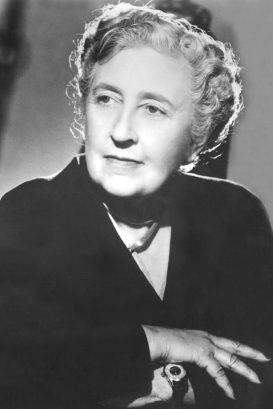
 Agatha Christie is arguably one of the most well-loved authors of all time. And her books are still being published in new formats, turned into plays and TV series and mini-series, and of course films on the big screen, a hundred years after she first began her writing career. Her books regularly top the online bestseller lists and there have been spin-offs, recreations and fan fiction. You can even buy her ‘secret notebooks’, biographies and merchandise.
Between 1920 and 1973-ish she wrote 66 detective novels under her (first) married name, Agatha Christie, 6 non-detective novels as Mary Westmacott, and 14 short story collections. In addition a number of her works have been adapted for the stage, or were written as plays that have now been novelised.

But far from setting out to be a great author, she only started writing at all due to a bet with her sister, and a certain amount of boredom. Yet she has created some of the best and worst (sorry, but Parker Pyne and Mr Quin????) detectives in the genre, and some of the most devious and controversial plots to ever trick, misdirect and enthrall the reading public. If we sometimes today find her plots predictable or jaded, that is because we can easily forget that she and a handful of other trailblazers have, through their work, made us as readers more sophisticated and at the same time, have aroused expectations to fit the genre. If we can place the books in their original era, then they become even more fresh, more unusual and very, very clever.
So if you’ve been living on the moon, and haven’t read anything by Christie before, or if you’ve only lately come to detective fiction via some other nefarious genre, what are the five books you should read by Agatha Christie?
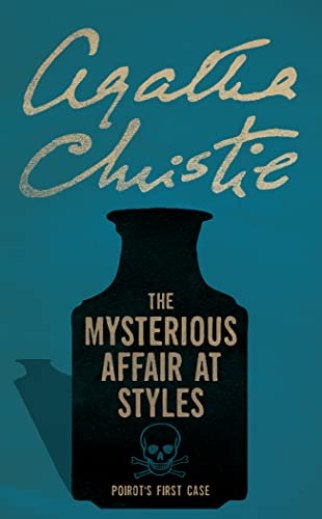 Well obviously you’ve got to read the first Poirot book, not that sequence is an issue with Christie as it is with many authors. But it’s always interesting to a) read an author’s first book, and b) read the first book to feature a well-known detective. So you absolutely must begin with The Mysterious Affair At Styles, published in 1920 and featuring Hercule Poirot. I would say he is the world’s foremost fictional detective (though fans of Sherlock Holmes would no doubt disagree). This is a phenomenal debut, and an intriguing mystery.
Christie famously disliked Poirot, and her dislike is clear in the rather comical, uncharitable description of him as he makes his first appearance in chapter two, meeting by accident the narrator of the story, his famous side-kick Hastings. Right from the outset, we note that Hastings always treats Poirot with a mixture of pity and affection. We are told: Poirot was an extraordinary-looking little man. He was hardly more than five feet four inches, but carried himself with great dignity. His head was exactly the shape of an egg, and he always perched it a little on one side. His moustache was very stiff and military. We are also told of his love of neatness bordering on obsession and, again as always, Hastings is at pains to point out that Poirot’s glories are behind him and he is past his prime. In fact, he’s past his prime for the next, what, thirty, forty years?
 So Poirot is not in any shape or form the figure of a hero – he’s short, stout, he limps, he’s fussy and overly particular, and he’s older in years than a classic swash-buckling, overcoming-all-obstacles big-screen hero of that era or even our own. And he has personality flaws in the form of vanity and self-importance, and often, a deep lack of self-belief that I think most of us could identify with today.
But his strengths – oh they are good – he is an acute observer of humanity, he notices EVERYTHING, he understands human psychology, and his success lies in his deep thought processes and his use of logic to work out the details of a crime, that and a reliance on the everyday bigotry that overlooks the intelligence or usefulness of a foreigner on the part of many he comes into contact with.
So that’s Styles.
You also HAVE to read two other classic Poirot’s: Death on the Nile and Murder on the Orient Express. These have become such genre classics almost independent of their creator, and the TV series and various film versions have definitely assisted with that. These books have masterful plots featuring an ensemble cast, and represent neat variations on the country house theme by being a ship and a train. The exotic locations just add to the pleasure.

Miss Marple is one of Christie’s other detectives, and is almost as well known and beloved as Poirot. She is a single old lady who knits and gossips. She solves mysteries by the simple expedient of listening, asking questions and again, like Poirot, knowing a great deal about human behaviour. This is largely the result of her life experience, and the fact that she lives in a small community where everyone knows everyone. Like Poirot, she is often overlooked as a threat to the plans of baddies and evildoers. The best Marple book to start with, in my opinion, is again the book that introduces us to the character, a volume of short stories first published in 1933, The Thirteen Problems (or in the US this is called The Tuesday Club Murders). In this book, each of a group of friends tells of an unsolved murder they know about, and various solutions are put forward by the rest of the group, until in the end, Miss Marple, between counting stitches or casting on a new ball of wool, puts forward the truth, which is then acted upon and checked by someone who is a high-up legal chap. By the end of the book, the others now turn immediately to Miss Marple, knowing she will tell them the only true solution.
Two more famous Marple books, which are in a way companion pieces, are A Caribbean Mystery and Nemesis and are also excellent, showing her personality in her strength of purpose and determination to see justice done.
 Okay, I know I said five books, and there they are (not really five but it’s not easy to choose between some of them…). And I can’t resist adding a bonus one: the extraordinary Death Comes As The End. It was published in 1945, and is a traditional-style murder mystery, but it is set in ancient Egypt, and the background was gleaned by Christie from her archaeological exploits with husband number two, Sir Max Mallowan. It’s a great story, full of fascinating detail, and it inspired me as a teenager to learn more about history of all eras.
And of course, you’ve got to read The Murder at the Vicarage, Lord Edgware Dies, my personal favourite, The Murder of Roger Ackroyd, and my ‘other’ personal favourite, Evil Under the Sun.
I hope that, having read all the above books, you might feel an impulse to go back and read the rest of her works. They are well worth the effort, and I am sure you will agree, not only are they entertaining and enjoyable, you will also feel that you have come to know the woman behind not just these works but the modern cosy mystery genre as a whole. Without Agatha Christie, I believe there would be no Midsomer Murders, no Vera, Shetland, no Line of Duty, or Inspector Morse.

***


 And yes, they often come as a pair or even more, not just as a lone individual. Detectives, for example, often come as a pair – one an amateur and one a professional. Villains too, can sometimes deliberately confuse the reader by sharing the limelight with another villain, and share the crimes too.
 A handsome young man on his honeymoon. (I’m looking at you, Death on the Nile.)


You must be logged in to post a comment.