
As I may have mentioned 473 times this year, my new Miss Gascoigne book, A Wreath of Lilies is due out on the 8th December this year. It’s book 2 of my new series set in Britain in the ‘swinging’ (not like that, you naughty people) 60s.
The protagonist, Dee Gascoigne has actually been offered a paid excuse to go to a small village and be her normal nosy self. She can hardly believe her luck! That is, until a boring meeting turns into something for more dangerous…
If you’re intrigued, you might like to take a look here to read a bit from Chapter One (a big bit, it’s more or less the whole chapter…)
Or you could just carry on and read this scene from a later chapter:
It was a relief to leave the hot angry air of the pub’s meeting room and get out into the cooler air of the evening. Most of the villagers who had attended the meeting were well ahead of them due to Miss Marriott’s slow pace.
Only half past eight in the evening, but night was fast approaching. At the horizon the sky was still pale blue, but higher up in the atmosphere the blue velvet sky was growing deeper, darker, and already Dee could see a few scattered stars twinkling as silvery pinpricks. She would have loved to stand and gaze at the sky, to enjoy the hush as the night-time settled around her. A night for lovers, she thought, and dismissed the image of her ‘cousin’ Bill. There was no time for that sort of thing right now.
She couldn’t be sure he would ever be truly hers. Men liked to play the field, didn’t they? And he seemed to be committed to doing exactly that. Busty Barbara had given way to Leggy Pam, Giggly Susan, then Wistful Wendy, according to Bill’s mother, her Aunt Dottie. The last thing Dee needed was a man who changed girlfriends as often as his socks. Yet he’d sworn to Dee that he loved her… That he would wait for her. Perhaps waiting didn’t mean saving himself? She sighed. Why were things always so complicated?
Snapping Dee from these unhelpful thoughts, someone came running up and spoke to Miss Marriott.
‘You’ll never guess what!’ This newcomer exclaimed, excitement bubbling over as she giggled.
‘Well, out with it, Sylvia, what are you on about?’ Before Sylvia had a chance to explain, Miss Marriott was turning to Dee and grumbling, ‘I do hate it when people hem and haw, and hint and don’t say exactly what they mean. Hurry up, Sylvia, we’ve got to get to the churchyard!’
‘That’s where they’re doing a séance!’ Sylvia burst out.
Miss Marriott huffed. ‘We already know that, dear, that’s why everyone is rushing in that direction. Surely you realised that? Now do come along.’
‘It’s them beatniks, them seekers. They’re doing it again!’
‘We know that too, dear,’ Miss Marriott told her again, sounding exasperated by this new person. Dee glanced at Sylvia, a young woman in her early twenties, dressed in a housecoat over slacks and a blouse. Her hair was scraped back severely in a ponytail that hung over her left shoulder.
As they went along, Sylvia continued excitedly, ‘They’re holding hands in a circle and calling on the spirits to speak to them. Oh it’s so exciting!’ She broke off to look at Dee. ‘Sorry, but who are you?’
Dee introduced herself. ‘I’m Dee Gascoigne. I’m staying at Miss Marriott’s for a few days. I’m here to find out more about what’s going on in the village.’
‘Police? Or a reporter?’
‘Neither, actually. Miss Marriott’s legal adviser sent me. Shall we…?’ Dee pointed after Miss Marriott who was already some distance in front of them now.
Sylvia nodded. ‘Ooh yes, let’s!’ as if it was a treat.
They hurried after the old woman who was moving faster than Dee had so far seen her move, albeit aided by her walking stick. The other people from the meeting were also headed that way, though many of them were already inside the walled expanse of the churchyard.
By the time they reached the area where the séance was supposedly happening, Dee had already seen two people stumble over half-hidden gravestones in the dark and sprain their ankles, and one person had fallen headlong and now had a suspected concussion. Little knots of people offered assistance to the injured parties, but in general, the mood amongst the villagers had turned from mere curiosity to that of an angry mob. Dee’s heart pounded as she gave into the urge to hurry along. She had serious misgivings. And when she saw the mass of people crowding into the area and heard loud shouting a short way ahead, she halted, taking Miss Marriott’s arm.
‘I think we should just get you home,’ she said.
Sylvia on the other hand, was still trying to urge them forward more quickly, impatient with them for holding her back when she clearly wanted to run.
‘Oh what rot!’ Miss Marriott snapped. She rummaged in her coat pocket and held out a key. ‘Here, take this. You can go back, if you’re such a ninny.’
With an inward groan, Dee gave in. Thirty or forty yards ahead, she could see a bonfire burning in a brazier, whilst around it figures in silhouette were standing in a circle, chanting softly, their hands joined.
Even in the darkening twilight, Dee could see that their robes were saffron, or white, or purple, and of a floating light fabric that reached to the ground. There were, she thought, perhaps eight or ten of them, men and women, all dressed alike in these robes, some in white ones, two men in purple, and nearer to where she was now, an older woman and two men in saffron-coloured robes, then there was one person, already crouching down onto the ground in an emerald robe.
They wore flowers and strings of beads about their necks, and in their hair, and they sang a song without words, one that Dee instinctively felt she knew somehow. They touched no one, called out to no one, but were gathered by their brazier, arms raised now to rattle tambourines, or to beat a rhythm on a tabor or to chime cymbals together.
A saffron-clad man with hair reaching almost to his waist began to speak, and his cohorts stepped back and bent to sit on the ground, cross-legged and silent.
‘Again the unclaimed one calls out to you, heart to heart, spirit to spirit, and begs to be brought home, to be mourned and released, no longer to be cast adrift between this world and the next. They cry out to you for your pity. Do not turn away from their plea. We who seek implore you…’
But he got no further.
A couple of the men at the head of the rabble of villagers rushed forward to break through the circle of seated chanters, grabbing a couple of them by their arms or legs and dragging them away from the group.
Someone kicked the fire brazier over, and predictably instead of going out, the flames caught at the tall grasses and set them alight. People began to yell, the flames spread, someone threw a punch and within seconds there was a brawl. The flowing white robe of a young woman caught alight. Galvanised into action, Dee rushed forward to throw the girl onto the ground, tearing off her own jacket to quickly smother the flames. Mercifully, the girl was unharmed, Dee thought. She shuddered to think what might have happened had her jacket not been to hand.
‘Are you all right?’ she asked the girl, who appeared somewhat dazed. She nodded.
‘I-I think so… Thank you…’.
Dee helped her to her feet. Most of the robe had been burnt away now, as was Dee’s jacket, a sooty rag on the ground. The young woman hurried away, no doubt to rejoin her friends. Dee looked about her for Miss Marriott, worried yet again that the old woman was too frail to be out amongst this chaos.
There was no sign of Miss Marriott and Dee began to panic. The shouting of the people, the billowing flames, and the orange-black smoke already hanging seemingly all about her made it near impossible to see what was going on. She became aware that she was breathing shallowly due to the smoke, her eyes stinging, her hands shaking. She had to fight down a sense of panic and force herself take her time to look about her properly. She stood for a minute or two in the midst of all this noise, looking about her.
There, she thought, there she was. She made her way over to Miss Marriott’s side. The old woman clutched at Dee with relief. Her bony fingers pinched at Dee’s arm, icy through the fabric of Dee’s dress.
‘Oh my dear, I thought I’d lost you. I tripped, and then somehow, I lost my bearings in all this smoke. And I can’t find my walking stick.’ She was looking all around her at the ground, hoping to spot it. But there wasn’t a hope of finding it. They needed to leave.
Dee put an arm around the old woman and tried to guide her away. ‘Don’t worry about that now, you can lean on me.’
The bishop and the woman from the local history group were standing together by the gate and watching the scene with horror. The bishop attempted to call for peace but he was shouted down. Dee once again tried to persuade Miss Marriott to return home. Sylvia was nowhere to be seen; it seemed likely that by this time she was much farther ahead.
A scream rang out—and finally people began to realise the scale of the problem, and at last began to back away to the safety of the lane. The fire had taken a firm hold and was snatching with greedy licks at the dry grasses, weeds and fallen branches. With lightning speed, it was conquering the churchyard.
Behind them, at the village end of the churchyard, police officers began to appear, running forward, waving truncheons haphazardly, and Dee grabbed Miss Marriott firmly by the arm.
‘We’re leaving now!’
*
Thanks for reading! I hope you enjoyed that extract.
I do hope you’ll nip over to our old friend Mr Amazon right now and pre-order your eBook, but if like me you prefer something solid you can hold, the paperback, large print paperback, and hardback editions will all be out around the same time as the eBook on Amazon, or you can find a paperback copy on Barnes and Noble, Waterstones, Scribd and many other online book shops on or just after 8th December.

***

 I recently read somewhere that routine hinders the creative process. To really be creative, I read, we need to let go of organisation, routine and any kind of rigid preconceptions or framework, and allow ourselves freedom to explore in any direction and form that appeals to us.

 If you are organised, you can relax and focus on the job in hand. You make the most of your time, you crack on, (hopefully/usually) and have something concrete to show for it, so productivity is improved and you feel good about what you’ve achieved. Which makes it more likely you’ll do it again tomorrow. In addition, good output leads to increased experience, increased confidence and also positivity, and as many writers know, these are commodities that can be hard to come by.
 As I’ve said already, routine, planned writing leads to increased output and measurable results. You see the word count piling up and you see that you are moving towards your deadline or goal. This gives you the impetus you need to write through the tough sections of your book, those tricky little scenes and the mid-book blues, even through the ‘I don’t want to do this anymore’ sulks.
 This week, I’m away so I thought I’d do a quick and easy (for me haha!) post: It’s a deleted scene from A Meeting With Murder: Miss Gascoigne Mysteries Book 1 which is one year old!!!!!!!
 I remember as a kid I was a voracious reader. By the time I was 6 or 7 I was reading from a big book of fairy tales.

 Guess what? I’ve been doing stuff on social media!


 Agatha Christie is arguably one of the most well-loved authors of all time. And her books are still being published in new formats, turned into plays and TV series and mini-series, and of course films on the big screen, a hundred years after she first began her writing career. Her books regularly top the online bestseller lists and there have been spin-offs, recreations and fan fiction. You can even buy her ‘secret notebooks’, biographies and merchandise.
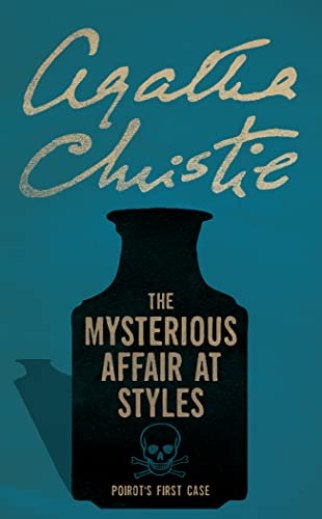 Well obviously you’ve got to read the first Poirot book, not that sequence is an issue with Christie as it is with many authors. But it’s always interesting to a) read an author’s first book, and b) read the first book to feature a well-known detective. So you absolutely must begin with
  So Poirot is not in any shape or form the figure of a hero – he’s short, stout, he limps, he’s fussy and overly particular, and he’s older in years than a classic swash-buckling, overcoming-all-obstacles big-screen hero of that era or even our own. And he has personality flaws in the form of vanity and self-importance, and often, a deep lack of self-belief that I think most of us could identify with today.
 Okay, I know I said five books, and there they are (not really five but it’s not easy to choose between some of them…). And I can’t resist adding a bonus one: the extraordinary
 I’ve been really stumped for ideas to come up with for a blog post or a newsletter lately. Mainly because I’m using all my creative energy and inspiration for the final edit/polish I’m currently doing on A Wreath of Lilies (out 8th December, lest we forget – all too soon for my comfort right now).
 I’m giving in to the long-suppressed urge to share a scene from the new murder mystery I’m currently working on. It will be called
  Because more than half of my books are set in the 1930s, I constantly find myself – even eight books in – looking stuff up. It might be easy to find stuff like ‘good poisons to kill someone with’ (My search history would def land me in a lot of trouble if anything ever happened to my nearest and dearest), but sometimes it’s deeper, more complicated stuff (ie questions such as ‘when did the UK first get direct dialling telephone systems?’ or ‘how much did a postcard and a stamp cost in 1934?’) I need answers to.


You must be logged in to post a comment.