The bath that came in from the cold: the rise of the modern domestic bathroom: part 2

A baby bath now used for logs for the fire

I’ve been re-reading a great book about domestic life: ‘If Walls Could Talk: An Intimate History of the Home’ by Lucy Worsley. I highly recommend this book for a fascinating, very accessible history of the home. Of bathrooms she says, ‘Bathrooms are now…the only rooms…with a lock on their doors, yet the activities that take place within did not always require privacy’.

The full immersion of the body into water was more of a ritual for spiritual purposes or for political allegiance than it was to do with getting clean. Soldiers would cleanse themselves before going off to the crusades – it was a setting aside of the physical and the spiritual self for the express purpose of going into battle for God. Knights bathed before receiving the    conveyed upon them.

The concept of a room set aside (more or less) for the sole purpose of cleansing the body is a relatively new one. Previously, bathing was a communal, social activity. In the medieval times, both sexes enjoyed bathing in public bathhouses. It was not done to cleanse the body but for fun and relaxation. You could even get a meal sent in to you, and a few pints of ale from a nearby inn. Unfortunately the bathhouses where you could bathe, drink and be merry rapidly acquired a reputation for naughty sexual shenanigans, and it wasn’t long before bathhouses became brothels, pure and simple. There were other concerns too: sharing water with a large number of other people meant that bacteria lurked, and bathing became more likely to infect your body, not less. Bathing began to be regarded with suspicion and distrust, and consequently, people stopped doing it.

This gave rise to the private wash in the bedroom. We have probably all seen the large jug sitting in a matching china bowl on a washstand, a vital piece of furniture. Hot water was carried up from the fires of the kitchen or scullery by panting maids who must have had biceps and shoulders like a modern action movie hero. These days we still see these jug sets in homes, guest houses and boutique hotels, no longer for daily use but for decoration, used to convey a sense of homely comfort and traditional values.

But with bathing out, the emphasis was on the wearing of clean clothes. Underwear was invented, and it became the norm to change the clothes more often. Washing was done in the dim recesses of the servants areas of the large country house, with households employing one, two or sometimes a whole team of laundresses for this particular work. Labour was cheap, clothes were not.

And it wasn’t all about the nasty germs that you might pick up from bathing, nor about having enough staff to fill a bath or run up and down with hot water. From the middle of the nineteenth century more than half of Britain’s population were living in cities. The sheer logistical demands of bringing fresh, clean water into the cities was a nightmare. Remember these places still had open sewers until the beginning of the 19th century. Water, when piping began, was often rusty, or tainted, or just not available due to the inefficiency of the system or the lack of proper distribution. Piped water was often only available at set times, so households had to either manage without, or get used to collecting and storing it until needed. This all required management and planning.

But from the Regency period onwards bathing, at home and beyond, again began to be seen as an important part of everyday life across all social strata. If you watched the new adaptation/reimagining of Jane Austen’s unfinished work, Sanditon on TV recently, you would have enjoyed the sight of gorgeous young men emerging from the sea after a swim – naked, of course, but perilously close to where the ladies are bathing from bathing machines in a ridiculous array of clothing to swim in. In Jane Austen’s wonderful work Pride and Prejudice, the precocious Lydia says, ‘I’m sure I should love to go sea-bathing,’ whilst her mother responds with ‘A little sea-bathing would set me up forever.’

There were still concerns about the dangerous effects of the action of the sea having a stimulating effect on women in particular, as ‘everyone’ knew that women were hysterical creatures at the best of times, and any kind of physical enjoyment was to be strictly controlled. I wonder if the birth rate went up nine months after a trip to the seaside? I guess that depends on whether or not ladies spotted someone like Sidney Parker (aka Theo James!) ambling out of the sea with not a stitch on.

Jane Austen’s works are so popular these days.

In Northanger Abbey, Catherine Morland travels to Bath with Mrs Allen to take the waters for their health, and in doing so, they are participating in the huge trend that was sweeping the nation: it was once more a good and healthy thing to do, not to mention a vital aspect of the social calendar for the well-to-do. To go to Bath, to see and be seen in the various rooms of the spa was on everyone’s to-do list. Science – or natural philosophy as it was then called – touted the benefits to mind, body and spirit of warm water containing salts and minerals. They didn’t just bathe in it, either. It was drunk by the pint.

But what if you were too poor to be able to be seen at a trendy spa?

The poor, or even middling wealthy, could of course, always swim in the sea, or lakes and rivers, and were arguably less at risk of the rapid rise and fall of fashionable opinion. New coastal resorts sprang up from the Regency era onwards, and from the middle part of Victoria’s reign the railways took even the less well-off to the coast for a day’s relaxation, walking swimming and sandcastle building. But even at home, the tin bath would come out and be filled with hot water for getting off the week’s grime and starting a new week fresh and clean. Ish.

Faith played a part here. Religion determined your bath night. Did you believe that Sunday or Saturday was the sabbath? Was the start of the new week Sunday or Monday for you? Because that dictated which day of the week your family had their weekly bath. For many, the end of the week was Sunday, and that was bath night, but there were large numbers for whom Saturday was the last day of the week and Sunday the first, so they had their bath on a Saturday night. Scandanavian languages still carry this concept in the everyday word for Saturday – in Swedish it’s lördag, in Danish and Norwegian it’s lørdag, and in Icelandic it’s laugardag (which is the closest to the language of origin). But they all mean the same – pool or bath day. There was also a sense that bathing was a social duty – one had to consider the people aroudn one, and the idea of smelling bad to others was abhorrent.

That long ditch in the middle of the street is the communal open sewer

For most people who were brought up C of E (Church of England/Anglican) Sunday remained the day when you had your weekly bath. And there was a strict order to who got to have the bath: starting with either the eldest or the ‘man of the house’ or main bread-winner (usually all three would have been the father of the family), and proceeding down the chain to the youngest. All using the same water. Can you imagine the state of the water by the end? There is a reason we have an old saying ‘Don’t throw out the baby with the bath-water.’ I’m guessing the water was so murky it would be hard to tell if anyone was left in there, though I sincerely hope no mother would accidentally leave her baby int he water and forget about it. (Said the woman who once took a picture of her baby in her new coat, then left the house, and was halfway into town before remembering the baby was still lying on the sofa… sorry, Darling!)

In 1918, a law was passed in Britain to the effect that all new houses had to have hot and cold running water to a bathroom. But of course, this had no impact on the millions of older homes. Only as finances allowed would bathrooms be added to the terraces and villas across the nation. These days if you buy a Victorian home, you will find either a bedroom or two have been sacrificed to provide bathrooms, or a bathroom has been added on as a built extension to the back of the house, often downstairs.

Fast forward to the Second World War, and hot water was rationed – or rather the coal that was usually the means of heating it, and individuals were only supposed to use a depth of four inches of water per day in their baths. I’m not sure how anyone hoped to regulate this, or how much it contributed to the war effort, but like a lot of things at that time, it gave the community as a whole a sense of ‘doing our bit’ and made people think they were helping their nation to win the fight.

So that’s it, from there we went to actual baths in actual designated bathrooms, and the concept of a daily shower quickly became a normal part of our cleansing ritual.

I want to close with this lovely item. I took this picture at Calke Abbey, Derbyshire. It’s a portable or travelling shower bath. The bamboo supporting canes can be removed, and the water tank at the top taken off, so that the traveller is left with conveniently-sized separate sections that can be readily reassembled on arrival at the destination. Always supposing you haven’t left vital screws, nuts or bolts etc on the dining room table at home. I like to think of it as a kind of IKEA device, with a Scandanavian-sounding name. Maybe The Lördag?

next week – the loo!

***


The rise of the domestic bathroom: My childhood in the 60s

As you will know if you’ve been to this blog before, I’m a bit of a history nut, and in particular I love the history of the private home. I mainly write mysteries set in the 1930s, although I set my books in other eras too from time to time.

But the few short years between the World War I and World War II bewitch and intrigue me. These were the years that really created the world as we know it now, and the legacy of those years is still widely felt and experienced today. (To read a bit more about how I see this era, please click on this link to read a blog post from last year)

Because of my daft preoccupation with the first part of the twentieth century, I visit a lot of English country houses and I take LOADS of pictures. I’m particularly interested in the more ‘basic’ aspects of life. I want to know about how meals were created, how houses and clothes were cleaned, and how people cleaned themselves. So I thought I’d tell you a bit about my childhood, and also next week, a bit about the rise of the modern domestic bathroom.

I was born in 1960 in the South of England. Contrary to many peoples’ view, this was not a time of universal comfort and modernisation. Not that I was particularly aware of it as a child, but looking back now, I can see we were very badly off by modern standards. Yet we were not alone, and I doubt if our experience was a rare one.

From when I was about three, or a little younger, we lived in what can only be described as a bedsit, though in those days we gave it the grander name of a one-room flat. Mum and I slept, cooked, and relaxed in that one room in an old house, with many other such rooms. If you read books written in the 40s, 50s and 60s, you will often come across mention of these grand old houses gone down in the world and divided up into flats or bedsits. Larger private homes became unmanageable without a staff to run them, and after the first world war, wages rose, and labour was scarce, lured away by the higher wages and often shorter working weeks in the factories. We lived in one of those grand old houses, a handsome very square, white-washed Georgian villa over four floors.

We were on the first floor ( second floor to you guys from the States), and our room faced out the back where there were the remains of a beautiful garden. Our neighbours on the same floor were two men sharing a room. They were British but called themselves Pierre and Rene, and they worked as hairdressers. They were young, noisy and seemed to have a lot of fun. They gave me gifts and sent postcards whenever they went away. I realise now they were a gay couple. But not then. Then, we thought they were just good friends. Really good friends…

Next door to them was ‘Uncle’ Harry, an elderly refugee from the former Yugoslavia. He’d been living there for fifteen or so years, since the war ended. He gave me tinned fruit and cream as a treat, and told me stories. I think he was lonely. He had lost his family in the war. He proposed to Auntie Zonya regularly but sadly she always turned him down. It was normal for children to call adult friends Auntie or Uncle, even if they were no such relation.

Across the hall was Auntie Zonya. I adored her. She was a strong influence on my early years. I have written a number of short pieces about her, including Jazz Baby, Patrick’s Irish Eyes, Big Knickers, and others. More importantly, she bought me my first cat.

There were others too, who were out for most of the day or kept to themselves, so we didn’t know them so well as these four. Upstairs in what used to be the servants’ quarters in the attic, was Miss Lilian, who was the owner of the house, and I was always told to behave and be polite when she came down to our floor, as she had the power to throw us out onto the street. I remember her as seeming incredibly old, with very white wavy hair, and not much taller than me. I’d love to know more about her life and whether she remembered the house in its prime, when it was all for one family. There’s never a time machine around when you need one.

There were people who lived downstairs in the basement too, but I only slightly knew the couple with the little girl who I played with occasionally. They had windows that were below the level of the garden, with little dug-outs around them to bring in the light. These were presumably the old kitchen, scullery etc of the house when it was in its heyday.

There was a shared bathroom on each floor. I remember we shared our bathroom with at least three and sometimes more other families, though usually these families consisted of single people or couples.

It wasn’t unusual to be on the loo or in the bath and someone else needed to use the facilities. It wasn’t unusual for there to be no hot water because someone else had used too much for their own bath. (No shower!) Most of the time when I was having a bath, someone would come in to shave, or wash, to rinse some clothes, or to use the loo–not a pleasant experience for either of us!

One friend in the house–my Auntie Zonya–used a chamber pot until well into the late 60s. I found it (empty I hasten to add) under her bed once and thought she was putting out cups of tea for an invisible giant. (I was an imaginative child) I only found out what it was when I asked her where the saucer was, as the ‘cup’ was shaped and patterned just like a huge teacup. I’d say that the fact that I didn’t know what it was shows that usage of chamber pots was in decline by the 60s, although clearly not completely done away with.

Even when we moved from there to a house–one bedroom upstairs and a kitchen/sitting-room downstairs, with a toilet in the backyard under a lean-to roof and with no light and loads of spiders–we still had no bath of our own. That was around 1966 or so. But it was private, and cosy, and I remember I loved that house. I was about 6 when we moved in, and only about 7 when we left, so we weren’t there as long as it seems in my memories. It’s gone now: that and the house next door–that belonged to a blind gentleman who was a piano-tuner–were bulldozed to create something a bit nicer. Auntie Zonya lived in the house after us, when we moved on. She said the piano-tuner’s house was haunted. Then again, she said that about everywhere.

Hot water had to be boiled. Baths were not available at all–we didn’t have one of those old-fashioned baths you see in period dramas. We had a plastic washing-up bowl and used to put hot water in it, stand in it and wash ourselves down. I had long hair. Washing that was a nightmare. We used to take a torch out to the loo when we needed it. As a lean-to shack, the loo had no light, no windows, and was freezing cold – even in summer. And the spiders…

When we moved into a council flat (again, for those from outside the UK, I mean an apartment complex in social housing/government housing for the needy/low-income families) we had a big dining/sitting room, a separate kitchen, two bedrooms. AND–drum roll please–a bathroom!!!!!!!! Not to mention under-floor heating. (That was blissful) We had to go to the flat to clean it the week before we moved in as the previous occupants had left it dirty, and this gave us the perfect excuse to have a hot bath, which seemed to us the height of luxury and I can remember it even now, more than fifty years later.

The most exciting part of this house, apart from the bathroom, and the two bedrooms, was the coal door next to the front door. Basically if a thief timed it right they could get into the flat through this coal door and take whatever they wanted (not that we had anything!) and leave by either the front door or the coal door. Not a great feature from a security point of view. As an avid Famous Five reader, I loved the idea of the coal door giving absolutely anyone access to our home.

From there, we entered the modern world of running hot water, central heating and baths, then showers, of washing machines, then tumble driers, fridges, freezers, microwaves, toasters and colour television, computers, the Internet, eBooks and self-publishing…

But long before I came into the world, the common approach to washing, going to the loo, and in personal grooming had undergone massive changes. Read more next week!

***


‘Features’ of the 1930s.

That’s an A5 notebook for comparison – Betty’s Paper was so much smaller than I expected.

I’m back to Betty’s Paper again. I wanted to have a look at the features that are inside the magazine.  Tell me what you think – do they seem very ‘now’ to you? I was a little surprised by how similar these mags were to the ones we read today. I’m not sure if I expected something different, and if I did, what exactly? Seems like they nailed the art of selling and entertaining even then.

The first thing that caught my eye with these and with some of the others I’ve seen, is that alluring offer of a ‘Free Gift’ emblazoned on the front. That sent me straight back to the 70s and my copies of Jackie and other magazines designed for teenage girls. There was often a free eye-shadow, or a lip gloss or something. They still do that, dont’ they? That was usually the only reason you bought the mag – that and the pin-ups inside! Can I confess right here and now that I had a massive poster of Ben Murphy from Alias Smith and Jones on my bedroom wall?

So an offer of a ‘platinette ring’ with a ‘sparkling stone of sapphire blue’ is going to lure us in with our hard-earned cash, isn’t it? I love the creativity displayed just in that little offer – platinette – sounds a teeny bit like platinum – so it’s bound to be good! I wonder how many girls were told, ‘Marge, it’s just gilt, love.’ And Marge, faithful to Betty’s Paper unto her dying breath would immediately retort, ‘It’s not gilt, it’s platinette!’ And not just any old platinette, either, it’s got a sparkling stone of sapphire blue in it. (Blue glass to you and me.) Free gifts always had a massive appeal, and would undoubtedly have sold loads more copies of the magazine, at small cost to the publisher. Another ‘free gift’ of note from another issue: A butterfly-shaped dress ornament. I bet that was taken out and admired repeatedly, but never worn – because how many opportunities does a hard-working girl get to go out dolled up with a butterfly on her frock?

But apart from the free gift, what features did Betty’s Paper offer? A few weeks ago I touched on the ads which offered all manner of fortune-telling and astrology. But just like today, for the readers of 1930s Betty’s Papers, the combination of both astrology and celebrities were a heady mix.

There is a double page spread on exactly this topic: ‘Confessions of a Hollywood Fortune Teller’. It’s quite clearly a gossip column under another name, and yet again, I take my metaphorical hat off to the cunning and crafty imagineers who created the content for Betty’s. They knew how to get people’s attention. If I could only bottle that stuff…

We start with a section about a girl called Ruby. You’ve never heard of her, right? Me either. Her name was Ruby Keeler. The article goes on to say ‘It’s hard to imagine a lovely talented girl accepting stardom reluctantly and being doubtful about it, isn’t it?’ (as if we’d know) and then, ‘She had come to Hollywood not as a star but as a star’s wife. That was all Ruby wanted to be. She was completely happy just to be Mrs Al Jolson.’ Oh ok, now I’m interested. But I’m a bit of a cynic and I couldn’t help laughing when I read: ‘She had never quite got over the thrill of realising that anyone so famous and splendid as Al could have wanted her–a night-club and vaudeville dancer. ‘I think you’re marvellous,’ he told her.’

Aww bless. Lifestyles of the rich and famous.

Are you a lonely, single night-club and vaudeville dancer? You too could meet someone famous and splendid who will admire you and call you marvellous for no reason other than that you’re young, blonde, beautiful, and can dance and sing. Just write in to Betty’s Paper and you might win a lovely undie set. We promise not to use your real name and address unless you win. Or are featured in our loveliest readers competition.

Seriously, I hope they were happy.

The bit about Ruby ends with, ‘Ruby became a star–rather reluctantly–and although she’s a bigger star than Al these days, I’m thankful to say that it hasn’t spoilt her married happiness in the least.’

(naughty snigger: a comment later on: ‘I sometimes think that Dick is out of place in Hollywood.’)

Another feature in very much the same vein is ‘Untold Love Stories of The Stars’ – the byline says, ‘Intimate Gossip About Hollywood’s secret romances’. Not any more. Secret, that is. they talk about Joan Crawford, June Clyde, and of course, Ginger Rogers, Hollywood’s sweetheart.

”When I marry Lew, I’ll have to learn how to cook,’ Ginger said seriously.’ (Lew Ayres – yes I’ve never heard of him either. Soz Lew.) The caption to the photos of them (two separate ones – obviously Betty’s Paper’s Authority on Hollywood didn’t get close enough for a pic of them together) says ‘Ginger Rogers and Lew Ayres are married now, but kept the gossipers guessing for nearly eighteen months!’ They should have called in the person who did the Fortune Teller of Hollywood article.

I was thrilled to discover Betty’s did a problem page! None of that Ask Auntie stuff. the page is called ‘It Helps To Tell’ then adds, ‘write to Betty about that problem that simply won’t come right.’ The bait? Another freebie of course! this time a cute camisole and french knickers or something like that. ‘This Lovely Undie Set For A Reader’s Problem’. It doesn’t say one each, so I imagine this is for the most exciting, I mean, the most unfortunate problem of the week. All names and addresses will be strictly in confidence, we’re told, but send in your name and address, just in case you win the prize!

What kind of problems do the worried readers of 1935 have? Well, it’s boys, obviously. A worried 18-year-old from Manchester writes, ‘I’m in love with a boy who doesn’t notice me.’ Reading between the lines, it’s clear that said boy, having only recently discovered girls, is now walking out with that fast piece from number 26. ‘On no account,’ Betty cautions, ‘dear, must you do anything to steal this boy away from this girl he has chosen.’ Find someone new, is Betty’s wise advice. Other problems – ‘My friend and I are both unhappy in our home lives and want to go into service in London. We are both eighteen.’ Oh dear. That immediately triggers my maternal WTF response. Two young girls going off to London all alone…????? Take a deep breath, concerned mums, and read on:

What does Betty say in response? ‘First, dear, yes, you are quite old enough to go into service. As a matter of fact, there is a great demand for girls of your age (I bet there is!) But you will find it easier to obtain a position if you first obtain some experience int he province. Your local employment exchange will help you to do this.’

Phew. Looks like Worried of Bradford will stay out of trouble a wee bit longer, then!

Thanks Betty’s Paper for all the fun of yesterday, which seems so remarkably like the fun of today. My conclusion: we haven’t changed a bit. I hope you enjoyed this trip into the 30s. I loved it.

Ben Murphy — because – why not???

Stories for a 1930s audience.

Last week I took a look at the kind of advertising you might have found if browsing through an issue of Betty’s Paper, a popular magazine from the 1920s through to (I think) about the 1940s. It’s hard to find out much about the mag without doing some hardcore research (it might come to that), but I know it was at its peak in the 30s, and there are still quite a few issues left to be snapped up if you’re of a mind to buy this kind of memorabilia.

Betty’s Paper wasn’t the only one around. There was also Peg’s Paper (1919 to 40) English Woman’s Journal (1850s to 1910), The Gentlewoman (1890 to 1926), The Freewoman (1911 to 1912), The Lady’s Realm (1890s to 1914), Time and Tide (1920s to 1970s), Woman’s Journal (1920 to 2001) to name the most well known. There were others, often with a more targeted purpose, for example, campaigning women’s suffrage and letting women know what was happening in various groups. Mostly magazines were aimed at middle and upper class women, but Peg’s Paper, and Betty’s Paper were aimed at working class women, and had less educational and more purely entertaining content than other magazines.

Betty’s – and Peg’s – contained short fiction, sometimes as serials, that thrilled the imagination, and owed a great deal to the cinema. There were fashion and style tips, using actresses of the era as role models, and holding them up as examples of the right look to emulate, very much as all the media do today. We looked at the ads last week, and I concluded that, again just as now, many were fixated upon appearance: looking slim, budget fashion that stood up to scrutiny, easy health fixes for people who lived busy lives, working hard and with little time or money to spend on themselves. Perfect for the factory and domestic girls of the 1920s and 1930s.

But what were the stories like that were every week there to tantalise our girls as they took a quick tea break or read for ten minutes before going to sleep?

Firstly, I noticed that the stories were illustrated, a bit like a children’s comic. I know that still happens today, but these struck me as being more dramatic. The men often seem to loom over the women in a authoritative almost aggressive manner. The men also look very old compared to the younger-looking women. Pretty sure all these heroines are about 20 and all the heroes are about 48.

The headlines and taglines too were melodramatic and leaning towards the scandalous. I presume this was a good way to draw in readers and get them to spend their cash – Betty’s Paper was tuppence ‘Every Friday’. When wages were paid weekly in cash, I imagine this was one of the first ‘treats’ a girl would get herself before going home and giving most of her money to her parents.

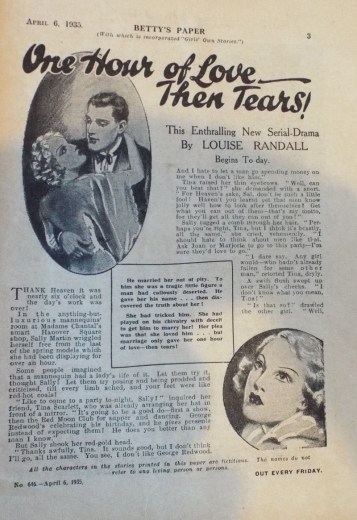
Anyway – on to the stories. I’ve only got two issues (at the moment hahaha) but between these two issues of 36 pages each, there are eight stories, and seem to be serialised in two or three parts. Some of them masquerade as ‘real life stories’ (see me next week for more…) but the rest are presented as written by ‘well-known’ lady authors. The sensational headings are guaranteed to pique the interest of any normal woman: ‘One Hour of Love Then Tears’, ‘The Sin That Came Between Them’, ‘When Men Are Dangerous’, ‘But She Was Blamed’, and my particular favourite, ‘Back Street Blonde’, tagline ‘she was born to be a man’s girl’.

They read a bit like cautionary tales – be careful, be cautious, be modest, they seem to say. Keep away from MEN. And like Mary Bennett in Pride and Prejudice, they seem to hint vaguely at the dreadful fate that awaits a woman without virtue. This was probably useful information for a young woman with a little bit of her own money able to go out with her friends in the evening in the wicked city and not come home until – ooh – ten? eleven o’clock? The stories are about trying very hard to make a marriage work, about being honest, and morally upright, about protecting your home and family. So they are aspirational, inspirational and improving. But they can be a bit juicy, as this picture seems to show: ‘Guy held her close in his arms. ”I don’t care about anything else–I want you, Dawn,’ he whispered.” Oh Dawn, get out girl, while you can!

Mostly I’m in awe of the writers. Week after week they turned out 5000 words or maybe more, and (I assume) got paid for it. I’ve tried Googling some of the authors whose work features in these magazines: Denise Egerton (Secret Bride), Louise Randall (One Hour of Love – Then Tears), Stella Deans (The Sin That Came Between Them), Cynthia Loring (But She Was Blamed), Jasmine Day (Back Street Blonde). Of these, I’ve found a number of books from the 50s and 60s by a Denise Egerton, and they appear to be romance genre, so maybe it’s the same woman? I haven’t been able to find out anything about the others–who knows–maybe they were all Denise? Or possibly all these ‘lady writers’ were simply the pen names of a grizzled editor with pages to fill and a talent for writing totes emosh romance? I can picture him, tapping away at his typewriter until all hours, cigar ash spilling all down his shirt. I bet his real name was something like Isaac Peabody.

I think these stories offer an intriguing insight into the values and aspirations of working women in the 1920s and 1930s. They’ve actually been the subject of study in a number of British and American dissertations and publications, for example, Peg’s Paper was looked at in Class and Gender: The ‘Girls’weeklies’ by Billie Melman,  a section in ‘Women and The Popular Imagination in the Twenties.’  And in this article in The Guardian by Kathryn Hughes. 

But lest we forget, what they really were was an escape from the drudgery of everyday life for women with little opportunity to do anything other than dream.

***


What I learned from reading Lord Edgware Dies by Agatha Christie.

I’ve always loved reading, and mysteries have always been ‘my thing’. Of all the authors in all the bookshops and libraries in all the world, Agatha Christie and Patricia Wentworth remain my faves, with my girl Pat a nose ahead.

Why do I love them so much when a) there are thousands of modern authors out there, and b) these traditional mysteries seem rather old-fashioned by today’s standards?

There is a definite lure of the era: a time of long frocks, a time of afternoon tea, dinner parties, bridge evenings (I can’t even play bridge) and so forth. Yes, the plots can seem tame, contrived and are often insular, but as Miss Marple often comments, you see every aspect of life in a small village. It’s like viewing a sample of the whole of society under a microscope. I love to see how ordinary (kind of) people react in an apparently ‘safe’ setting when something goes wrong.

I often reread these books. I have read all of Christie’s works at least twice, often many more times than that, and the majority of Wentworth’s. (I’m still working my way through her non-series books.) Some of Wentworth’s books I have five or six different copies of, all with different covers, from different eras, and one of them is quite valuable. I won’t tell you which in case you nick it.

I recently decided to reread Lord Edgware Dies by Agatha Christie. As you can see, I used quite a few sticky notes as I read it and made notes to myself–for funsies–at the same time. I wish I could say there was a special coded reason for using pink and green then yellow sticky notes, but it’s simply that I ran out of pink, then green…

There’s something a bit different about reading a book if you are a writer, and also, if you’ve read it several times before. (And, let’s not forget, it’s been on TV too.) As well as an enjoyable read, it’s been an interesting, and useful experience. Different things struck me this time. Here are a few of them: (btw – contains spoilers!)

Point 1. The book is quite long, I reckon it’s about 90,000 words or so. If you think in pages rather than words, it’s about 340 pages. That’s fairly standard for now, but many of Christie’s most well-known works are considerably shorter. (And Then There Were None, for example, is only 250 pages.) BUT the first clue comes on page 31! Wow! And even more interesting, the first red herring comes on page 30!!!!

p31 – the clue is: ‘A face that you liked but that you would find it hard to know again.’

p30 – the red herring is: ‘…the undercurrents that I sensed were nothing to do with Jane Wilkinson.’

Point 2. There are a lot of characters!  It can be hard for the writer to handle a large cast, and just as hard for the reader! To try to keep track of a lot of people without making them all into over-large caricatures takes a lot of skill and hard work. This is something I struggle with.

Point 3. There is a surprisingly large amount of sitting around talking. I know it’s not exactly an action thriller, but it still surprised me how static the story is in many places. Poirot notoriously eschews running from place to place violently searching for clues, preferring to sit and exercise his little grey cells. But still, it was more static than I remembered, and so I feel it would lend itself well to a play or film, (as it has!) because of the economy of sets required. It would be so easy to have a couple of side-boards, a couple of chairs, a different lamp and hey presto! You’ve got a completely different drawing room. Please note, future play-makers.

Point 4. Obviously we have a sidekick. A sidekick, such as ‘ma cher Hastings’, is such a useful device to enable the author to ask and answer questions she puts to the reader. I love Hastings, he is supremely gullible, naive, and a wee bit thick. The perfect sidekick, in fact, as he allows the detective to shine. Hastings, in this book, asks all the questions that the reader might ask given the opportunity, and answers a good many of them himself, almost always wrongly. Having a sidekick enables the author to speak Poirot’s thoughts out loud, so that his detection is not entirely internal, and we, the readers, can be involved.

Point 5. The use of attitudes of the era, and the use of appearances crops up regularly in Agatha Christie’s work. You can tell a wrong ‘un by how they talk about other nationalities, or how they dress or behave.

We see that those who make racial comments are often unmasked later as the perpetrators. Famously, in Death In The Clouds, the two main characters find they have much in common, including their racial attitudes. These commonalities help them to fall in love. But importantly for the reader, they also mark them out as the murderer and his unwitting accomplice.

In Lord Edgware Dies, there’s a touch of that same thing. We can identify some of the worst characters by their espoused attitudes towards other races.

In appearance too, anyone a bit different, or wearing colourful clothes, is set down as dandified and therefore downright suspicious. This works well for Poirot, who is often viewed with mistrust by those–particularly the men–who meet him. We know that Christie hated Poirot, who was probably her most successful character, and possibly got a secret joy from having him so vilely abused by those he met.

But the attitudes of others towards him plays into his hands. They observe his outer appearance, make a judgement about him based on that, and they fall into the trap of underestimating him. Through this, we are invited to laugh at the staid, traditionally-masculine Brit who refuses to get in touch with his feminine side for another forty or fifty years at least. And Poirot emerges triumphant once more–as he should.

Point 6. Suspects are set up and knocked down one by one like ninepins. The reader, along with Hastings, and even Japp, and Poirot himself, turns their suspicions first on one suspect, then these are (reluctantly) dismissed as being the perpetrator. Alibis are given, investigated, found wanting, then reinvestigated and finally the alibi is accepted. Until… well it’s almost become an in-joke that Christie herself invites us to share in – the least likely one is the true murderer. Usually it’s someone who has been suspected, then proved innocent.

This is a satisfying plot device actually, as it means working out timelines and getting your cats, ornaments and salt and pepper pots to help you envision the action on your dining table, just so you can be sure that what you think happens, could in fact have happened.

Point 7. This investigating, dismissing then returning to a suspect develops layers in the plot, and this is the intriguing and absorbing nature of crime fiction: edging closer and closer to a hidden truth, or to a definitive set of events. This is the intellectual riddle that draws readers to this type of fiction, and is so satisfying, because at the end, you think, just as the detective (or the writer) thinks, ‘Ah, now I know everything.’

Point 8. There are other points too, but I’ve waffled on quite a bit. So I’ll end with this: The detective.

The detective of any single book or series is clearly of supreme importance. Hercule Poirot (in this particular book) begins by being lauded by Hastings as a great man, but then as always, Hastings, and the police, and everyone else, lose their faith in him and begin to think he’s past it. Poirot himself declares his greatness, which Hastings wryly smiles over, because neither Hastings nor the reader would ever say such a thing about ourselves, but Poirot does not hesitate to state his abilities and announce his talents.

However, if he is vain, that’s not to say he is confident. He can be humble, he can admit he has made a mistake. In fact if there is one characteristic that defines Poirot for me it is his willingness to admit he has made a mistake and to reevaluate the evidence. He constantly rethinks his approach, going over and over the facts, because if there is one thing he trusts more than his own judgement, it is logic. He knows there must be an explanation and he will not rest until he finds it. The detective and the writer have a lot in common – persistence is everything.

So that’s it. That’s what I’ve learned or observed in Lord Edgware Dies. As a review, this isn’t much cop, but if it’s made you think, ‘I might read that’, then my work here is done.  Enjoy!

***

Coming soon: The Thief of St Martins: Dottie Manderson mysteries book 5

As you may be aware, (I’ve talked about it a couple of times recently) there is a new Dottie Manderson book in the pipeline. I plan/hope to release it on 27th October, as an eBook and paperback on Amazon, and as an eBook and paperback through other online outlets such as Apple (not the print, though, soz), Kobo, eBook through Barnes and Noble’s Nook, paperback at Barnes and Noble’s online store, and a few other places. Still not at Waterstones, sorry, that would be a dream come true for me, but hey, maybe next year? I can’t give you the links at the moment for anything except the Kindle pre-order page.

The book is called The Thief of St Martins. It’s the fifth book in the series, and I’m really excited about it. If you want to read a sample chapter (that may or may not still be chapter one by the time the book is released, I’m not quite decided, but it will definitely be in there somewhere…) you can find the link to it below this brief description:

We last saw Dottie in the Summer of 1934, discovering that her mother was in fact really her aunt, and that she was the shameful daughter of her mother’s sister, her ‘aunt’ Cecilia Cowdrey. Some months later, to help herself to come to terms with this revelation, Dottie accepts an invitation to spend a few days with Cecilia and Lewis Cowdrey over New Year, although she’s not too sure what to expect.

Sample chapter that may or may not be chapter one on publication ;D

Meanwhile though, if you’ve missed out on books 1 to 4, here’s a little catch-up: (warning, contains a few spoilers!)

Book 1: Night and Day:

London, November 1933. Dottie Manderson stumbles upon the body of a dying man in a deserted night-time street. As she waits for help to arrive, she holds the man’s hand and tries to get him to tell her what happened. But with his last breaths he sings to her some lines from a popular stage show.
But why, Dottie wonders? Why would he sing to her instead of sending a final message to his loved ones? Why didn’t he name his attacker?
Dottie needs to know the answers to these questions and even though a particular, very annoying young policeman Sergeant William Hardy is investigating the case officially, she feels compelled to carry out her own investigation into the mysterious death.

Book 2: The Mantle of God:

Can a tiny piece of faded cloth really be worth killing for? Is the past ever truly forgotten? Dottie’s new friend William Hardy asks her to find out more about a scrap of fabric found in a dead man’s pocket. But as soon as she starts to ask questions, things begin to happen. It’s not long before someone dies, and Dottie wonders if she may be next. Can the insignificant scrap really be a clue to a bloody time of religious hatred and murder?
Join Dottie as she works to uncover the truth of a distant past, whilst uncovering secrets held by her own closest friends and family. Can Inspector Hardy put the murderer behind bars before it’s too late? Setting aside his own personal tragedy, Hardy has to get behind the polite façade of 1930s London society to find a killer.

Book 3: Scotch Mist: 

After the funeral of her friend and mentor Mrs Carmichael, Dottie Manderson is sent on a mission to find the dead woman’s missing son and to inform him of the death of a mother he never knew. Unbeknown to her, Dottie’s close friend Inspector William Hardy has also been sent on a mission, one that will force him to confront his past. His conversation with the Mrs Carmichael just before she was killed opened up questions about his father William would prefer not to ask. A sentimental lawyer has plans to bring Dottie and William together, acting on Mrs Carmichael’s bequest. But after a personal tragedy and some hectic months in his new role, is Inspector Hardy ready for romance? Perhaps if no one got murdered, he could think about other things?

Book 4: The Last Perfect Summer of Richard Dawlish: 

Dottie’s had a hectic and difficult time: she’s attended too many funerals, and has just had a massive row with the man she thought she loved. on the spur of the moment she makes a stop off on her way home, in search of a dear friend who needs her help. In any case, a few days rest in a hotel by the sea is just what Dottie needs. It’s not long before she makes the acquaintance of the newly-widowed Penny Parfitt, and her attractive brother-in-law Gervase. Dottie impulsively accepts their invitation to spend a few days at Penny’s home in the country.
Quickly Dottie realises that secrets and intrigues lurk beneath the pleasant surface of their lives. A suicide years earlier casts a shadow. Was it really suicide? Dottie begins to think something sinister has taken place.
But after all this time, can she find out what really happened?

So now that you know a little bit about these, I hope that you feel intrigued enough and inspired enough to give them a try. There are more in the pipeline, but as yet I’ve only planned the first ten books in this series. Will there be more? Yes, I think there will. By book 11 we will be into the war years: the war no one ever thought would happen. So I am looking ahead and seeing the potential for that. How will the war affect the lives of Dottie, Flora, Mr and Mrs Manderson, and of course, William Hardy? Who will fight for King and Country? Who will be left behind, and what will they do to cope with the strain of constant danger? I’m quite keen to get to that point. But there’s so much to do first.

I’m what writers call a ‘pantser’ ie I don’t plan my books in meticulous detail in advance, but I write by the seat of my pants, almost literally making it up as I go along. BUT I do plan loosely, sometimes years ahead. But if I told you any of those loose plans now, it would ruin everything, wouldn’t it?

I’d like to say a huge thank you to the wonderful people who’ve said such nice things, and given me so much encouragement with my writing, and with this series in particular. Honestly, you have no idea how amazing it is to know that someone somewhere has read and enjoyed one–sometimes more than one–of my books. Thank you so much.

And thank you too to my family and friends for all their love support and active assistance, ‘without whom’…

***

The anti-social writer

This is what I overheard in a café in town a while ago: “I find that writers aren’t very nice to work with. One or two are okay, but most of them…well, they very much like to keep to themselves, don’t they? And they don’t like the competition either. It would be nice to have a chat, you know, but most of them just won’t. You get the odd one who will say ‘Hi’, but that’s about it.”

Needless to say, my ears were flapping as I tried (surreptitiously) to hear every word and quickly write it down as I knew I would forget it, and at the same time I’m trying to look casual and eat a caramel-topped, cream-filled doughnut (definitely high on my mental list of priorities, I don’t get out much), and hoping they won’t turn round and see me writing down their every word. I decided Lady Number One must work in a theatre or something, and the café we were in was close to Quad in Derby, where they run both writing doobries and theatrical thingies. (Please pause here to marvel at my expert use of the English language.)

She went on to talk about how some of the actresses had been very moved by the speeches they had to deliver. Lady Number Two was her friend-from-another-workplace and just kept nodding and agreeing.

Now I freely admit that we are all entitled to our opinions…

But…

I apologise on behalf of all writers everywhere if we aren’t as good at chatting as you would like us to be. It’s not always easy talking to someone you don’t really know too well. Just give us another chance…

Quite often it can be difficult to shut a writer up. Once you get them started, they can talk for hours – all that time spent alone with a journal or laptop means they rarely see actual humans, let alone enjoy conversation. But it’s also often said that a writer is busy with an internal life others are not privy to, working away at the coal-face of a tricky plot or puzzling over the intransigence of a character.

But maybe, like everyone else, sometimes writers are just rude. Or shy. Or nervous. Or feeling out of their depth. Or worried. Tired. Or maybe even wondering if their wife is having an affair, or if the kids are in trouble, or yes, about their work, if their plot is shallow or their characters wooden. Maybe they are looking at you and thinking, ‘Wow he/she would be the perfect victim in my next book’. Or an arch-villain.

Do we hear people complaining about dentists not being chatty enough? No. All too often, anecdotal evidence – and TV comedies – tell us that dentists love to talk and only ever require an answer if your mouth is full of putty, fingers, sharp objects, or that scary sucky gadget.

And no one complains that hairdressers don’t talk. Or lawyers. Or retail assistants. Or window cleaners. Usually lack of conversation is a bonus in everyday situations. So why do writers have to be so chatty?

Is it because we’re ‘wordsmiths’?

(I hate that word – so pretentious! Imagine me up all night, filing and drilling and smoothing then peering myopically through a loupe at my carefully crafted, gleaming word. Congratulations, it’s a pronoun!)

But I can’t deny that words are my – our – profession. Does that mean I have to share them constantly? Does a banker hand out free cash to all their friends and acquaintances? If only! Do my marketing and publishing contacts promise me freebies to help me sell my books? Nope! Again – if only!

No. We all inhabit our little solitary worlds. It’s not because I’m a writer that I’m rubbish at making conversation with a total stranger. It’s because I’m a human being. There are loads of things I’m rubbish at, making conversation is only one of them.

***

Gold or silver?

I found these notes in an old journal. I had been pondering the attributes, from a writer’s point of view, of gold and silver, and how whether as metal or colour, they are portrayed in literary works.

Gold is the colour of royalty, of quality, of the authorised, and acknowledged, of states and state, religions and churches and faiths, of the accepted and acceptable, of righteousness.

Gold is pure, incorruptible, reliable, ‘pure gold’, good, honest and forthright.

Gold is given in blessing and to enrich, it is security, savings and wealth. Gold is warm and appealing. It is masculine, and constant; the colour of the noonday sun, giving life to all and sight to all. The ‘gold standard’ indicates a status achieved, a level of existence and compliance, of regularity and trust, and a line by which all else is measured. Gold is laid up for the righteous, we are told.

But silver? No. Silver is ‘other’. Silver is secretive and fleeting, it is mercurial and unremarkable in nature, and always not quite good enough: doomed to be second best. It changes hands easily, each time serving or claiming a new master.

Silver works its arts by night, it is hard, feminine and bright and although it’s the colour of small change, ready money, the easily-obtained (for some people, anyway), it really is a confidence trickster: appearing cheap and easy to get, but actually constantly demanding more from us, just that little bit beyond our grasp.

It is the colour of the stars and the light of the moon, alluring, beautiful, cold. Silvery and secret, sinister and elusive, it dances through the sky, always out of reach, now hidden, now displayed. The thirty pieces of silver, the betrayer’s coin, the turner of hearts and souls, the illicit, the unauthorised, the denied, or the denier.


These gorgeous images from Steve Bidmead, Arek Socha, Kevin Schneider and Patricia Alexandre, all at Pixabay.com 

***

A bit of colour in your cheeks: 1930s make-up

This ad for Maybelline shows the archetype for 1930s make-up.

Make-up in the 1930s was gradually moving away from the secretive, rather apologetic attitudes of the 1920s and earlier which kept make-up containers such as compacts small and discreet, in much the same way as women’s smoking accoutrements. Partly this new acceptance was to do with the trend for more a feminine look after the androgynous 20s, but it was also due to the burgeoning movie industry and the new passion for celebrity role models, and the aspiration to adopt Hollywood styles and trends as part of everyday life, even for those on low incomes. You might see a certain dress or hat in a film, and a week later your friend, sister, mother or yourself could have copied it at home to create your own variation to wear on your half-day out or the next time you went to the cinema.

Yes, that is 1930s mascara, to be applied with a kind of toothbrush thing. It looks like boot polish. And who knows, maybe it was. But it got a girl noticed.

The cosmetics companies lost no time in showing the everyday woman how to use their products to achieve the same looks, or an approximation of them, as the big screen icons such as Myrna Loy, Barabara Stanwyck, and Carole Lombard, whose glamour was so appealing to women – and of course to men, which was a big part of the thrill.

In 1937, Myrna Loy was featured by Photoplay magazine in a kind of cross-over promotion with Max Factor, sporting her face with a clever ad for her latest film Parnell, in which she appeared with Hollywood megastar Clark Gable, whilst her photograph lent authority and appeared to endorse the products being promoted, no doubt sending her fans out in droves to buy the make-up ‘used by Myrna’.

The typical look was for pale foundation, with pink ‘roses’ on the cheeks. Eyebrows were very arched, and plucked extremely thinly, or even completely removed then pencilled-in in a much higher bow than nature intended. The eyes were emphasised with deep colour–blues, greens and mauves were popular–on the lids and highlighter or shimmer on the under-brow area. Lips were painted in a range of tones, mainly deep pinks, reds and oranges.

A range of lovely, very appealing products from the Coty range, and featuring the Lalique powder puff design.

It’s a surprisingly colourful palette, and the products were manufactured by many of the big brand names we still know today such as  Revlon, Max Factor, Coty, Almay, and Maybelline, not forgetting our own dear Boots No. 7 which first appeared in 1935! Helena Rubenstein created the first waterproof mascara in 1939. Cream eye-shadows, lip ‘glosses’, and ‘pancake’ make-up also appeared in the 1930s. It was an exciting time to be a girl! Make-up like face creams and powders were mostly sold in glass or china pots, or for cheaper brands, or the lighter products such as eye-shadows and lip-sticks, in sturdy, decorated cardboard boxes or in tin or plastic.

Here’s an extract from the sales pitch for Max Factor: ‘Choose your colour harmony shade in Max Factor’s Face Powder and see how naturally the colour enlivens the beauty of your skin.’ It sounds so similar to the kind of advertising copy we read or hear today, doesn’t it?

Sales were booming. The new advances in chemicals and manufacturing processes helped to pave the way for a wider use of make-up, especially among younger women who worked in factories and had their own money. Prices came down and demand went up. Glamourdaze.com quotes the Daily Mail as asserting that ‘In 1931, 1,500 lipsticks were being sold to women for every 1 being sold in 1921.’ How true that is I don’t know, but I wouldn’t be surprised if it were fairly accurate. Affordability, economics, a decade of peace, industrial progress, and women having jobs, their own money and more autonomy all must have combined to create the perfect climate for a boom in make-up alongside other new consumer goods such as clothing, accessories, household appliances and even cars.

The Coty compact with design by Lalique.

In the image above, you can see a lovely vintage Coty powder compact. The design was by Lalique, the famous glass guy. I sold one of these on eBay for a nice little sum a few years ago! Coty started in 1904 and Lalique set up his first glass ware and design business in 1921. This gorgeous powder puff motif is still highly collectable, though affordable, and is still in the very small size compact that was normal for the 1920s – a little over two inches in diameter. A tiny thing of great beauty. You can find them quite easily on the Internet, sometimes still with a little powder inside, and usually with an applicator or sponge. But beware, there are replicas about. They are easy to spot, being much larger–the kind of size we usually see now of about three and a half inches or more–plus shallower, and the design is more precise and detailed.

So make-up, then as now, really did depend on who you wanted to be, and just as in the fashion world, the designers followed trends very closely, with lower priced brands following after the big leagues, and with everyone keeping an eye on their favourite celebs.

PARNELL, US poster art with Clark Gable and Myrna Loy, 1937

***


1930s capsule wardrobe

Since I’ve ‘discovered’ Pinterest, I’ve also reaffirmed my love of the idea of the capsule wardrobe. I don’t know why I love these so much, maybe it’s just that my own clothing collection is rather hit-and-miss and I often find it hard to know what to put on. Whatever the reason, I love those graphics that show you 16 or 20 items of clothing with accessories, then show you how to combine and rearrange them to create 30 or 40 outfits. I note they are often in neutral colours especially beige, which is a colour I rarely wear, and I’m guessing that the neutral palette makes it easier to put together ‘a look’.

As I work from home and have no colleagues, apart from Mabel and Malcolm, that is, I usually schlep about in scruffy tops and aged comfy jeans. I’m a bit ashamed to admit my own shortcomings, because I not only enjoy the history of costume and fashion, but when I created my 1930s mystery series, the Dottie Manderson mysteries, I decided to make my main character a mannequin in a fashion warehouse, just so I could indulge my love of clothes. I regularly mention clothing and fabrics in the stories, which some readers–especially gentlemen–Stuart Aken, I’m looking at you–have found a bit trying, to say the least. Soz, guys.

All this got me to thinking, ‘What would Dottie wear?’ Being a 1930s mystery series featuring well-to-do families in between-the-wars England, there are a lot of visits and house parties. So what would a young woman need to take with her for, say, a weekend in the country in Summer? I’m leaving out tweeds, because a) I abhor shooting and hunting and so, consequently, does Dottie, and b) no woman looks good in tweeds. I’m sorry, but it’s true. Where’s the glamour in a tweed coat and skirt? Answer: there is none.

Here we go. Oh, and by the way, I’m taking the role of Dottie’s maid Janet for this trip, so I will do the packing.

Firstly, I will be packing nightwear in the form of a negligee and matching wrap. Dottie is 20ish so there’s no way this girl will be wearing a massive up-to-the-neck-down-to-the-floor cotton nightgown, she’s not 90! The negligee will be ankle-length, and made of something soft and sheer like artificial silk or crepe-de-chine, probably in soft blues or pinks, with lace edging in cream of a deeper cream/coffee colour and narrow ribbon in a matching colour to fasten. Women’s underwear came in the form of long bloomers, to the knee or just above the knee, in either a loose and light sheer fabric with lace trim, or in close-fitting, machine-knitted cotton. There were also teddies and camisoles, worn with a sense of modern naughtiness by the younger women and viewed with maternal concern by the older. Petticoats with supporting lace or embroidered cupped bodices.  Bras as we know them today were still waiting in the future, but the complete lack of support of the well-named ‘flapper’ style of the twenties was no longer fashionable. Pantyhose was still to come, so stockings were worn with a suspender (garter) belt and no doubt thrilled men then as they do now. Stockings for day-wear would be sturdier than their evening-wear counterparts. I must remember to pack some silly little slippers just to keep Dottie’s feet warm in the bedroom, and the hallway to the bathroom and back.

There will be a day outfit in the form of a day dress or suit/costume. If we are travelling light, I think we might manage with one or two, but if we have a whole car to fill, we might take three or four outfits just for a two-day trip. The style for the 1930s was fairly straight but more feminine and less plain than the very straight, quite masculine styles of the 20s. Picture a dress with a very slight flair, an A-line skirt, or perhaps quite close-fitting to the knees then flaring out, gently for a day dress and more dramatically for an evening dress when the wearer might want to dance and feel the fabric swirl out about her. The length would reach to the mid-calf for day-wear with ankle-length or floor-length for evening. Shoes had quite high heels, say three inches or so, and were often buckle-fastening or laced. With the exception of tennis shoes and gumboots, shoes would have been made of leather.

Styles were plain in execution, but with a lot of embellishment such as bows or jabottes at the neck, functional or decorative buttons on pockets, sleeves and bodices. There were variations in lapel size and shape, from deep and wide, to small and standing up straight, from squared off, to drooping downward. Belts, cuffs, shoulder tabs and waistband tabs were very ‘in’. The zip was still a few years away from general fashion use, so buttons, hooks-and-eyes, and buckles were used far more than we do today. For day-wear necklines were quite high.  Fabrics would be mainly cotton, linen or wool, although man-made fibres that laundered easily such as crepe-de-chine and artificial silk for blouses or light summer dresses were popular. And of course, no lady would go out without a little clutch purse, gloves, and a hat, even in summer.

Hat boxes could accommodate two or three hats depending on size and shape, so Dottie doesn’t need to worry about wearing the same hat all weekend! I’d suggest a neat little beret for going out in the day time, or perhaps a felt cloche hat with a rakish feather, some beading or ribbons, or if the weather is very warm and sunny, I think she’ll need a wide-brimmed straw hat to keep the sun off her face.

Then obviously she will be changing for dinner, so a long evening gown is a definite must. And a girl can’t wear the same frock two evenings in a row, so perhaps I’ll take two gowns. White was a popular colour for an evening dress for a young woman, although shades of red, brown and green were also worn. Older ladies tended to favour black too, though this was not usually seen on young women due to its funereal connotation. Gowns would be flaring, long, and low-cut, or with cut-out sections in the bodice, and were made from taffeta, satin, or silk mixes: silk-satin, silk-organdie, silk-crepe. The shoulders were often bare, or the gown might be more or less backless, and rather daring. No wonder the gentlemen flocked to light a lady’s cigarette. Smoking was gaining popularity amongst the young and it was more socially acceptable for women to smoke in public. Shoes for evening wear would be strappy and often silver or gold in colour, and perfect for dancing in, but affording little protection from a partner with two left feet. In case the apologetic gentleman should ask a young lady to step out on the veranda to look at the stars, a lady would also require a wrap, and I’m sorry to say these were very often animal fur, although silks, brocades, velvets and fine wools were also worn.

I think we have everything we need for a summertime weekend in the country. As a maid, of course, I will require only my uniform, a plain dress, sensible shoes and an overcoat. My main fashion pleasure will be confined to taking care of the precious garments of my mistress. I could never hope to own such things.

Of course, I don’t wear the anorak all the time. It’s for special occasions.

***