The red and gold thoughts of Autumn

For me, it is not Spring, but Autumn and Winter that form my season of creativity. I have no idea why this is. I don’t know why, but for me, autumn is not the season for rest and consolidation, but of flights of imagination taking wings.

It seems as though the rest of the world is full of new life in the Spring. Is it because I’m an October baby, my lifecycle naturally goes from Autumn onwards? Or because when we lived in Brisbane, October was in the Spring? But how can five years there undo the habits of the other fifty-four years I’ve lived in the Northern Hemisphere? Or maybe it’s because for parents everywhere in the UK, Autumn is when the children go back to school and you at last get two minutes to sit in silence and just enjoy hearing – nothing. Ah, bliss!

New ideas are taking shape, even before the old ideas have been put to bed. I’m thinking about what I want to say in a new story. I’m having a wonderful time creating book covers, and though I’m struggling to come up with new titles, I have some ideas to mull over.

I’m always drawn to old stuff, I’m drawn backwards into the past. I’m thinking of tea-dances, afternoon picnics on wide sweeping lawns, I’m thinking of couples dancing on a veranda under the stars, the music softened by distance and the soft evening breeze.

I’m thinking rural, villagey, fields, water, trees. I’m thinking of sorrow and haunting, of deeds never talked of, of the guilty secrets of the past. I’m thinking of shame and sacrifice, I’m humming old pastoral songs and rhymes, Scarborough Fair, children’s songs and folk songs, ‘Bobby Shafto(e) Went To Sea, He’ll Come Back And Marry me… Bonny Bobby Shafto(e).’ Or the old folk song and pop hit from the 70s, Whiskey in the Jar – ‘When I was going over/the Cork and Kerry mountains…I saw Captain Farrell and his money he was counting…’’

I’m remembering the duplicitous nature of the minstrel, wandering, legitimately able to plant one foot in each camp, never on any side but his own. A useful means for conveying information, often ill-gotten. And he can sing out in public everyone’s secrets, and how can you stop a man doing that?

I’m thinking of myths and legends, hillsides cloaked in mist, an unseen bird calling in the gloom, of the soft insinuating sound of the wind, like a sigh, like a breath, or like a dragon’s terrible approach. I’m thinking about the returning home of the prodigal, how we carry the past with us, inside, even when we are looking forward and moving on, something draws us ever back.

I’m thinking too of that moment when you come home and you know someone else has been there. Someone who shouldn’t have been there. The stillness—too much—and the silence that waits. Your house feels guilty, complicit, hushed as if someone had been speaking and just this moment stopped when you opened the door.

I am thinking, staring at the falling leaves, driven across the grass by a pushing wind, and I am thinking of long ago, of people who may not have existed, but who could come into being in my imagination. I am thinking of a man at a window staring out, his mind working on things he cannot put into words. I’m thinking of a woman, always waiting, wringing her hands in front of the window, her own shadow cast out across the lamplit stones of the yard. When will he return? Will he ever return? The waiting woman. The unspeaking man.

I’m thinking of a boy coming over the hill. Of grass, green, long, dewy. Of the sun, soft, golden, gentle as a mother’s hand, just touching his hair, his shoulder. How long has he been away? How much has changed? Will anything ever change?

If I never have another new idea, I’ve already got enough to keep me writing for the next twenty years. I only hope that’s possible.

‘Now fades the glimmering landscape on the sight,/And all the air a solemn stillness holds.’ Thomas Gray’s Elegy.

Autumn – not for sleeping but for creating anew.

***

Stories for a 1930s audience.

Last week I took a look at the kind of advertising you might have found if browsing through an issue of Betty’s Paper, a popular magazine from the 1920s through to (I think) about the 1940s. It’s hard to find out much about the mag without doing some hardcore research (it might come to that), but I know it was at its peak in the 30s, and there are still quite a few issues left to be snapped up if you’re of a mind to buy this kind of memorabilia.

Betty’s Paper wasn’t the only one around. There was also Peg’s Paper (1919 to 40) English Woman’s Journal (1850s to 1910), The Gentlewoman (1890 to 1926), The Freewoman (1911 to 1912), The Lady’s Realm (1890s to 1914), Time and Tide (1920s to 1970s), Woman’s Journal (1920 to 2001) to name the most well known. There were others, often with a more targeted purpose, for example, campaigning women’s suffrage and letting women know what was happening in various groups. Mostly magazines were aimed at middle and upper class women, but Peg’s Paper, and Betty’s Paper were aimed at working class women, and had less educational and more purely entertaining content than other magazines.

Betty’s – and Peg’s – contained short fiction, sometimes as serials, that thrilled the imagination, and owed a great deal to the cinema. There were fashion and style tips, using actresses of the era as role models, and holding them up as examples of the right look to emulate, very much as all the media do today. We looked at the ads last week, and I concluded that, again just as now, many were fixated upon appearance: looking slim, budget fashion that stood up to scrutiny, easy health fixes for people who lived busy lives, working hard and with little time or money to spend on themselves. Perfect for the factory and domestic girls of the 1920s and 1930s.

But what were the stories like that were every week there to tantalise our girls as they took a quick tea break or read for ten minutes before going to sleep?

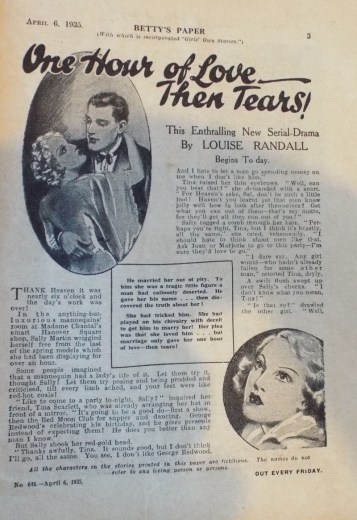
Firstly, I noticed that the stories were illustrated, a bit like a children’s comic. I know that still happens today, but these struck me as being more dramatic. The men often seem to loom over the women in a authoritative almost aggressive manner. The men also look very old compared to the younger-looking women. Pretty sure all these heroines are about 20 and all the heroes are about 48.

The headlines and taglines too were melodramatic and leaning towards the scandalous. I presume this was a good way to draw in readers and get them to spend their cash – Betty’s Paper was tuppence ‘Every Friday’. When wages were paid weekly in cash, I imagine this was one of the first ‘treats’ a girl would get herself before going home and giving most of her money to her parents.

Anyway – on to the stories. I’ve only got two issues (at the moment hahaha) but between these two issues of 36 pages each, there are eight stories, and seem to be serialised in two or three parts. Some of them masquerade as ‘real life stories’ (see me next week for more…) but the rest are presented as written by ‘well-known’ lady authors. The sensational headings are guaranteed to pique the interest of any normal woman: ‘One Hour of Love Then Tears’, ‘The Sin That Came Between Them’, ‘When Men Are Dangerous’, ‘But She Was Blamed’, and my particular favourite, ‘Back Street Blonde’, tagline ‘she was born to be a man’s girl’.

They read a bit like cautionary tales – be careful, be cautious, be modest, they seem to say. Keep away from MEN. And like Mary Bennett in Pride and Prejudice, they seem to hint vaguely at the dreadful fate that awaits a woman without virtue. This was probably useful information for a young woman with a little bit of her own money able to go out with her friends in the evening in the wicked city and not come home until – ooh – ten? eleven o’clock? The stories are about trying very hard to make a marriage work, about being honest, and morally upright, about protecting your home and family. So they are aspirational, inspirational and improving. But they can be a bit juicy, as this picture seems to show: ‘Guy held her close in his arms. ”I don’t care about anything else–I want you, Dawn,’ he whispered.” Oh Dawn, get out girl, while you can!

Mostly I’m in awe of the writers. Week after week they turned out 5000 words or maybe more, and (I assume) got paid for it. I’ve tried Googling some of the authors whose work features in these magazines: Denise Egerton (Secret Bride), Louise Randall (One Hour of Love – Then Tears), Stella Deans (The Sin That Came Between Them), Cynthia Loring (But She Was Blamed), Jasmine Day (Back Street Blonde). Of these, I’ve found a number of books from the 50s and 60s by a Denise Egerton, and they appear to be romance genre, so maybe it’s the same woman? I haven’t been able to find out anything about the others–who knows–maybe they were all Denise? Or possibly all these ‘lady writers’ were simply the pen names of a grizzled editor with pages to fill and a talent for writing totes emosh romance? I can picture him, tapping away at his typewriter until all hours, cigar ash spilling all down his shirt. I bet his real name was something like Isaac Peabody.

I think these stories offer an intriguing insight into the values and aspirations of working women in the 1920s and 1930s. They’ve actually been the subject of study in a number of British and American dissertations and publications, for example, Peg’s Paper was looked at in Class and Gender: The ‘Girls’weeklies’ by Billie Melman,  a section in ‘Women and The Popular Imagination in the Twenties.’  And in this article in The Guardian by Kathryn Hughes. 

But lest we forget, what they really were was an escape from the drudgery of everyday life for women with little opportunity to do anything other than dream.

***


A shameless plug to a captive audience.

The use of advertising media to sell products to customers is not something new, it’s been around for a lot longer than I ever realised. I think I vaguely knew that advertising ‘must have’ been used before I became fully aware of it in the late 1960s or early 1970s, and I suppose that most of us have seen those hilarious TVs shows featuring ‘how we used to be’ commercials from the 50s and 60s, showing a happy smiling housewife holding up a box of laundry detergent, or a pipe-smoking father in a suit sitting behind a newspaper.

A few years ago, it was so popular to collect old advertising boards, usually made of tin, or printed onto postcards, calendars, place-mats, mugs, mouse mats, you name it. Pears Soap ads appeared on tea-towels and even t-shirts. You know the ones? With the Millais-inspired pics of Victorian children, rosy-cheeked and curly-haired, with frilly collars or petticoats?

But until recently I hadn’t imagined that advertising was rife in the earlier part of the twentieth century, and I’m now convinced, even before that.

Last month I finally caved in and bought a few items I had been looking at a while – and I’m warning you now that this means you will have to look at these over the next couple of weeks. I’ve now received some gorgeous vintage items from Messrs eBay and Etsy.

These included two copies of Betty’s Paper: a magazine aimed at (young) (working class in the main) women from 1935, and one copy of The Picture-Goer. I love this vintage stuff, and as you know, I’m a bit obsessed with the 1920s, and even more so with the 1930s. I was so excited to get my hands on these items. And if you also like this stuff, they are usually not expensive, and there are quite a few of them around! But please don’t buy them all, there are still a few I’ve got my eye on.

Soon I’m going to have a more general look through Betty’s Paper, and maybe even, if you can stand it, through The Picture-goer. But right now, I’d like to take a quick look at some 1935 advertising, and what I discovered amongst the hallowed pages of these once avidly-read magazines.

Th first two pics I’ve shared are for ‘guidance from beyond our world’ – yep, clairvoyance was all the rage from the Victorian era up to…well, I think a lot of people still check their horoscopes and send for readings etc. Now we probably see more in the way of crystals and meditation, whereas back then it was quite literally written in your palm. Note that on the one hand a male figure offers information about the future in a pseudo-scientific manner, the maleness, the use of the title of professor adding authority to make the ad seem genuine and plausible. His odd kimono thingie is his robe of office, as is his hat. It all ties in with the late 19th century and early 20th century passion for culture and art from the ‘mysterious East’.

The second one, Madame Astral, looks far more like the contemporary modern young women’s look – if anything she looks like your sister who had a tent at the church fete last summer. So the reader is being invited to share a sisterly gossip about matters of the heart, just like a cosy and none-too-serious reading of the tea-leaves at home. Good old Betty’s offers coupons to give readers a discount!

I love this. We’d never do this today, would we? or would we? This is the Bettys’ Paper Loveliest Reader competition – complete with photos of the ladies, and… Wait for it – their names and addresses!!!!!!!!!!!!!!!!!!!

What on earth??????

It was definitely a different era. What, I ask myself, is to prevent any ruthless person rocking up to Miss Metcalf’s at 144 Wanstead Park Road, Ilford??? It seems naive in the extreme, but I can’t decide if that was perfectly okay for those days or was it the height of idiocy even then? Or was it Miss Metcalf’s design, in the hope that a gorgeous single man with a good income, good sense of humour, own home, would arrive on her doorstep with a bouquet of flowers and a pleasing smile? Mind you, the £10 prize money for the winner had to be a big bonus.

Speaking of a pleasing smile, in the corner of the Loveliest Reader comp page there was another ad – for toothpaste. Surely what we get from that is, if you want to be Betty’s Papers loveliest reader, and have strange men turning up at your door, you’d better follow the trend for wavy dark hair, perfect skin and you’d better have fabulous teeth too.

You can tell that Betty’s paper is all about appearance, inspiring women and showing them how to look Silver-Screen-great on a limited budget. In the first half of the twentieth century many young women were earning their own money and had disposable income for the modern commodities that science and technology had created.

So it’s no surprise that these ads are all about looking right. They address clothes, skin, hair and teeth, as well as the hope instilled by the stories and the ads for clairvoyant assistance. It’s all about looking as good as you possibly can – not for yourself, obviously, but so you can catch a man. These were not the days of sisters doing it for themselves.

When I first saw this next ad, with the woman drinking something and the slogan ‘slenderising and modish’ I assumed it was for some kind of diet or weight-loss supplement. But no. It’s for wool. To make your own slim-look sweaters and cardis. Not sure this ad would work so well today (leaving aside the fact that most women simply buy their woollens now) as it immediately sent me in the wrong direction. Or is that just me, coming to the ad with my 21st century eye? Again, here it’s all about looking right – and that means thin. Maybe nothing changes, after all.

Interesting that the slogan is a ‘quote’ from one Lady Georgiana Curzon – her title gives authority to her pronouncement, and yes, she is the wool manufacturer’s ‘fashion adviser’. Note also the family-empire sounding name – well, it probably was a family run business at least originally, but these days everything is General something, or Associated whatnot… no family businesses any more. Again, I feel, but this might be my contemporary perspective, but this sense of family-run, long-standing, aristocratically-endorsed seems to add to the authority and trustworthiness of the ad and the product.

Two more. One is an ad for the cheaper new stockings made from a man-made fibre rather than real silk. They ask,’Which is which?’And add that only your purse will know the difference. The use of the pictures of men to imply that males are looking at your legs, girls, and they’d better be worth looking at would doubtless have worked better if, a) they’d used different pictures of men and b) the men were actually facing the legs in question-or would that have been too risqué?

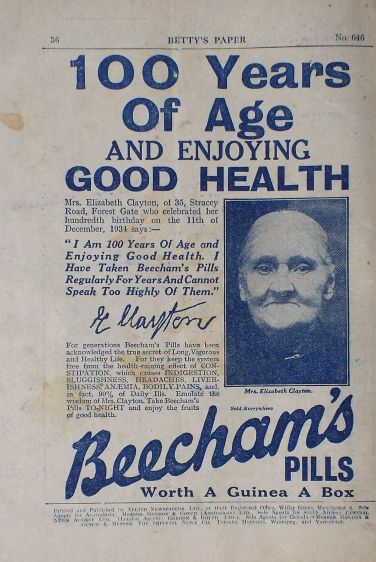
Lastly, my favourite ad of all. It made me spit coffee all over my t-shirt. Scroll down and take a look at the pinnacle of Betty’s Paper’s fine advertising material. It’s from the back page. It’s the one with the lady purporting to be over one hundred years old and still ‘enjoying’ good health.

Bless her. Mrs Elizabeth Clayton, she doesn’t look as though she enjoys anything. I know we all want to live forever, but this is funny. Again, I love the use of the lady’s address. Did people go there to marvel at the lady and her great age? Surely it’s fictitious, put in to lend credence to the advertisement? But part of me really wishes I could go there and witness the spectacle of Mrs Clayton enjoying life to the full and a hundred years old. I really hope it’s not just cynical advertising but that the old girl had a brilliant life and earned a fortune from companies using her face to astonish the world.


People Watching for Writers

Inspiration comes from all different places. And I’m often asked where I get my ideas. It’s more that ideas come looking for me than I go looking for them. I’m incredibly nosy about other people, and I am an incurable people-watcher.

I don’t advocate, as a writing tutor in Brisbane once told a group of creative writing students, that you should actually follow people to get ideas for your story or to experience what it’s like to ‘shadow’ someone a la detective fiction. BUT I must admit I do covertly eavesdrop and watch people, especially in a coffee-shop situation. I don’t actually record conversations or film people, though it is SOOOO tempting.

I remember overhearing one yoof talking to another about his baseball cap. Yoof #2 was admiring the cap and trying it on. Yoof #1 said, rather anxiously, ‘Don’t you lose my cap, man. That cap is my identity.’

It’s these kind of scenarios that fuel my imagination.

Here’s what happened one day. I must just add, as a disclaimer, that all I saw were two people in a coffee-shop—my imagination, tawdry and cynical, and my love of detective fiction did the rest!

So I was sitting there with my cappuccino and my triangle of ‘tiffin’, in a Coffeebucksta Emporium in the town where I live. And I saw this:

A smart young man, late twenties, in a very modern suit, latest hair-do etc., all smiles and full of conversation. With him a frail and bent old lady in a wheelchair. She was also smartly dressed and her white hair was short and chic a la Dame Judi Dench. But she was way too old to be his mother. Grandmother? Great aunt? Great-Great-grandmother? I mean, she was OLD.

I’m already plotting a story around them. He parked her at a table and went to join the queue. She was reading the paper. I’m thinking, maybe she’s not a relative but his Sugar Mommy?

The idea appeals to me. I can remember several detective novels where scandal ensues due to an inappropriate attachment between a favoured young man and an older, vulnerable (or perhaps not so vulnerable) woman. I like the idea that even in this day and age, a young man can still cash in on his good looks, and an old lady can still enjoy having someone to dance attendance on her.

I decide she probably has someone at home to help with her personal care. And to take care of the cooking and cleaning. I’m picturing a large sprawling mansion, empty of people but stuffed with suits of armour and gloomy, grimy portraits of people who have been dead for hundreds of years. Glass cases of long-dead animals. Lots of wood panelling. Surrounded by vast expanses of grass and tall dark trees. Maybe some peacocks? An old uneconomical car, with her cosseted in the back under blankets, and him in front at the steering wheel.

if you try people-watching, just make sure you don’t get caught, people don’t always enjoy being spied on.

And I don’t want to think there could be anything sexual involved (eww!) but that he acts as chauffeur, secretary, assistant, companion and entertainer. He flatters her, makes her laugh and she pays him for his smiles.

I think of the people that know her, local villagers? I imagine them talking to me. Or to a policeman sent down from Scotland Yard to investigate some awful crime. Perhaps she’s been murdered? Or him? Perhaps he’s the victim, not the perpetrator? Over our coffee, my informant tells me, (this is in my head, you understand,) “Well of course she gave out that he was her great-nephew, though I’ve never believed it. But she said it—you know—for appearance’s sake. He certainly is a charmer. And so patient. Well all I can say is, he’s worked damned hard for the money she’s left him. If there is any money. No one seems to be too sure about that.”

Was he a little too friendly with the nurse who looked after the old lady? Is that what they’ll say when her body is discovered? Did the old lady resent him giving those smiles to someone else?

Back in the real world, I’m picking up on tiny details. He returns with a coffee for her. Nothing for himself. Which seems odd. He sits. She leans forward and says something to him, and he takes her cup and has a sip of the coffee, and shakes his head. He returns it to its saucer. Too much sugar? Not enough? Does this taste a little odd to you? I’m not sure what is going on, but she doesn’t drink it.

They don’t stay long. I think he was actually in the queue longer than they sat over the drink that went almost untouched. Why didn’t she have her drink? Why even bother coming into the cafe? Why didn’t he have anything? Does she hold on a little too tightly to the purse-strings?

Even though he is smartly turned out, perhaps his shoes are showing signs of wear? Not quite as new or of such good quality as they first appeared? Perhaps she doesn’t pay him so well after all? Are there arguments over money? She thinks he spends too much, or asks for too much. He thinks it’s unfair that he has to beg and plead and justify what he needs, thinks she is too keen on having power over others. Perhaps it’s just not worth it after all? Perhaps it’s time for this ‘arrangement’ to come to an end?

For one mad moment I think about taking her cup for analysis before the table is cleared. Then I remember. Only in my imagination am I a detective. Here in the real world, I’m just another person sitting in a cafe. But in my mind, and in my notebook, I have the bones of a story.

***